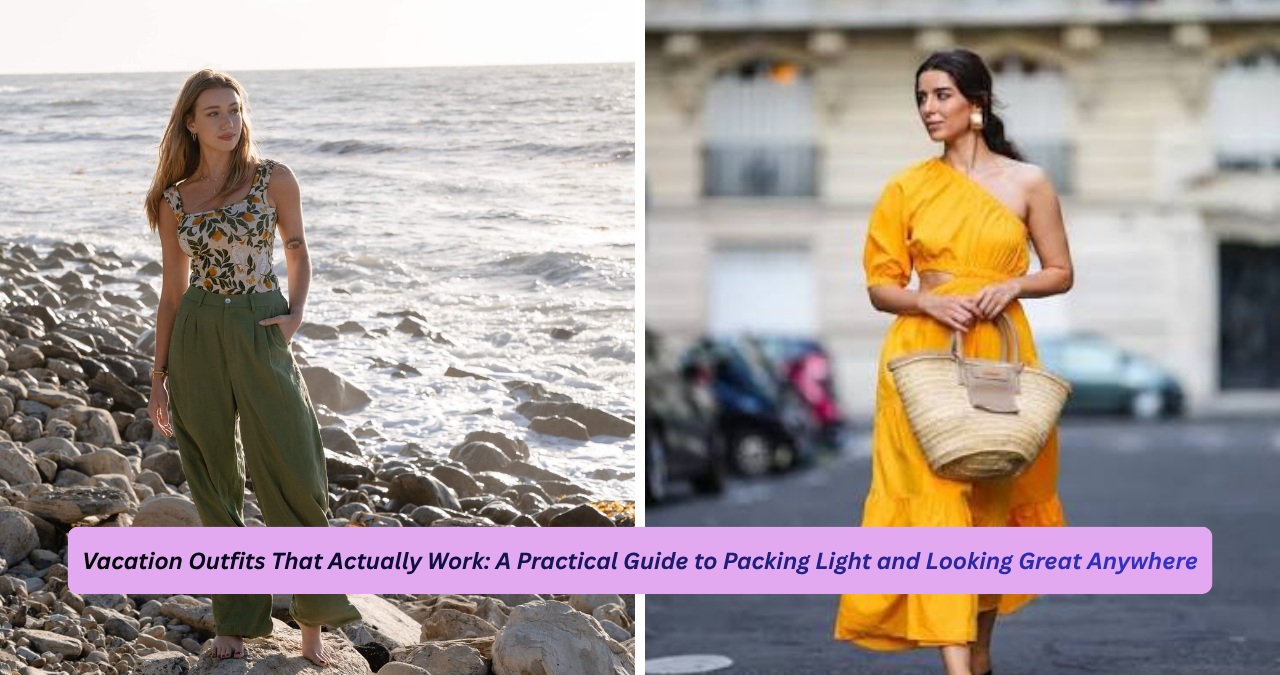
Planning vacation outfits always sounds simple until you’re staring at an open suitcase the night before a flight, torn between packing “just in case” options and sticking to what you’ll realistically wear. Most people either overpack out of anxiety or underpack out of overconfidence, and both mistakes show up the moment they land somewhere hotter, colder, or dressier than expected. The good news is that building a solid vacation wardrobe isn’t about owning more clothes — it’s about choosing the right ones and understanding how they work together.
This guide walks through how to think about vacation outfits the way an experienced traveler does: starting with the destination and itinerary, building around a small color palette, and layering in versatile pieces that pull double or triple duty. Whether you’re heading to a beach resort, a European city break, a mountain cabin, or a mix of all three on one trip, the same core principles apply, and once you understand them, packing gets dramatically less stressful.
Why Most People Get Vacation Outfits Wrong
The single biggest mistake travelers make with vacation outfits is packing for an imagined version of the trip rather than the actual one. It’s tempting to throw in a cocktail dress “in case we go somewhere fancy” or a heavy jacket “just in case it gets cold,” but these low-probability items eat suitcase space and rarely get worn. Every unworn outfit is dead weight you carried through airports, up hotel stairs, and across cobblestone streets for nothing.
The second common mistake is packing individual outfits instead of a wardrobe system. When people plan trip clothing outfit-by-outfit — “day one look, day two look, day three look” — they end up with pieces that don’t mix and match, which multiplies the number of items needed. A smarter approach treats your suitcase like a capsule wardrobe: a handful of tops, bottoms, and layers that can combine into far more outfit combinations than the item count suggests. Five tops and three bottoms aren’t just eight items — they’re fifteen possible outfits, which is the entire logic behind efficient vacation outfits that experienced travelers rely on.
Start With the Destination, Not the Suitcase
Before picking a single item, the climate and culture of your destination should drive every decision about your vacation outfits. A trip to Bali calls for breathable, lightweight fabrics and modest coverage for temple visits, while a trip to Reykjavik demands thermal layers and waterproof outerwear regardless of the season. Skipping this step is how people end up wearing linen pants in near-freezing rain or sweating through jeans on a tropical island.
Beyond climate, local dress norms matter more than most travelers expect. Many European churches and religious sites require covered shoulders and knees, some Middle Eastern countries expect more conservative clothing in public spaces, and certain upscale restaurants still enforce smart-casual dress codes that rule out shorts and flip-flops. Researching these expectations ahead of time — even a quick search for “what to wear in [destination]” — prevents the awkward scenario of being turned away from a site or feeling out of place at dinner. A well-planned set of vacation outfits accounts for where you’re going as much as what you personally like to wear.
Build Around a Capsule Color Palette
Professional travel stylists consistently recommend the same trick: pick two or three neutral base colors and one or two accent colors, then build every piece of clothing around that palette. Neutrals like black, white, navy, beige, or olive mix effortlessly with almost anything, while a couple of accent colors — a coral top, a mustard scarf — add visual variety without requiring extra shoes or accessories to match.
“The travelers who pack the lightest are the ones who commit to a palette before they commit to specific pieces,” is a sentiment echoed by nearly every professional packing consultant, and it holds up in practice. If every top can be worn with every bottom, you eliminate the “nothing goes together” problem that causes people to pack extra outfits as a safety net. This is especially useful for vacation outfits built around a week or more of travel, where laundry access may be limited and versatility becomes essential rather than optional.
The Core Pieces Every Vacation Wardrobe Needs
Regardless of destination, a handful of foundational items show up in nearly every well-planned vacation wardrobe. A couple of well-fitting tops in breathable fabric, one versatile bottom that works for both daytime activity and a casual dinner, a light layer such as a cardigan or packable jacket, comfortable walking shoes, and one slightly elevated outfit for an unexpected nice occasion all form the backbone of a functional travel wardrobe. These pieces aren’t glamorous individually, but together they solve the majority of situations a trip throws at you.
Fabric choice matters just as much as the silhouette. Wrinkle-resistant materials like certain blends of polyester, merino wool, or technical travel fabrics hold up far better in a suitcase than pure linen or silk, which crease the moment they’re folded. Frequent travelers often gravitate toward brands built specifically around this problem — think performance travel lines from retailers like Athleta, Uniqlo’s heattech and airism layers, or merino basics from Unbound Merino — because the fabric technology reduces the need to iron, steam, or re-pack constantly. Choosing the right fabric for your vacation outfits can be the difference between arriving looking put-together and arriving looking like your suitcase fought back.
Packing for Multi-Climate or Multi-City Trips
Trips that span multiple climates — a city stop followed by a beach leg, or a ski trip that ends with a warm-weather layover — present a genuinely harder packing puzzle, and this is where the capsule approach proves its worth. Rather than packing a separate wardrobe for each leg, experienced travelers pack layering pieces that adapt: a breathable base layer that works alone in warm weather but combines with a jacket in the cold, or a dress that works with sandals on the beach and with a light cardigan and sneakers in a cooler city.
A practical example: someone traveling from a chilly city like London to a warm destination like Lisbon might pack the same pair of dark jeans for both legs, pairing them with boots and a coat in London, then swapping to sandals and rolling up the cuffs in Lisbon. The jeans do double duty instead of requiring two separate pairs of pants for two different climates. This kind of cross-functional thinking is what separates efficient vacation outfits from an overstuffed suitcase full of climate-specific single-use items.
Accessories and Footwear: The Details That Make or Break an Outfit
Accessories are where a lot of travelers either overpack unnecessarily or underpack and regret it. A well-chosen scarf, a couple of interchangeable pieces of jewelry, a crossbody bag, and one statement item — like a hat or a bold pair of sunglasses — can transform the same five outfits into something that feels fresh every day of the trip without adding significant weight or bulk to a suitcase.
Footwear deserves special attention because it’s usually the bulkiest and least flexible category in any vacation wardrobe. The rule most seasoned travelers follow is to bring no more than three pairs: one comfortable walking shoe for daytime activity, one pair of sandals or lightweight shoes for beach or casual wear, and one slightly dressier option for evenings out. Trying to pack a separate shoe for every outfit is one of the fastest ways to blow past a carry-on weight limit, and it’s rarely necessary once you’ve built vacation outfits around a shared color palette.
Problem: Overpacking Anxiety — And How to Actually Solve It
Almost everyone struggles with the fear of not having “the right thing” for every possible scenario, and that anxiety is the root cause of most overpacked suitcases. The most effective solution is a simple planning exercise: lay out every planned activity for the trip day by day, then match specific outfits to each one before packing a single bag. If an item doesn’t clearly map to at least two planned activities, it usually doesn’t need to come.
A second practical solution is the “one in, one out” packing rule — for every optional or non-essential item added to the suitcase, something else gets removed. This forces prioritization and prevents the slow creep of “just in case” items that never get worn. Combined with the capsule color palette approach, this method consistently produces a lighter, more functional set of vacation outfits without the traveler feeling like they’ve sacrificed style or preparedness.
Vacation Outfits by Destination Type
Different trip types call for genuinely different wardrobe priorities, even though the underlying capsule principles stay the same. A tropical beach vacation leans heavily on breathable, quick-drying fabrics, swimwear cover-ups, and sun protection, while a European city break shifts the emphasis toward comfortable walking shoes, a few smart-casual outfits, and a packable layer for unpredictable weather. A mountain or ski trip flips the priority almost entirely toward thermal layering, waterproof outerwear, and insulated footwear, with far less emphasis on variety since most days involve similar activewear.
| Destination Type | Key Fabric Priorities | Essential Footwear | Common Packing Mistake |
|---|---|---|---|
| Tropical beach | Linen blends, quick-dry synthetics, cotton | Sandals, water shoes | Packing too many single-use swimsuits |
| European city break | Wrinkle-resistant blends, merino wool | Comfortable walking shoes, one dressier pair | Bringing heels or dress shoes for daily walking |
| Mountain or ski trip | Thermal base layers, fleece, waterproof shells | Insulated waterproof boots | Underestimating layering needs indoors vs outdoors |
| Business-leisure (“bleisure”) | Wrinkle-resistant separates, breathable blazers | One versatile dress shoe, one casual shoe | Packing full formalwear for a mostly casual trip |
How to Adapt Vacation Outfits for Photos Without Overpacking
Social media has changed how people think about vacation outfits, and it’s fair to want photos that feel intentional rather than repetitive. The good news is that a small capsule wardrobe can still produce visually varied photos through styling changes rather than entirely new outfits — swapping accessories, rolling sleeves, changing how a top is tucked, or layering a jacket differently can make the same core pieces read as distinct looks across a photo gallery.
This is also where the accent-color strategy pays off visually. If your neutral base pieces stay consistent but you rotate two or three accent pieces — a patterned scarf one day, a bright bag the next — your photos avoid looking like you wore the exact same outfit in every shot, even though you’re technically working from the same small suitcase. Travel photographers and influencers who pack efficiently rely on this trick constantly, proving that visually diverse vacation outfits don’t require an oversized suitcase to pull off.
What Is a Vacation Outfits Capsule Wardrobe?
A vacation outfits capsule wardrobe is a small, deliberately chosen set of clothing items — typically five to ten pieces — designed around a shared color palette so that every item can be mixed and matched with several others. The goal is maximizing outfit combinations while minimizing the total number of items packed, which reduces luggage weight and simplifies daily decision-making while traveling.
How Many Outfits Should You Pack for a Week-Long Vacation?
For a week-long trip, most experienced travelers pack far fewer full outfits than days of travel, relying instead on a rotation of interchangeable tops, bottoms, and layers. A well-built capsule of around five tops, three bottoms, one dress or jumpsuit, and two layering pieces can realistically generate more than a week’s worth of distinct vacation outfits when accessories and styling changes are factored in.
What Fabrics Work Best for Vacation Outfits That Travel Well?
Wrinkle-resistant, breathable fabrics such as merino wool, certain polyester and nylon blends, and technical travel fabrics hold up best for vacation outfits packed in a suitcase for extended periods. These materials resist creasing, dry quickly if hand-washed, and typically require little to no ironing, unlike pure linen or silk, which wrinkle heavily during travel.
How Do You Pack Vacation Outfits for Multiple Climates in One Trip?
The most effective strategy is layering rather than packing separate wardrobes for each climate. Choosing base pieces like jeans, breathable t-shirts, and a versatile dress that can be layered up with a jacket and boots for cold weather or worn alone with sandals in warm weather allows the same vacation outfits to adapt across drastically different conditions without doubling your luggage.
Do Vacation Outfits Need to Match Local Dress Codes?
Yes, and this is one of the most overlooked aspects of trip planning. Many religious sites require covered shoulders and knees, certain countries expect more conservative clothing in public, and upscale restaurants often enforce smart-casual dress codes that exclude shorts or flip-flops. Researching local norms before finalizing your vacation outfits prevents both cultural missteps and last-minute scrambles to buy appropriate clothing while traveling.
Final Thoughts on Building Better Vacation Outfits
Great vacation outfits aren’t about owning a closet full of travel-specific clothing — they’re about applying a system: research your destination, commit to a tight color palette, choose fabrics that travel well, and build pieces that combine in multiple directions rather than serving a single purpose. Once that framework clicks, packing stops feeling like a stressful guessing game and starts feeling like solving a fun, solvable puzzle.
The next time you’re staring at an open suitcase the night before a flight, resist the urge to add “just in case” items, and instead ask whether each piece earns its place across at least two planned activities. Do that consistently, and your vacation outfits will end up lighter, more versatile, and honestly more stylish than an overpacked bag ever could be.