
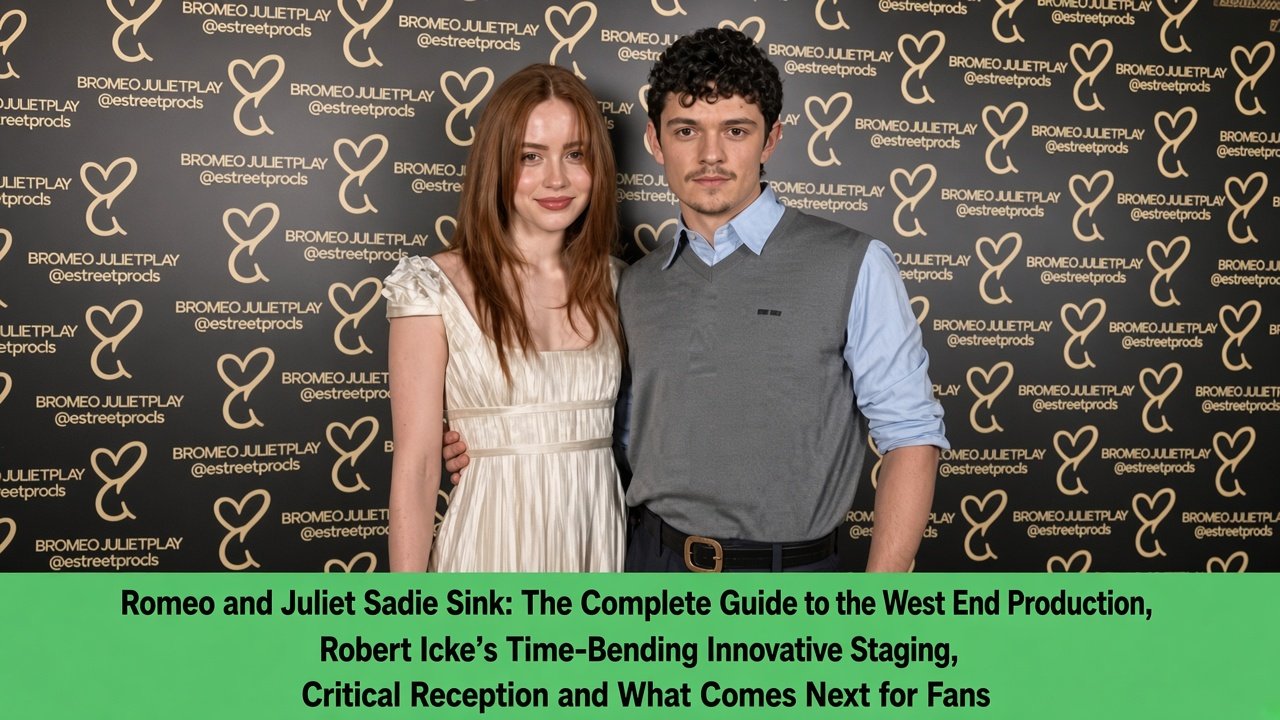
When Robert Icke and Empire Street Productions announced in November 2025 that Sadie Sink would play Juliet in London, two very different audiences perked up at once. Stranger Things fans wanted to see Max Mayfield trade the Upside Down for Verona. Theatregoers were curious what one of Britain’s most inventive directors would do with the most famous love story in the English language. The romeo and juliet sadie sink production, staged at the Harold Pinter Theatre in spring 2026, satisfied both camps and became one of the most discussed Shakespeare stagings of the year.
This guide gathers the essentials in one place. It covers the cast and creative team, the time-obsessed concept at the heart of the staging, what critics said (including the dissenting notes), how it compares with Tom Holland’s 2024 production, and what to do now that the run has finished. It is written for people who saw the show and want context, for those who missed it, and for students or newcomers who want a clear explanation.
What the Production Is and Why It Drew So Much Attention
The romeo and juliet sadie sink staging was a 2026 West End revival of Shakespeare’s tragedy, directed by Robert Icke and produced by Empire Street Productions, with Sadie Sink as Juliet and Noah Jupe as Romeo. It played at the Harold Pinter Theatre in London and finished on 20 June 2026. Both leads were making their West End debuts. The run was first announced as a shorter season, but it was extended through June 20, a quiet sign that demand held up after the reviews landed. Romeo and Juliet
The attention came from a rare alignment of star power, directorial reputation and cultural familiarity. Icke is an Olivier Award-winning director known for taking canonical texts and finding new pressure points in them, with credits such as Oedipus and The Doctor. Sink arrived fresh from the end of Stranger Things and a Tony-nominated Broadway turn. Pair those with a play that nearly everyone has met at school, and you get a production that appealed to casual fans and seasoned critics alike.
There is also a revealing detail about how the project began. According to a review citing an interview with Vogue, Icke said the production started with a desire to work with Sink rather than a long-held urge to stage Romeo and Juliet. That is a bit like designing a house around one exceptional window. The casting came first, and the concept grew outward from the performer, which helps explain why critics kept returning to her Juliet as the production’s centre of gravity.
Production Facts at a Glance
Because several Romeo and Juliet stagings have played London in recent years, it helps to pin down exactly which one this is. The table below collects the verified details of the romeo and juliet sadie sink production in one scannable place.
| Detail | Information |
|---|---|
| Play | Romeo and Juliet by William Shakespeare |
| Director | Robert Icke |
| Producer | Empire Street Productions |
| Venue | Harold Pinter Theatre, Panton Street, London |
| Juliet | Sadie Sink |
| Romeo | Noah Jupe |
| Other cast | Includes Jamie Ankrah, Dylan Corbett-Bader and Eden Epstein |
| Design team | Hildegard Bechtler (set and costume), Jon Clark (lighting), Tom Gibbons (sound), Ash J. Woodward (video) |
| Run | Mid-March 2026 to 20 June 2026 (extended) |
| Running time | Roughly 2 hours 50 minutes to 2 hours 55 minutes, depending on the source |
| Tagline | “In a minute there are many days” |
The Harold Pinter Theatre is a mid-sized West End house in the Theatreland district near Piccadilly Circus, which matters for the experience. A venue of that scale puts an audience close enough to read faces, a quality that suits a performer like Sink, whose Juliet relies on small shifts of expression as much as on verse. It is a different proposition from a stadium-sized stage or a screen close-up.
The tagline in the table comes from the production’s own announcement, which described two young people who meet at a party before the rest becomes tragedy. That line captures Icke’s interest in compressed time, a theme the next sections unpack. When searching for tickets, reviews or photographs, matching the director, venue and cast against this table keeps you from confusing the 2026 staging with the 2024 production at the Duke of York’s Theatre.
How Sadie Sink Landed Juliet and Why the Casting Mattered
Sink was already one of the most recognisable young actors in the world thanks to Netflix’s Stranger Things, which ended with its fifth season in December 2025. Theatre, however, was not a new pursuit. She appeared on Broadway as a child in the 2012 revival of Annie, and more recently earned a Tony nomination for John Proctor Is the Villain. Speaking when the project was announced, she described herself with a short phrase that explains a lot: she was a “Broadway kid” who had long dreamed of a West End show.
Her route into Shakespeare was less obvious. In an interview with Tatler, she admitted she “wasn’t really interested in doing Shakespeare” at first, according to a report on her comments. That honesty makes the result more interesting. An actor who approaches the verse without reverence-driven stiffness can bring a fresh, conversational energy to it, and several reviewers noticed exactly that quality in her delivery.
Noah Jupe, cast as Romeo, brought a different kind of credibility. Known for the Quiet Place films and for Hamnet, he was making his professional theatre debut, and one review said he supported Sink ably in that debut. The pairing worked as a classic casting contrast: a well-known screen star carrying the production’s emotional weight alongside a rising actor who suits the role’s boyish earnestness. For ticket buyers, that balance meant the evening did not feel like a one-person vehicle.
Robert Icke’s Time-Bending Concept Explained
Icke’s central idea turns on time. A review pointed out that the word “hour” appears more often in Romeo and Juliet than in any other Shakespeare play, and the director built his staging around that preoccupation with how a single moment can redirect an entire future. The Stage summed up the effect with the phrase “sliding-doors take on Shakespeare’s tragedy,” which is a helpful shorthand: imagine the story constantly hinting at the other paths it could have taken.
This approach solves a genuine problem. Everyone knows how Romeo and Juliet ends, so a standard staging can struggle to generate suspense. By emphasising the contingency of every decision, from a missed message to a hurried vow, the production invites the audience to watch for the small hinges on which the plot turns. One comparison article noted on-stage clocks and narrative rewinds as part of the method, which fits the concept even if the exact choreography is best judged by those who saw it.
For readers new to the play, a simple analogy helps. Think of a sports replay that freezes on the crucial pass, asking you to notice how close the other outcome was. The romeo and juliet sadie sink staging used a similar logic to make a four-hundred-year-old ending feel preventable, and therefore more painful. That is the difference between a tragedy you observe and a tragedy you feel responsible for.
Reading Sink’s Performance: Comedy, Intelligence and Fury
Critics agreed more on Sink’s Juliet than on almost anything else in the production. The Telegraph said she was so commanding that the performance would make you cry. Time Out focused on her intelligence, describing a clever, quick-witted Juliet whose ability to speak so beautifully seems connected to how sharply she thinks. That is a subtle but important choice, because it frames Juliet’s eloquence as a product of her mind rather than a poetic convention.
The romeo and juliet sadie sink performance also drew praise for its comedy. One review described a quirkily neurotic teenager who brings humour to the balcony scene. That might sound risky, since the balcony scene is the play’s most romantic moment, but it grounds the romance in recognisable adolescence: nervous, impatient and a little self-conscious. Another review praised the layering, with comedy in Juliet’s impatience, tenderness in her vulnerability and a quiet ferocity in her resolve.
The payoff comes in the second half, when the humour recedes and the stakes harden. A performer who has established Juliet as funny and sharp earns the audience’s investment before the tragedy tightens. Some reviewers felt Sink was so strong that Juliet at times seemed the play’s central protagonist, a notable claim given how often the title characters are treated as an equal pair. For students writing about performance choices, this is a useful case study in how casting and interpretation can shift a play’s balance.
Noah Jupe as Romeo and the Supporting Ensemble
Jupe’s Romeo was described as dramatically mopey in his early unrequited love for Rosaline and earnest in his passion for Juliet. That reading is faithful to the text, where Romeo begins the play lovesick over someone else entirely, a detail that productions sometimes rush past. By taking it seriously, the staging set up the speed of his shift to Juliet, which is one of the play’s most debated psychological leaps.
The wider ensemble included Jamie Ankrah, Dylan Corbett-Bader and Eden Epstein, among others, working within a staging that asked them to move fluidly between comic and violent registers. This is where the production drew its sharpest criticism. One dissenting review argued that the staging too often lapses into broad comedy, which can undercut the tragic build. It is a fair reminder that a bold concept carries risk, and that the tonal balance between laughter and grief is one of the hardest things in the play to get right.
For anyone assessing the production honestly, the critical picture is mixed in the right way: strong praise for the leads and the concept, with reservations about tone. That mix is typical of ambitious Shakespeare, and it is a better sign of a serious production than uniform acclaim would be. If you are deciding whether a recording or future revival is worth your time, those reservations are worth weighing against the enthusiasm.
What the Critics Said at a Glance
The reviews were broadly positive, with several four-star verdicts from major outlets. The table below summarises the main notes from the round-up coverage.
| Outlet | Rating | Main takeaway |
|---|---|---|
| The Telegraph | Four stars | Sink is commanding enough to move the audience to tears |
| Time Out | Four stars | The romance is not romanticised; Sink’s Juliet is quick-witted |
| The Stage | Four stars | Poignant leads in a “sliding-doors” reading of the tragedy |
| Theatre & Tonic | Four stars | An impressive, contemporary revival, even if some original impact is lost |
Beyond the star ratings, the language of the reviews reveals what audiences valued. BroadwayWorld called the production dreamlike, young and assuredly sophisticated. Another review described Sink as luminous. A user review from June 2026 even argued that Icke’s version delivered what a rival staging should have, praising its energetic yet poignant use of time. Taken together, the response points to a production that was admired for clarity and speed more than for spectacle.
There is also a practical lesson in how to read review round-ups. Star ratings compress a lot of nuance, and the most useful information is usually in the adjectives. Words like “clarity” and “speed” suggest a staging that serves the text, while the single note about broad comedy flags a possible mismatch for viewers who prefer a more sombre tone. Matching your own taste to those signals is a better method than relying on the number of stars.

Design and Staging: How the Creative Team Shaped the Experience
The credits tell a story of their own. Hildegard Bechtler handled set and costume design, Jon Clark lighting, Tom Gibbons sound and Ash J. Woodward video. The presence of a dedicated video designer in a Shakespeare staging signals that the production was not content to rely on bare boards and verse alone. In a concept built around time, projected or screen-based elements are a natural tool for marking the passing of hours.
Costume and set choices also shaped the first-look photographs released to the press. Press Association coverage described Sink in an off-white corset with white shorts and in a red dress, with images showing her kissing Jupe and pointing a knife at him while he wore black. Those images hint at a staging that mixed contemporary dress with Shakespeare’s language, a common approach that keeps the verse from feeling like a museum piece.
The sound design deserves attention too, because it carries a lot of weight in a play about urgency. A well-judged soundscape can compress or stretch a scene’s perceived duration, which suits a production concerned with minutes and hours. While audience members will remember the performances most vividly, it is often the lighting and sound that make a time-focused concept legible. That teamwork is one reason the staging was praised for clarity and speed rather than for any single showy gimmick.
How It Compares with Tom Holland’s 2024 Romeo and Juliet
Comparisons were inevitable. Jamie Lloyd directed Tom Holland as Romeo at the Duke of York’s Theatre from 11 May to 3 August 2024. Variety noted that Lloyd was known for a minimalist, stripped-down approach to classics. Holland’s co-star as Juliet was Francesca Amewudah-Rivers, and the production leaned into stark staging and a modern sensibility.
| Feature | 2024 production | 2026 production |
|---|---|---|
| Director | Jamie Lloyd | Robert Icke |
| Romeo | Tom Holland | Noah Jupe |
| Juliet | Francesca Amewudah-Rivers | Sadie Sink |
| Venue | Duke of York’s Theatre | Harold Pinter Theatre |
| Defining idea | Minimalist, stripped-down staging | Time, contingency and “sliding doors” |
| Run | 11 May to 3 August 2024 | Mid-March to 20 June 2026 |
The two stagings share a trait: both used a celebrity lead to bring new audiences into Shakespeare, and both approached the play with a distinct directorial identity. The romeo and juliet sadie sink version was widely read as warmer and more emotionally driven, while the 2024 production was more austere. Neither reading is objectively better, and one comparison article went so far as to argue each excelled in different categories, with Lloyd’s staging stronger on bold design and Icke’s stronger on emotional heart.
There is also a personal link between the two. Holland and Sink were co-stars in Spider-Man: Brand New Day, and social media posts in April 2026 reported that Holland and Zendaya attended the West End show. Treat that as reported rather than confirmed by an official source, but it illustrates how closely the two productions were connected in the public imagination. For readers researching both, comparing the director’s concept first and the casting second is the cleanest way to tell them apart.
A Plain-English Primer on Why Shakespeare’s Teenage Lovers Still Work
For readers who have never seen the play, here is the short version. Romeo and Juliet follows two teenagers from feuding families in Verona who fall in love at a party, marry in secret and are undone by a chain of mistimed events and inherited hatred. The play was written around 1595 and remains one of the most performed works in the English language. Its power comes from speed: the entire story unfolds over only a few days, which makes every decision feel enormous.
Juliet is just shy of fourteen in the text, which raises a question every modern production has to answer. Casting a young adult, as this staging did with a 23-year-old lead according to press reports, allows an actor to convey adolescent intensity without placing a child in the story’s adult events. The solution is to emphasise emotional truth over literal age, a choice that lets audiences focus on the feelings rather than the arithmetic.
The play’s themes also explain why directors keep returning to it. Impulsive love, generational conflict, the cost of violence and the role of chance all feel current. Icke’s emphasis on time is a smart way into that last theme, because chance in this play is largely a matter of timing. If you are using the production as a study aid, the useful questions to bring to any version are which moment the director treats as the hinge, how the humour is balanced against the grief, and whether Juliet is allowed to drive the story.
Tickets, Pricing and the Problem of Missing a Sold-Out Run
Demand was strong, and tickets were reported to start from around £73 for the Harold Pinter Theatre run. For anyone who missed out, the practical reality is that the engagement ended on June 20, 2026, so there is nothing to book at the venue today. That creates a specific risk: listings or social posts offering tickets for a closed run are a red flag for scams, and a reminder to check dates against the official production details before paying anyone.
The solution is a short routine. Buy only from the theatre’s official channels or established ticketing partners, confirm the date against the confirmed run, and avoid transfers to strangers by bank transfer or gift card. If you are following a future announcement, subscribing to the producer’s mailing list and the theatre’s own updates is more reliable than third-party aggregator pages, which can lag behind or repeat outdated information.
It is also worth planning around the format of the evening. At close to three hours, the production asked for a real commitment, so early arrival and a pre-show meal made sense for audiences who attended. If a future staging of the romeo and juliet sadie sink version ever returns, those same habits apply: confirm the running time, check the interval, and book return transport in advance, since West End evenings often finish close to the last convenient trains.
What Comes Next for Fans of the Production
As of October 2026, none of the sources reviewed point to a confirmed transfer, return run or filmed release of the production. Fans hoping for a revival should treat any rumour cautiously until it appears on an official producer or theatre channel. The company behind the show, Empire Street Productions, and the Harold Pinter Theatre are the most reliable places for confirmed news.
In the meantime, Sink’s career has plenty of momentum. She has completed her run in Stranger Things and was due to appear in Spider-Man: Brand New Day in July 2026, with reports of a larger Marvel commitment that should be treated as industry rumour until confirmed. For theatre followers, her Tony-nominated work in John Proctor Is the Villain and now her Juliet suggest a performer who plans to keep returning to the stage between screen projects.
For readers who want to keep learning, there are good ways to engage with the production’s ideas without a ticket. Reading the play with Icke’s time theme in mind is a rewarding exercise, since the many references to hours and minutes become hard to ignore. Review round-ups and cast interviews also give a sense of the rehearsal-room thinking. The romeo and juliet sadie sink staging may have closed, but its influence on how audiences discuss the play is likely to linger.
Frequently Asked Questions About Romeo and Juliet Sadie Sink
Who played Juliet in the 2026 West End production?
Sadie Sink played Juliet, opposite Noah Jupe as Romeo. It was the West End debut for both actors, and Sink was already known worldwide for playing Max Mayfield in Stranger Things and for her Tony-nominated performance in John Proctor Is the Villain on Broadway.
Where and when did the romeo and juliet sadie sink production run?
The production played at the Harold Pinter Theatre in London’s West End, beginning in mid-March 2026 and running through June 20, 2026 after an extension. It was directed by Robert Icke and produced by Empire Street Productions, and the run has now finished.
Who directed the production?
Robert Icke directed it. He is an Olivier Award-winning British director whose recent credits include Oedipus and The Doctor, and he is known for reworking classic texts. His concept for this staging focused on time, chance and the sense that each moment could have gone another way.
Is the romeo and juliet sadie sink show still on?
No. The engagement at the Harold Pinter Theatre ended on June 20, 2026, and no return, transfer or recorded release had been confirmed in the sources reviewed. Anyone offering tickets for dates after that should be treated with caution, and fans should rely on official theatre and producer announcements for any future news.
How long was the production?
Listings and reviews put the running time at roughly 2 hours 50 minutes to 2 hours 55 minutes, which is close to three hours. That is long for a single evening, so audiences were advised to arrive early, check the interval length and plan their journey home in advance.
How did it differ from Tom Holland’s Romeo and Juliet?
Tom Holland’s 2024 production, directed by Jamie Lloyd at the Duke of York’s Theatre, was known for a minimalist, stripped-down approach. Icke’s 2026 staging centred on time and contingency, with a warmer emotional focus built around Sink’s Juliet. Both used a famous lead to attract new audiences, but their directorial ideas were quite different.
Was the production well reviewed?
Largely yes. The Telegraph, Time Out, The Stage and Theatre & Tonic each gave four stars, and Sink’s performance drew the most consistent praise. A minority of reviewers felt the staging leaned too heavily on broad comedy, which is a useful counterpoint for anyone weighing the production’s strengths and weaknesses.
Conclusion
The romeo and juliet sadie sink production worked because every major element pulled in the same direction. A director with a clear idea about time, a lead actor who found intelligence, humour and fury in Juliet, and a design team that made the concept legible combined to make a familiar tragedy feel urgent again. Critics did not agree on everything, particularly the tone of the comedy, but the broad verdict was that this was a clear, fast and emotionally direct staging.
For fans, the practical takeaway is straightforward. The run ended on June 20, 2026, no return has been confirmed, and official channels are the only trustworthy source for future news. The deeper insight is about why the production landed: it treated the best-known ending in theatre as something that could still surprise, by asking audiences to notice how narrowly it might have been avoided. That is what made the romeo and juliet sadie sink staging memorable, and it is a useful lens for watching any version of the play from now on.