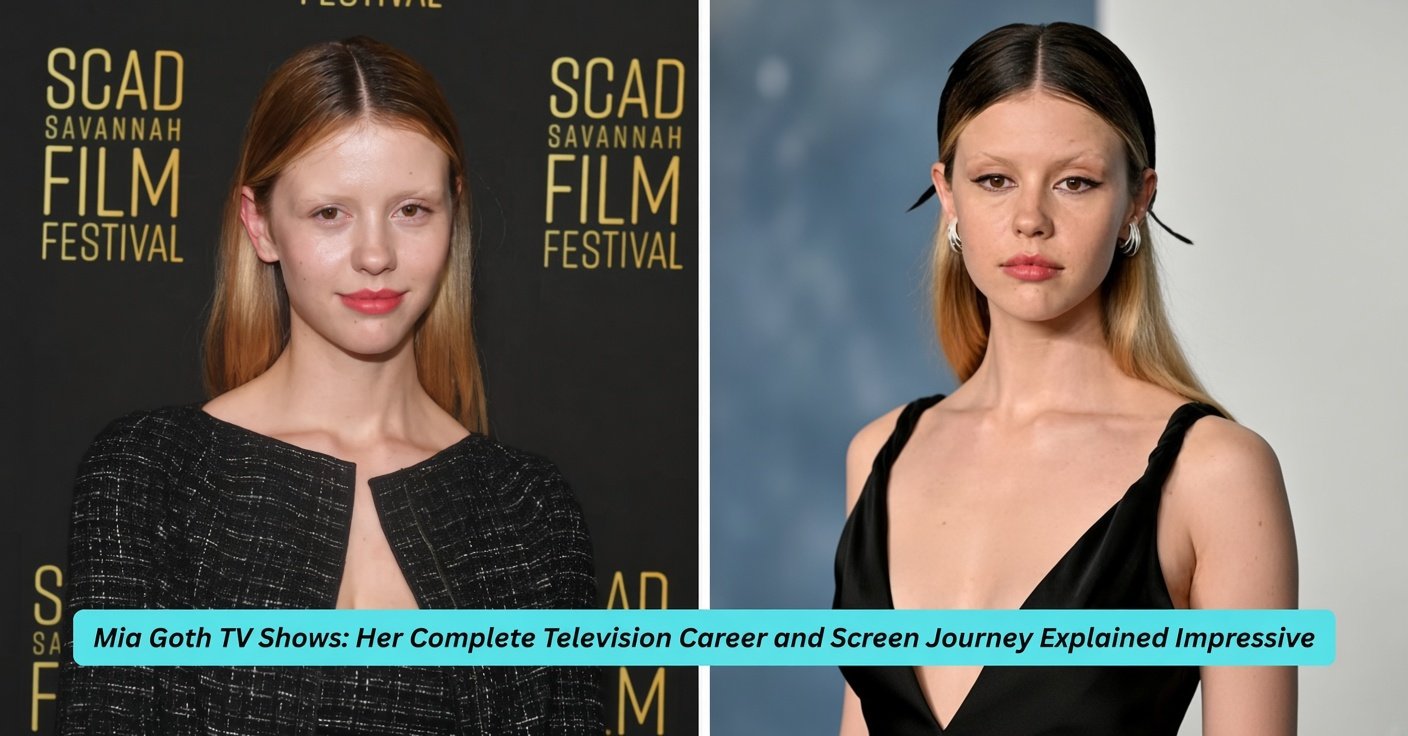
Mia Goth TV shows have become an increasingly common search topic as fans of the acclaimed actress try to track down every project she’s appeared in, particularly since her breakout success in Ti West’s “X” trilogy pushed her into mainstream horror stardom. While Goth has built her reputation primarily through feature films, her television credits, though comparatively limited, played an important role in shaping her early career and demonstrating the range that would later define her most celebrated film performances. Understanding Mia Goth TV shows requires looking closely at her earliest professional years, when she was still establishing herself as a serious dramatic actress long before “Pearl” or “MaXXXine” made her a household name among horror enthusiasts.
This article breaks down her complete television history, explains why her career has leaned so heavily toward film rather than episodic television, and explores how her small but meaningful TV credits connect to her broader artistic trajectory. Whether you’re a longtime fan retracing her filmography or someone who discovered her through recent horror hits and wants the full picture, this guide covers everything relevant to Mia Goth TV shows and her overall screen career.
Mia Goth’s Background Before Television and Film
Before discussing any specific Mia Goth TV shows, it helps to understand her origins as a performer. Born Mia Gypsy Mello da Silva Goth on October 25, 1993, in Southwark, London, she initially entered the entertainment industry through modeling rather than acting. She was discovered as a teenager at London’s Underage Festival by fashion photographer Gemma Booth, which led to representation with Storm Model Management and subsequent campaigns for major fashion houses including Miu Miu and Prada, along with editorial features in publications like Vogue and Dazed.
This modeling background is worth noting because it shaped her early visual presence and industry connections before she transitioned into acting around age 16. Many actors who begin in fashion modeling develop a particular comfort with visual storytelling and screen presence that translates naturally into film work, and Goth’s trajectory reflects this pattern closely. Her eventual move into acting, first through Lars von Trier’s controversial “Nymphomaniac” in 2013, marked the beginning of a career that would soon include her first notable television appearances.
Her Earliest Television Role: The Tunnel
Among the earliest entries in any accurate list of Mia Goth TV shows is her appearance in “The Tunnel,” a crime drama series that aired on Sky Atlantic. In this British-French co-production, a remake adapting the Scandinavian format “The Bridge” to the English Channel setting, Goth played the character Sophie Campbell in a single episode. While her role wasn’t a lead position, appearing in a prestige crime drama early in her career gave her valuable experience working within a serialized television format, which differs significantly from the standalone narrative structure of feature films.
Crime dramas like “The Tunnel” tend to attract strong ensemble casts and maintain relatively high production values compared to typical procedural television, which made this an appropriate early credit for an actress still building her reputation. A casting professional familiar with UK television production has noted that guest appearances in acclaimed crime dramas often function as important stepping stones for young actors, providing exposure to industry professionals and demonstrating range within a tightly controlled, dialogue-heavy format that rewards subtlety over spectacle.
Wallander: A Brief but Notable BBC Appearance
Another significant entry among Mia Goth TV shows is her appearance in “Wallander,” the acclaimed BBC One crime series based on Henning Mankell’s novels and starring Kenneth Branagh in the title role. Goth played Hanna Helmqvist in an episode of this critically respected adaptation, which had already established itself as one of British television’s most prestigious crime drama exports by the time of her involvement.
Appearing in “Wallander” placed Goth within a production known for its atmospheric cinematography and restrained, character-driven storytelling, qualities that align closely with the tone she would later bring to more prominent film roles. This kind of early exposure to internationally acclaimed television, even in a limited capacity, often provides young actors with meaningful industry credibility that extends beyond the immediate visibility of the role itself. For anyone specifically researching Mia Goth TV shows from her formative years, this Wallander appearance represents one of the clearest examples of her working within an internationally recognized television property early in her career.
Why Mia Goth’s Career Has Prioritized Film Over Television
A natural question that arises when researching Mia Goth TV shows is why her filmography leans so heavily toward feature films rather than ongoing television series work. Unlike many actors who build sustained careers through recurring television roles, Goth’s career path has consistently favored film projects, from early supporting roles in “The Survivalist” and “Everest” through her career-defining work in “A Cure for Wellness,” “Suspiria,” and eventually the “X” trilogy that transformed her into one of contemporary horror’s most respected leading performers.
This pattern likely reflects a deliberate career strategy rather than simply a lack of television opportunities. A film industry analyst covering actor career trajectories has observed that performers focused on building an art-house or auteur-driven reputation, working repeatedly with acclaimed directors like Lars von Trier, Claire Denis, and Luca Guadagnino, often prioritize film specifically because it allows for tighter creative collaboration with a single directorial vision across a contained project timeline. Television, by contrast, typically involves multiple directors and writers across a season, which can dilute the kind of singular artistic vision that has defined much of Goth’s most acclaimed work.
A Breakdown of Mia Goth’s Film-Heavy Career Trajectory
To put her limited television work into proper context, it helps to see how her overall filmography has developed over time, with television representing only a small fraction of her total output.
| Project | Year | Format | Role |
|---|---|---|---|
| The Tunnel | 2013 | TV Series | Sophie Campbell |
| Wallander | 2015 | TV Series | Hanna Helmqvist |
| Nymphomaniac | 2013 | Feature Film | Featured role |
| A Cure for Wellness | 2016 | Feature Film | Hannah |
| Suspiria | 2018 | Feature Film | Sara |
| Emma | 2020 | Feature Film | Mrs. Elton |
| X | 2022 | Feature Film | Maxine Minx |
| Pearl | 2022 | Feature Film | Pearl |
| Infinity Pool | 2023 | Feature Film | Gabi Bauer |
| MaXXXine | 2024 | Feature Film | Maxine Minx |
This table makes clear just how heavily Goth’s career has skewed toward feature filmmaking, with her handful of television credits appearing almost exclusively in the earliest years of her professional acting career before her film work took off substantially.
How Her Television Roles Connect to Her Later Film Success
While Mia Goth TV shows represent a relatively minor portion of her overall body of work, the skills demonstrated in these early roles connect meaningfully to the qualities that later made her such a compelling film actress. Both “The Tunnel” and “Wallander” required restrained, psychologically nuanced performances within crime drama contexts, a skill set that transferred directly into her later horror work, where controlled tension and internal complexity became defining characteristics of her most celebrated performances.
Her dual role as both Maxine Minx and the elderly Pearl in Ti West’s “X” required an extraordinary range of physical and emotional performance techniques, and the foundational discipline built through her earlier television and film work likely contributed significantly to her ability to handle such demanding dual casting. Critics reviewing “Pearl” specifically highlighted her capacity for sustained emotional intensity within a single unbroken monologue sequence, a skill that draws directly from the kind of controlled, dialogue-driven performance work she first practiced in her television appearances.
Fan Interest in Future Television Projects
Given how significantly Goth’s profile has grown since the release of “X,” “Pearl,” and “MaXXXine,” fan interest in potential future Mia Goth TV shows has increased substantially. As streaming platforms continue investing heavily in prestige limited series featuring major film talent, particularly performers with strong genre credibility like Goth, there’s reasonable industry speculation that she could eventually take on a significant television role now that her commercial and critical standing has risen dramatically compared to her earlier career.
This kind of career evolution, where film actors eventually transition toward high-profile limited series work, has become increasingly common as the line between prestige television and feature filmmaking continues to blur. Should Goth choose to pursue a substantial television project in the coming years, her established reputation for psychologically complex, genre-elevating performances would likely make any such series a significant industry event, though as of now, no major television commitments beyond her earlier credits have been widely reported.
Common Misconceptions About Her Television Work
Given how dominant her film career has become in recent years, some confusion has emerged online regarding Mia Goth TV shows, with certain lower-quality entertainment aggregator sites incorrectly attributing additional television credits to her filmography that don’t appear in any reliable, verified sources. This kind of misattribution is common for actors whose public profile has grown rapidly, since content aggregators sometimes conflate different performers or rely on inaccurate crowd-sourced databases rather than verified industry records.
Another common point of confusion involves talk show and awards ceremony appearances being incorrectly categorized alongside scripted Mia Goth TV shows. While she has appeared as a guest on programs like award ceremonies and late-night talk shows in a promotional capacity, these appearances are fundamentally different from scripted television roles and shouldn’t be conflated when discussing her actual acting filmography within the television medium specifically.
Frequently Asked Questions
What TV shows has Mia Goth actually appeared in?
Mia Goth’s confirmed television credits include “The Tunnel,” a Sky Atlantic crime drama where she played Sophie Campbell, and “Wallander,” the acclaimed BBC One series, where she appeared as Hanna Helmqvist. These represent her primary scripted television roles, both occurring relatively early in her acting career before her film work became more prominent.
Why hasn’t Mia Goth done more television work?
Her career has consistently prioritized feature films, likely reflecting a deliberate focus on collaborating closely with acclaimed directors on singular artistic projects rather than pursuing ongoing series commitments. This pattern is common among actors building reputations centered on art-house and auteur-driven filmmaking rather than episodic television.
Is Mia Goth going to star in any upcoming TV shows?
As of now, no major upcoming television projects have been widely confirmed for Goth, with her current and announced work continuing to focus primarily on feature films, including anticipated projects like “Frankenstein” and “The Odyssey.” However, given her rising industry profile, future television opportunities remain a possibility as prestige streaming series increasingly attract major film talent.
What is Mia Goth’s most well-known television role?
Her most notable television credit is likely her appearance in “Wallander,” given the series’ strong critical reputation and international recognition compared to her other limited television work. Both this and her role in “The Tunnel” remain relatively minor compared to her extensive and highly acclaimed film career.
How does Mia Goth’s TV work compare to her film career?
Her television work is significantly smaller in scope compared to her film career, with only a couple of notable series appearances against a much larger and increasingly celebrated filmography that includes “Suspiria,” the “X” trilogy, and “Infinity Pool.” This imbalance reflects her clear career preference for feature film work over television.
Final Thoughts on Mia Goth’s Television Career
While Mia Goth TV shows represent only a small chapter within her broader acting career, these early roles in “The Tunnel” and “Wallander” provided meaningful groundwork for the psychologically nuanced performance style that later defined her breakthrough success in film. Her career trajectory demonstrates a clear and consistent preference for feature filmmaking over episodic television, a choice that has aligned closely with her reputation as one of contemporary horror and art-house cinema’s most compelling performers. The clearest takeaway here is that while her television credits remain limited, they offer valuable insight into the foundational skills that eventually made her one of the most respected genre actors working in film today.