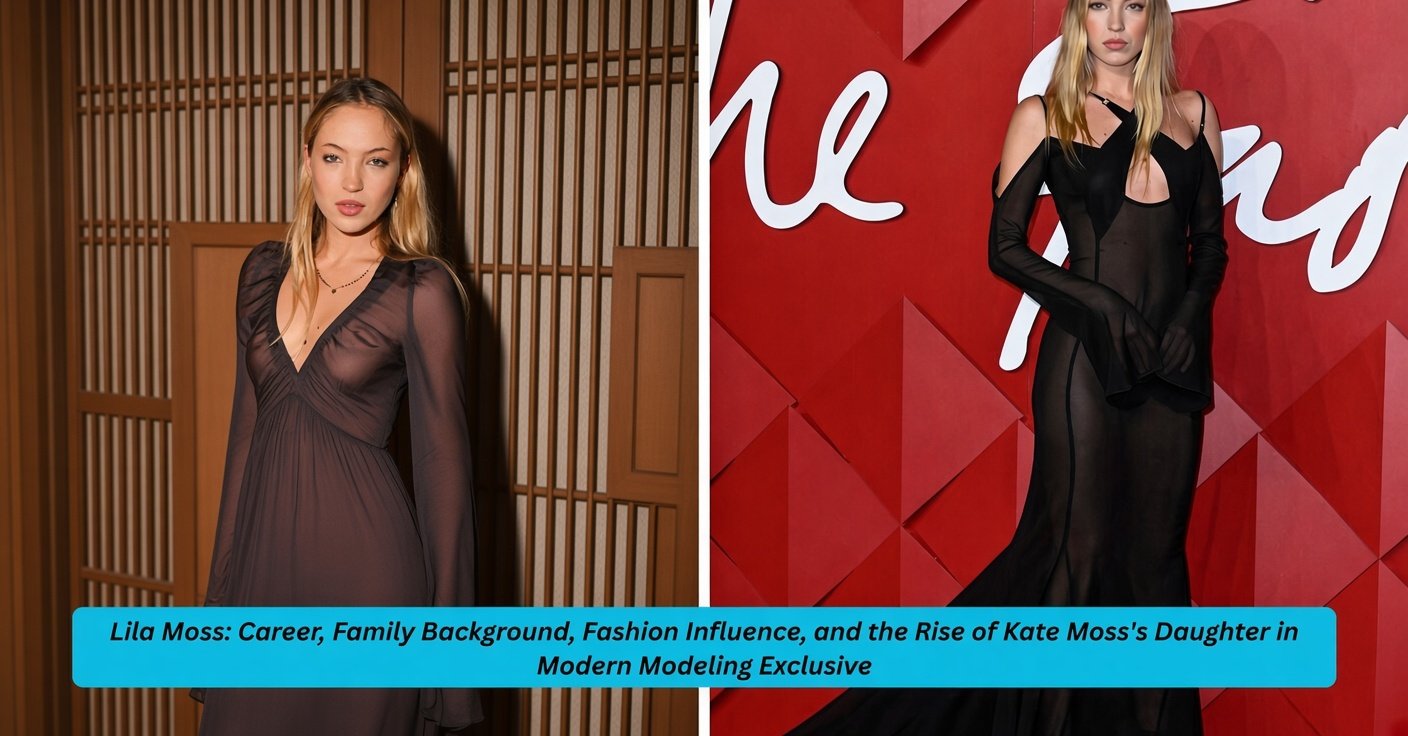
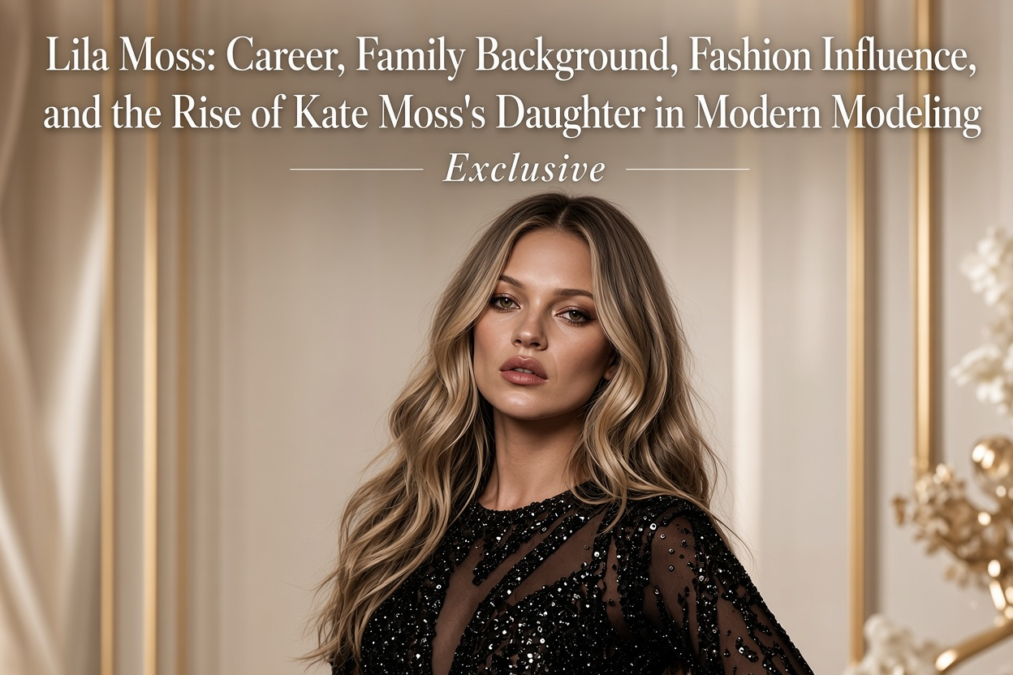
Few young models arrive with as much curiosity attached as Lila Moss. Her surname, her mother’s legend, and her front-row presence at every major fashion week guarantee attention, but attention alone does not build a career. Readers searching for her want to know who she actually is, what she has accomplished, and where she fits in today’s fashion industry.
Here is the short answer. She is an English fashion model, born in London in 2002 to supermodel Kate Moss and Dazed Media co-founder Jefferson Hack. Since her runway debut in 2021, she has built a résumé of Paris Fashion Week shows, Vogue covers, luxury campaigns, and two Met Gala appearances.
This guide covers her background, milestones, red-carpet moments, brand work, and the “nepo baby” debate that follows her. It also explains what her path teaches about modern modeling. Where information comes from published reporting, we say so.
Who Is She? A Clear Definition and Quick Profile
Lila Moss is an English fashion model, and Wikipedia lists her full name as Lila Grace Moss Hack. She was born on 29 September 2002 in London, studied at Parsons School of Design, and is represented by the Kate Moss Agency. That makes her 23 at the time of writing, with her 24th birthday days away.
In industry terms, she works as a runway, editorial, and campaign model, the three pillars of high-fashion modeling. Runway work means walking shows for designers during fashion weeks. Editorial work means shoots for magazines. Campaign work means advertising for brands, which is usually the best-paid category. Working across all three at her age signals versatility, and it is the same mix that builds long careers rather than single-season buzz.
She also belongs to a distinctly Gen Z cohort of models who came up alongside social media. Followers and street-style photography now influence casting decisions, so a model’s public image extends well beyond the runway. That helps explain why a new campaign or a red-carpet look about her tends to circulate quickly across fashion media.
Family Background: Kate Moss, Jefferson Hack, and Growing Up Inside Fashion
Her mother, Kate Moss, is one of the defining faces of 1990s fashion, and her father, Jefferson Hack, co-founded Dazed & Confused, the influential British youth-culture magazine, and later built Dazed Media. Growing up between those two worlds meant fashion was less a career goal than a family language. Photographers, stylists, and editors were part of the background of daily life.
That upbringing came with a downside as well. Reporting has noted that she learned early how it feels to have cameras flash unexpectedly, and that she has long been protective of her mother. She has told journalists that she had to learn quickly what sudden flashing cameras are like. For a child of a famous model, privacy is not a given, and handling scrutiny becomes a skill in itself.
The family connection is also a business one. Her agency is the Kate Moss Agency, which is worth stating plainly because it shows how the industry works. Access matters in fashion, and family relationships open doors that other newcomers spend years trying to reach. The more useful question is what happens after the door opens, and that is where her track record comes in.
Career Milestones From Miu Miu to Victoria’s Secret
Her professional timeline is easy to follow. She made her runway debut in 2021 walking for Miu Miu at Paris Fashion Week, and she has since appeared on covers of British Vogue, Vogue Hong Kong, Vogue Japan, and Vogue España. Debuting for Miu Miu is significant because the label is known for casting distinctive, fashion-forward faces rather than purely commercial ones. In 2022, she earned a Fashion Awards nomination for Model of the Year, a fast recognition for someone barely a year into runway work.
Over the following years, her schedule widened. She walked the Victoria’s Secret Fashion Show in October 2024 in Brooklyn, and she walked for Coperni at Paris Fashion Week for Fall/Winter 2025–2026. She has also appeared as a front-row guest at Gucci, Burberry, and Saint Laurent. Front-row attendance may look like a social perk, but for a working model it is also a visibility strategy, because it keeps her in the photographs that fashion media publish after every show.
The pattern here is a blend of high-fashion credibility and mainstream reach. Miu Miu and Coperni represent the design-led side of the industry, while Victoria’s Secret reaches a far larger public. Balancing both is difficult, since some models are seen as too commercial for the runway and others as too niche for advertising. Moving between the two suggests real range.
Met Gala Moments and Red-Carpet Presence
Red carpets have become an important part of how models build a public profile, and the Met Gala is the biggest stage of all. She debuted at the Met Gala in 2023 and returned in 2026 in a custom beaded Conner Ives gown covered in ecru beading. Both appearances came alongside her mother, which added a family narrative to the fashion story.
The 2026 look had real craft behind it. Vogue reported that the champagne-coloured gown was built from three 1920s dresses sourced in Paris, with a hand-dyed silk chiffon base that took seven dye trials to get right. It also nodded to Gustav Klimt’s Water Serpents, in keeping with the “Fashion is Art” dress code. She described the collaboration with designer Conner Ives by saying, “He basically built the dress on me,” which captures how bespoke red-carpet dressing works. Designers fit and adjust a gown on the body over multiple sessions rather than simply handing over a finished piece.
Her hairstylist, Ricky Fraser, told Bustle that the goal was an “ethereal romantic look” inspired partly by Botticelli’s The Birth of Venus. Details like that show why a Met Gala look is a team project, with a designer, stylist, hair artist, and makeup artist all working toward one image. For a model, the red carpet is effectively a live portfolio piece.
Campaigns, Covers, and Brand Partnerships
Campaign work is where a model’s commercial value shows most clearly. In January 2026, she fronted the spring 2026 campaign for Adanola, the Manchester-born active-lifestyle brand. That choice is telling. Adanola is a fast-growing contemporary label with a younger, broader customer base, so pairing it with a model known from luxury runways signals that her audience now stretches beyond the traditional fashion insider.
Editorial covers tell a different story. Vogue Japan, Vogue Australia, Vogue Spain, and British Vogue have all featured her, and Fashion Model Directory lists multiple Vogue editorials from late 2025 across the UK, US, and Japanese editions. Covers matter because editors choose them with an eye to newsstand and social impact, so repeated cover bookings suggest sustained editorial confidence rather than a one-off feature.
There is also the smaller-scale brand work, such as eyewear collaborations and magazine projects tied to the Kate Moss Agency’s own zine. For readers new to the industry, the useful takeaway is that a model’s income and reputation rarely rest on one channel. A healthy career layers runway shows, editorials, campaigns, and partnerships, so that a slow season in one area does not stall everything.
Career Snapshot at a Glance
The table below condenses the milestones discussed so far, so readers can scan the essentials quickly. It is a summary of published reporting rather than an official résumé, and the categories reflect how the fashion industry usually organizes a model’s work.
| Area | Milestone | Why it matters |
|---|---|---|
| Runway debut | Miu Miu, Paris Fashion Week, 2021 | Design-led house known for distinctive casting |
| Industry recognition | Model of the Year nomination, Fashion Awards, 2022 | Peer and press recognition early in her runway career |
| Major runway shows | Coperni Fall/Winter 2025–2026 and Victoria’s Secret Fashion Show 2024 | Blends high-fashion credibility with mainstream reach |
| Magazine covers | British Vogue, Vogue Hong Kong, Vogue Japan, Vogue España | Sustained editorial confidence across regions |
| Campaign work | Adanola spring 2026 | Reaches a younger, broader consumer audience |
| Red carpet | Met Gala 2023 and 2026 | Live showcase of designer collaboration and personal style |
| Representation | Kate Moss Agency | Family-linked agency with long industry ties |
Reading the table as a whole, a few things stand out about Lila Moss. Her recognizable moments cluster across different tiers of fashion, and none of them depends on a single brand relationship. That spread is a strength, since it mirrors the diversified profile that many long-lasting models aim to build over a decade or more.
The Nepo Baby Question: Privilege, Work Ethic, and Reality
Any honest discussion of her career has to address the “nepo baby” label, since it follows nearly every celebrity child who enters the same field as a parent. The problem is a real one. Family access can shorten the path to a first booking, and audiences are right to notice when opportunity is unevenly distributed. In fashion, where a well-known surname carries marketing value, the advantage is especially visible.
The more constructive solution is to separate access from outcomes. A famous name can open the first door, but brands spend real money on campaigns and editors risk real cover space, so sustained bookings depend on whether the model delivers. Looking at the record of Lila Moss, the ongoing run of covers, runway slots, and campaigns across several years is difficult to explain by surname alone. It also would not be fair to claim the surname plays no role, and pretending otherwise would not be credible.
A balanced view holds both ideas at once. The advantage exists, and so does the work. Readers can judge for themselves by looking at what has been booked, published, and repeated over time, rather than relying on labels. That approach is more useful for understanding any model, famous family or not.
Education and Personal Style: Parsons, Vintage, and Family Wardrobes
Her time at Parsons School of Design, the well-known New York fashion and design school, points to an interest in fashion beyond modeling. Design education gives a model useful vocabulary for talking with stylists and designers, which shows up in the way she describes collaborations. Designers tend to enjoy working with models who understand construction and history, since fittings become more of a conversation.
Her personal style leans heavily on vintage. Vogue’s Met Gala reporting described her showing off vintage shopping hauls during fittings with Conner Ives, and Harper’s Bazaar reported that she once wore a vintage leopard-print coat from her mother’s closet to a Paris dinner. Borrowing from a parent’s archive is both sentimental and strategic, because it links two generations of fashion in a single outfit.
In a recent interview with Who What Wear, she also spoke about the comeback of 2010s style, including military jackets and skinny jeans, and about fondly remembering the Isabel Marant wedge sneaker from her childhood. That kind of nostalgia is common among Gen Z fashion figures, who are now old enough to see their own formative years cycle back as trends. It also explains why her outfits often feel personal rather than purely styled.
What Her Career Says About Gen Z Modeling and Fashion Influence
Lila Moss represents a broader change in how modeling careers are built. A generation ago, a model’s reputation was shaped mainly by magazines and runway seasons. Today it is shaped by a constant loop of street style, social media, brand partnerships, and behind-the-scenes content. A single red-carpet look can reach more people online in an evening than a magazine spread reaches in a month.
An analogy helps here. Think of a modern model as running a small media company rather than simply holding a job. There is the product, which is her work on runways and in campaigns, and there is distribution, which is her public presence and the coverage it generates. Younger models who understand both sides tend to have more control over their careers than those who rely solely on agency bookings.
Her situation is unusual because distribution came built in through her family, but the underlying lesson applies to anyone entering fashion. Visibility, consistency, and a clear personal aesthetic all reinforce each other. That is why fashion media treat her outfits as news, and why brands see value in associating with someone whose image already carries a story.
Lessons for Aspiring Models: Problem and Solution
Many aspiring models look at high-profile careers and feel discouraged, because the advantages seem impossible to replicate. The problem is real, since most newcomers lack famous relatives, established agencies, or automatic press attention. The solution is to focus on the parts of Lila Moss’s career that anyone can learn from, rather than the parts tied to family.
Three lessons stand out. First, versatility pays: working across runway, editorial, and campaigns creates resilience, and newer models can begin building that mix through test shoots, local shows, and small brand collaborations. Second, professional relationships matter, as her Met Gala collaboration with a designer shows how repeated creative partnerships deepen careers. Third, a coherent personal style helps a model become recognizable, and vintage shopping, thrifted pieces, and thoughtful styling cost far less than luxury wardrobes.
Aspiring models should also research agencies carefully, since legitimate agencies do not charge upfront fees for representation. Building a simple portfolio with professional photographers, studying casting calls, and learning industry vocabulary are practical starting points. None of this guarantees success, but it moves a career from wishful thinking toward planned progress.
Frequently Asked Questions
Who is Lila Moss?
Lila Moss is an English fashion model born in London on 29 September 2002. She is the daughter of supermodel Kate Moss and Dazed Media co-founder Jefferson Hack. She made her runway debut for Miu Miu in 2021 and has since appeared on multiple Vogue covers, walked major fashion week shows, and attended the Met Gala in 2023 and 2026.
How old is Lila Moss?
She was born on 29 September 2002, which makes her 23 as of late September 2026, turning 24 within days. Her age is often mentioned because she started modeling professionally as a teenager and has built her profile over a relatively short number of years.
Who are her parents?
Her mother is Kate Moss, one of the most recognizable supermodels of the 1990s, and her father is Jefferson Hack, a publisher and co-founder of Dazed & Confused. Growing up around fashion and media shaped her early exposure to the industry, and she is represented by the Kate Moss Agency.
Has she attended the Met Gala?
Yes. She made her Met Gala debut in 2023 and returned in 2026, wearing a custom Conner Ives gown made from three 1920s dresses, with sequins, hand-dyed silk chiffon, and a nod to Klimt’s Water Serpents. Both appearances were alongside her mother.
What brands and magazines has she worked with?
Her work includes a Miu Miu runway debut, the Victoria’s Secret Fashion Show in 2024, Coperni at Paris Fashion Week, and a spring 2026 Adanola campaign. She has also appeared in editions of Vogue including British Vogue, Vogue Japan, Vogue Hong Kong, and Vogue España. The list keeps growing, so checking recent coverage is the best way to stay current.
Where did Lila Moss study?
She attended Parsons School of Design, the fashion and design school in New York. Studying design gives her a broader understanding of how garments are conceived and constructed, which is helpful when collaborating with designers during fittings and shoots.
Conclusion: More Than a Famous Surname
The clearest way to understand Lila Moss is to look at the whole picture. She is a 23-year-old English model with a documented run of runway shows, Vogue covers, campaigns, and Met Gala appearances, backed by a family rooted in fashion and media. The advantages of that background are real, and so is the record of work that followed. Together they explain why she holds a steady place in fashion coverage.
The final takeaway is that modern fashion careers are built on range and presence. Runway credibility, editorial trust, commercial campaigns, and a personal style people recognize all reinforce one another. Her story shows how those pieces fit together, and it gives readers a practical way to evaluate any model’s career by looking at what has actually been booked and published over time.