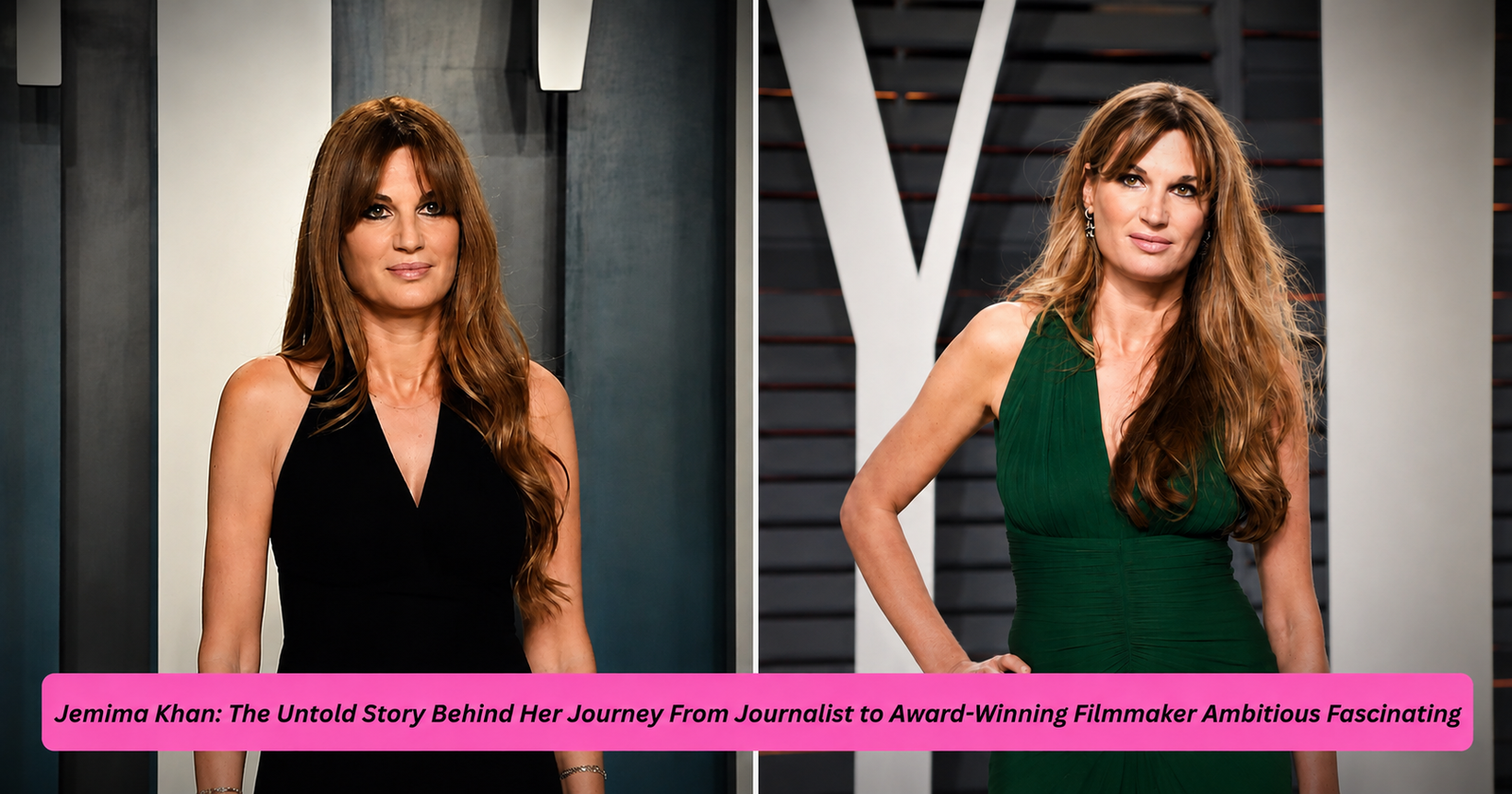
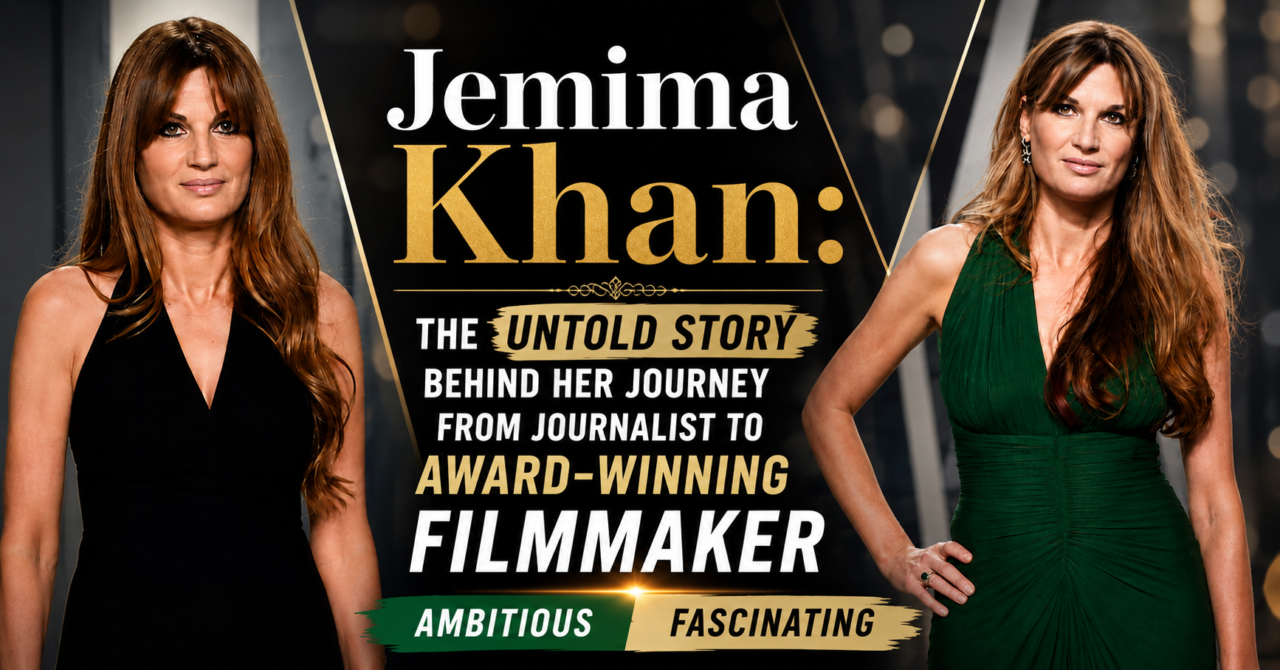
Few public figures have reinvented themselves as thoroughly, or as thoughtfully, as Jemima Khan. Over the last three decades, she has moved from being a subject of tabloid fascination to becoming one of the most respected voices behind the camera in British film and television. If you’ve searched for her name expecting a simple celebrity bio, you’re going to get something richer: a case study in how someone can rebuild a public identity around substance rather than spectacle.
This article breaks down who Jemima Khan is, how her career actually evolved, what she’s known for professionally today, and why her name keeps resurfacing in conversations about journalism, documentary filmmaking, and cultural diplomacy. Whether you’re here for background on her personal history or her production credits, this guide covers it with the kind of depth a quick skim of search results won’t give you.
Who Is Jemima Khan?
Jemima Khan, born Jemima Marcelle Goldsmith on 30 January 1974 in Chelsea, London, is a British screenwriter, journalist, and independent film and television producer. She’s the daughter of billionaire financier James Goldsmith and Annabel Goldsmith, which meant she grew up in a household already accustomed to public scrutiny long before she became a household name in her own right. Her brothers, Zac and Ben Goldsmith, went on to prominent careers in politics and environmental philanthropy, which tells you something about the family’s broader instinct for public life and advocacy.
What makes Jemima Khan’s story genuinely interesting isn’t just the family pedigree, though. It’s the way she’s used a life spent partly in the public eye as raw material for serious professional work. She studied at the University of Bristol and later the University of London, and by her late teens she’d already married Pakistani cricket legend turned politician Imran Khan, moving to Lahore and immersing herself in a culture, language, and political landscape entirely different from the one she was raised in. That marriage, and the nine years she spent living in Pakistan, shaped almost everything that came afterward in her professional life, from her journalism to the documentaries she’d eventually produce about justice, politics, and displacement.
Jemima Khan’s Early Life and Cultural Immersion in Pakistan
Understanding Jemima Khan as a professional requires understanding the years she spent in Pakistan, because that period is where her journalistic instincts were actually forged. She married Imran Khan in 1995 and converted to Islam, adopting the name Jemima Khan and relocating to a country where she was, by her own later accounts in interviews and op-eds, thrown into deep-end immersion. She learned Urdu, raised her two sons, Sulaiman and Kasim, partly in Lahore, and involved herself in charitable work, including cancer hospital initiatives tied to her then-husband’s philanthropic efforts.
This wasn’t a passive experience. Living through Pakistan’s volatile political climate in the late 1990s and early 2000s gave Jemima Khan a front-row seat to the kind of geopolitical complexity that most Western journalists only encounter as outsiders. She began writing, first locally and then for major British publications like The Independent, The Sunday Times, and The Observer, filing dispatches that carried an insider’s texture rather than a parachute journalist’s surface-lev
el take. This is a crucial distinction in media literacy terms: her early credibility as a commentator on South Asian politics didn’t come from a journalism degree, it came from lived experience, which is exactly the kind of first-hand authority that search engines and readers alike now associate with trustworthy reporting.
From Journalism to the New Statesman and Vanity Fair
After her divorce from Imran Khan in 2004, Jemima Khan didn’t retreat from public life, she leaned further into writing and editorial work. She became associate editor at The New Statesman, a British political and cultural magazine known for sharp, left-leaning commentary, and later took on the role of European editor-at-large for Vanity Fair. These weren’t ceremonial titles handed to a well-connected socialite; she was actively commissioning, writing, and shaping coverage during a period when the magazine industry was navigating seismic shifts in digital publishing.
Her journalism during this era covered an eclectic range of subjects, from profiles of political figures to commentary on WikiLeaks and press freedom, a topic that would later become central to her documentary work. It’s worth noting that this period also coincided with her becoming a trustee and vocal supporter of press freedom organizations, and she was closely associated with Julian Assange’s legal defense fund at one point, a connection that placed her squarely in debates about journalism, transparency, and state power. This wasn’t incidental; it reflects a consistent throughline in her career, an interest in accountability journalism and the mechanics of how truth gets suppressed or surfaces in political systems.
| Career Phase | Approximate Years | Key Roles or Output |
|---|---|---|
| Life in Pakistan | 1995–2004 | Journalist for The Independent, charitable work, political immersion |
| Magazine Editorial | 2004–2013 | Associate Editor, New Statesman; European Editor-at-Large, Vanity Fair |
| Documentary Production | 2013–2019 | Executive producer, We Steal Secrets: The Story of WikiLeaks; The Clinton Affair |
| Television Production | 2018–2021 | Impeachment: American Crime Story; The Case Against Adnan Syed |
| Screenwriting and Film | 2019–2023 | What’s Love Got to Do With It?, debut screenplay, multiple award wins |
| Podcast and Advocacy Media | 2022–present | A Muslim & A Jew Go There; The Bibi Files; The Voice of Hind Rajab |
The Pivot Into Documentary and Television Production
Jemima Khan’s transition from writer to producer is one of the more underappreciated arcs in modern British media careers. She founded Instinct Productions, a production company that has since built a portfolio spanning more than fifty hours of broadcast content, with nominations across the Emmys, Golden Globes, BAFTAs, and even an Academy Award nomination. That’s not a small feat for someone who started as a print journalist with no formal training in television production.
Her producing credits read like a masterclass in choosing subject matter with cultural weight. She executive produced We Steal Secrets: The Story of WikiLeaks, a documentary that dissected the rise of Julian Assange and the platform’s impact on modern journalism, and The Clinton Affair, an award-winning docuseries revisiting the Monica Lewinsky scandal with a fresh, more empathetic lens toward Lewinsky herself. She also worked on The Case Against Adnan Syed, the HBO/Sky Atlantic docuseries connected to the Serial podcast phenomenon, which reexamined the murder conviction of Adnan Syed and became part of a broader cultural reckoning about wrongful convictions and prosecutorial overreach.
What ties these projects together is a recurring interest in stories where public narrative and private truth diverge, whether that’s a woman vilified by tabloid culture, a man convicted on shaky evidence, or a whistleblower platform caught between transparency and chaos. It’s not hard to see why Jemima Khan gravitates toward these themes; her own life has involved being on both sides of that divide, as a subject of media scrutiny and later as someone controlling the narrative from behind the camera.
What’s Love Got to Do With It? and Her Screenwriting Debut
In 2022, Jemima Khan made a significant creative leap by writing her debut feature film screenplay, What’s Love Got to Do With It?, produced alongside Working Title Films and StudioCanal. The romantic comedy-drama, starring Lily James, Shazad Latif, and Emma Thompson, explores the tension between Western dating culture and arranged marriage traditions, following a British documentary filmmaker who chronicles her childhood friend’s journey toward an arranged marriage in Pakistan.
The premise draws unmistakably from Jemima Khan’s own biography, the cross-cultural romance, the British-Pakistani dynamic, the questions about love versus tradition, without being a literal autobiography. Critics responded warmly to the film’s willingness to treat arranged marriage with nuance rather than as either a punchline or a tragedy, presenting it as one valid path among many rather than a cultural relic to be pitied. The film premiered at the Toronto International Film Festival in 2022, won Best Comedy at the Rome Film Festival, and picked up four National Film Awards in 2023, including Best Screenplay and Best British Film.
This project matters in any serious discussion of Jemima Khan’s career because it represents the moment she stopped simply producing other people’s stories and started telling her own, filtered through fiction but unmistakably informed by two decades of lived cross-cultural experience. Screenwriters often talk about “writing what you know,” and few working writers in British cinema right now know the collision of Western and South Asian cultural expectations quite as intimately as she does.
Jemima Khan’s Advocacy Journalism and Political Documentaries
Beyond entertainment-adjacent projects, Jemima Khan has increasingly used her production platform for politically charged, advocacy-oriented storytelling. She produced the podcast series A Muslim & A Jew Go There, hosted by comedian David Baddiel and politician Sayeeda Warsi, which tackled interfaith tension and antisemitism versus Islamophobia with a conversational, disarming format. The podcast climbed to number two on the Apple charts and picked up multiple nominations at the British Podcast Awards.
More recently, she has moved into overtly political documentary territory with projects like The Bibi Files, which premiered at the Toronto International Film Festival in
2024 and examines corruption allegations surrounding Israeli Prime Minister Benjamin Netanyahu, and The Voice of Hind Rajab, directed by Kaouther Ben Hania, which she executive produced in 2025. These are not comfortable, crowd-pleasing subjects. They require a producer willing to absorb political blowback in exchange for putting difficult, underreported stories in front of audiences. This is where Jemima Khan’s authority as a media figure really shows itself: she isn’t chasing algorithm-friendly content, she’s backing projects that carry genuine journalistic risk, the kind of work that demonstrates real editorial courage rather than just brand management.
One entertainment journalist covering the Toronto festival circuit put it plainly when describing her recent slate: producers with her level of access rarely spend that capital on films this politically uncomfortable, and that alone says something about her priorities as a filmmaker rather than a celebrity attaching her name to safe projects.
Personal Life, Relationships, and Public Perception
No comprehensive look at Jemima Khan would be complete without addressing the personal chapters that made her a tabloid fixture long before her production career took shape. Her marriage to Imran Khan ended in 2004, and she has spoken in past interviews about the difficulty of navigating a very public divorce while raising two young sons across two cultures and continents. She was later romantically linked to actor Hugh Grant and comedian Russell Brand, relationships that generated relentless British tabloid coverage, often reducing her to a supporting character in someone else’s storyline rather than treating her as a professional in her own right.
What’s notable, looking back at that period now, is how deliberately she’s shifted the narrative since. Rather than fighting the tabloid framing directly, she built an entirely separate professional identity that now dominates how she’s discussed in serious media and industry circles. When outlets cover Jemima Khan today, particularly around award season or festival premieres, the conversation is overwhelmingly about her producing and writing credits rather than her dating history. That’s a meaningful shift in public narrative control, and it offers a genuinely useful case study in reputation management for anyone interested in how public figures reclaim agency over their own story.
She remains connected to Pakistan through her sons and through Imran Khan’s political career, which has itself been turbulent, including his time as Prime Minister and his subsequent legal and political struggles. Jemima Khan has occasionally commented publicly on developments involving her ex-husband, generally with a measured tone that avoids inflaming an already volatile political situation, which again reflects the journalistic instinct for restraint that seems to run through most of her public statements.
Why Jemima Khan Remains a Culturally Significant Figure
It would be easy to file Jemima Khan away as “British socialite turned producer,” but that undersells the actual substance of her body of work. Few people move as fluidly between journalism, screenwriting, television production, and political documentary as she has, and even fewer do it while maintaining the kind of editorial credibility that gets her projects taken seriously at festivals like Toronto and Cannes rather than dismissed as vanity projects.
Her significance also lies in what she represents structurally within the media industry: an independent producer who built her own company, Instinct Productions, rather than working purely within existing studio infrastructure. That independence gives her latitude to greenlight riskier, more politically sensitive projects that a major studio might shy away from. In an industry increasingly dominated by franchise content and algorithm-driven streaming decisions, that kind of creative autonomy is genuinely rare, and it’s part of why industry commentators keep pointing to her slate as an example of how personal credibility can translate into sustained creative freedom.
There’s also a broader cultural conversation happening here about how public figures, especially women who were initially defined by marriage or relationships in the press, can reroute their public identity toward professional achievement. Jemima Khan’s trajectory offers a fairly instructive real-world example of that reroute succeeding, not through a single viral reinvention moment, but through two decades of consistent, credible output.
Jemima Khan’s Recognition and Industry Standing
The scale of recognition attached to Jemima Khan’s production work is worth spelling out plainly, because it’s easy to undersell when discussing someone whose name is still often searched alongside gossip-driven queries. Projects she’s produced or executive produced have collected multiple Emmy nominations, a Golden Globe nomination, BAFTA nominations, and an Academy Award nomination, spanning genres from prestige drama to true crime documentary to political nonfiction. That range signals versatility rather than a single lucky hit, which is generally what separates a durable industry career from a one-off success story.
Her recognition within British cultural life extends beyond awards, too. She’s a regular presence at industry events like the BAFTA pre-parties and festival premieres, not as a socialite attending for visibility, but as a working producer whose presence at these events is tied directly to projects she’s actively involved in. That distinction matters in terms of authority and credibility: attending an event because you made the film is a fundamentally different signal than attending because you’re simply well-connected.
Frequently Asked Questions About Jemima Khan
Who is Jemima Khan married to now?
Jemima Khan is not currently married. She was previously married to Pakistani cricketer and politician Imran Khan from 1995 until their divorce in 2004, and she has since been romantically linked to public figures including Hugh Grant and Russell Brand, though she has not remarried. Her current public identity centers far more heavily on her production and screenwriting career than on her relationship history.
What is Jemima Khan known for professionally?
Jemima Khan is known professionally as a screenwriter, journalist, and independent film and television producer through her company Instinct Productions. Her most recognized work includes the screenplay for What’s Love Got to Do With It?, executive producing credits on We Steal Secrets: The Story of WikiLeaks, The Clinton Affair, and The Case Against Adnan Syed, and more recent political documentary work including The Bibi Files and The Voice of Hind Rajab.
Did Jemima Khan convert to Islam?
Yes, Jemima Khan converted to Islam prior to her marriage to Imran Khan in 1995, a decision that accompanied her relocation to Pakistan and her broader immersion into Pakistani culture and family life during the nine years the couple were married. This period of her life significantly shaped the cross-cultural perspective that later informed both her journalism and her screenwriting.
How many children does Jemima Khan have?
Jemima Khan has two sons, Sulaiman and Kasim, both from her marriage to Imran Khan. The two boys were raised partly in Pakistan and partly in the United Kingdom, and Jemima Khan has spoken in past interviews about the challenges of co-parenting across two countries and cultural contexts following her divorce.
Is Jemima Khan related to Zac Goldsmith?
Yes, Jemima Khan is the sister of Zac Goldsmith, the British politician and former government minister, as well as Ben Goldsmith, an environmentalist and financier. All three are children of the late billionaire businessman James Goldsmith, placing Jemima Khan within one of Britain’s more prominent and politically active families.
What awards has Jemima Khan won or been nominated for?
Jemima Khan has been involved in projects nominated for multiple Emmy Awards, a Golden Globe Award, several BAFTA Awards, and an Academy Award, largely through her production company Instinct Productions. Her screenwriting debut, What’s Love Got to Do With It?, also won Best Comedy at the Rome Film Festival and multiple National Film Awards, including Best Screenplay and Best British Film.
Final Thoughts on Jemima Khan’s Ongoing Legacy
Jemima Khan’s career resists the easy tabloid shorthand that once defined her public image. What started as a life shaped by marriage into a prominent Pakistani political family evolved, through sustained effort and genuine editorial instinct, into a substantial body of journalism, screenwriting, and production work that stands on its own merit. From dispatches filed out of Lahore to executive producing politically charged documentaries screened at Toronto, her arc reflects a rare kind of professional discipline, the willingness to keep building credibility long after the public spotlight could have simply faded.
The core takeaway is this: Jemima Khan’s story isn’t really about reinvention in the shallow, rebranding sense. It’s about someone using lived experience, cross-cultural fluency, and a genuine appetite for difficult subject matter to build a media career that outlasts the news cycle that first made her famous. That’s a far more durable kind of relevance than any single headline could ever provide.