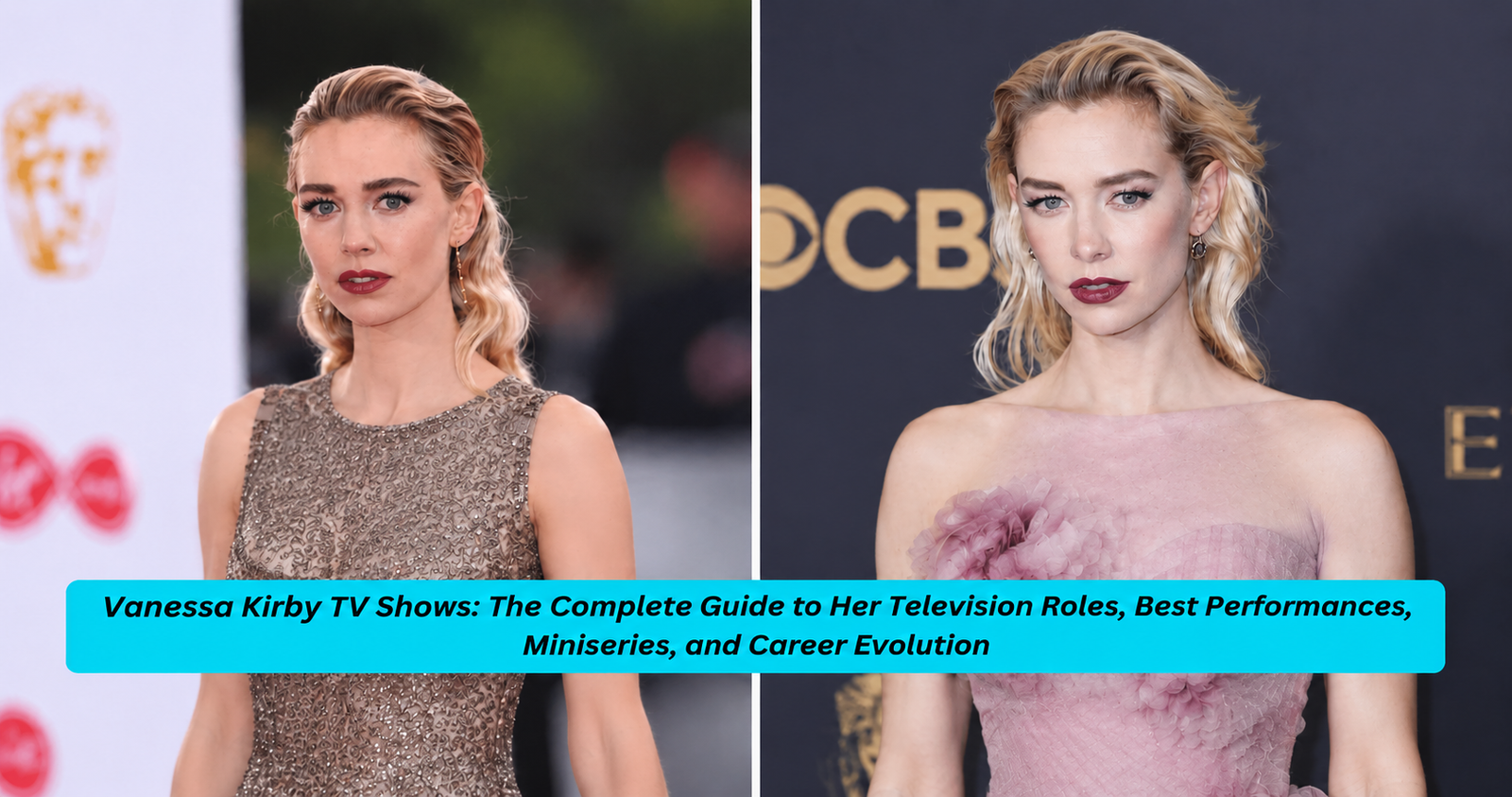
Vanessa Kirby has built a screen career that moves comfortably between prestige television, miniseries, television films, theater, and major studio movies. For viewers searching for Vanessa Kirby TV shows, the interesting part is that her television résumé is smaller than her filmography but unusually concentrated: several early projects are period dramas, literary adaptations, or character-led stories, and her defining television performance came with Princess Margaret in The Crown.
Kirby’s television work also makes a useful map of her development as an actor. She began with supporting work in British drama, moved into literary and historical material, took on darker genre territory in The Frankenstein Chronicles, and then reached a global audience through Netflix’s royal drama. Her film career later became much more prominent, but television remains essential to understanding how her range developed.
This guide focuses on scripted television roles and television films rather than treating every talk-show appearance or promotional interview as an acting credit. The core acting credits include The Hour, Great Expectations, Labyrinth, Agatha Christie’s Poirot, The Dresser, The Frankenstein Chronicles, and The Crown. Her representative’s television CV independently confirms several of the major credits and her BAFTA win for The Crown.
Vanessa Kirby TV shows at a glance
The clearest way to understand Vanessa Kirby’s television career is to separate traditional series from miniseries and television films. Her early screen work was concentrated in British productions, many of which used a limited episode count to tell a complete story. That format suited an actor with a strong theater background because it demanded precision without requiring a long-running character arc.
Her television credits include Ruth Elms in The Hour, Estella in Great Expectations, Alice Tanner in Labyrinth, Celia Ravenscroft in Agatha Christie’s Poirot, Irene in The Dresser, Lady Jemima Hervey in The Frankenstein Chronicles, and Princess Margaret in The Crown. Available filmography records list 18 episodes of The Crown, while The Frankenstein Chronicles gave her a seven-episode main role.
| Title | Year | Format | Vanessa Kirby’s role | Why it matters |
|---|---|---|---|---|
| The Hour | 2011 | BBC drama series | Ruth Elms | Early television work in a newsroom drama |
| Great Expectations | 2011 | Three-part miniseries | Estella | Literary adaptation and early showcase role |
| Labyrinth | 2012 | Two-part miniseries | Alice Tanner | Historical mystery with a dual-era structure |
| Agatha Christie’s Poirot | 2013 | Detective series episode | Celia Ravenscroft | Guest role in a long-running mystery franchise |
| The Dresser | 2015 | Television film | Irene | Prestige British television drama |
| The Frankenstein Chronicles | 2015–2017 | Drama series | Lady Jemima Hervey | Dark period drama and substantial recurring role |
| The Crown | 2016–2022 | Historical drama series | Princess Margaret | Breakthrough television role and BAFTA-winning performance |
One useful viewing rule is to treat these credits according to format rather than simply counting them. Great Expectations and Labyrinth are miniseries, while The Dresser is a television film, and The Crown is a long-form streaming drama. That distinction helps explain why a relatively compact list can still contain a substantial amount of screen acting. TVMaze, IMDb, and Kirby’s agency materials broadly agree on the major acting credits, although databases can differ in how they classify formats and episode counts.
The Crown: Vanessa Kirby’s defining television performance
For most viewers, the starting point among Vanessa Kirby TV shows is The Crown. Kirby played Princess Margaret during the first two seasons and later returned in a guest capacity in season five, with the character subsequently portrayed by Helena Bonham Carter and Lesley Manville as the series moved through different periods of Margaret’s life. Netflix lists Kirby among the principal cast, and the series is categorized as a British drama about the monarchy and political life.
What makes Kirby’s performance especially important is the balance between public image and private vulnerability. Princess Margaret is not presented simply as a glamorous royal or a rebellious younger sister. The character is pulled between duty, family loyalty, romantic disappointment, social expectation, and a desire for personal independence. Kirby plays those contradictions through changes in rhythm, expression, posture, and emotional restraint. In practical terms, that means the performance often works in the spaces between lines rather than through speeches alone.
The role also demonstrates why a theater-trained actor can be particularly effective in a prestige television ensemble. The Crown gives actors room for small behavioral choices, while the camera captures details that a stage audience might only see from a distance. Kirby’s Margaret can appear composed in a public room and emotionally unsettled a moment later, allowing the series to build character through contrast.
The awards history confirms the role’s professional significance without needing to treat awards as a substitute for artistic judgment. Kirby won the 2018 BAFTA Television Award for Best Supporting Actress for her work on The Crown and received a Primetime Emmy nomination for the role. Her agency’s CV records the BAFTA win and Emmy nomination, while IMDb likewise identifies The Crown as a central part of her television career.
Great Expectations: Estella and the literary-drama foundation
Among early Vanessa Kirby TV shows, Great Expectations is one of the most important because it places her inside a classic literary adaptation. The BBC’s three-part production, adapted by Sarah Phelps and directed by Brian Kirk, casts Kirby as Estella alongside Douglas Booth, Gillian Anderson, Ray Winstone, and David Suchet. It first aired in December 2011.
Estella is a demanding role because the character can easily become one-dimensional. In Charles Dickens’s story, she is both an object of Pip’s idealization and a person shaped by Miss Havisham’s manipulation. Kirby’s screen performance benefits from keeping some emotional distance around Estella. Instead of treating her simply as cruel or romantic, the production presents a young woman whose behavior has been shaped by an unusual upbringing.
This early credit is also useful when looking backward from The Crown. In both projects, Kirby works within highly controlled social environments where characters are expected to behave according to rules. Estella’s world is governed by class, wealth, education, and emotional conditioning; Margaret’s world is governed by monarchy, ceremony, press attention, and family hierarchy. The settings are different, but both require an actor to communicate pressure without making every scene overtly dramatic.
For viewers interested in literary adaptations, Great Expectations is therefore more than a footnote. It shows Kirby working with period costume, formal dialogue, and a character whose emotional meaning is partly hidden beneath social performance. It is also one of the clearest examples of how her early television work prepared the ground for later prestige drama.
The Hour: an early BBC drama role
The Hour is another key entry in Vanessa Kirby TV shows because it places her in a sharply different environment. Rather than the Victorian world of Great Expectations, the series is a 1950s newsroom drama built around journalism, politics, broadcasting, and institutional pressure. Kirby played Ruth Elms and appeared in three episodes.
The importance of The Hour is less about the size of Kirby’s role and more about the kind of television acting it demanded. Period newsroom dramas rely on dialogue, ensemble chemistry, professional hierarchy, and believable workplace behavior. An actor cannot simply deliver lines; the character must appear to understand the rules of the institution and the historical environment around it.
Kirby’s early television credits show a pattern that becomes clearer when viewed together: she repeatedly entered projects with strong formal identities. A Dickens adaptation has its own language and visual grammar; a newsroom thriller has another; a royal drama has another. Moving between them requires flexibility. That flexibility would later become useful in her film work, where she moved from intimate drama to action franchises.
The Hour is also worth watching for viewers who prefer ensemble storytelling. The series is not structured as a single-star vehicle. Its appeal comes from how professional ambition, friendship, politics, and personal relationships intersect. Kirby’s role sits inside that larger mechanism, making the credit a valuable piece of her television development even though it is much less famous than The Crown.
Labyrinth: historical mystery across two eras
Labyrinth expands the period-drama side of Kirby’s television résumé. The 2012 miniseries is based on Kate Mosse’s novel and uses a dual-era narrative, connecting a contemporary storyline with events rooted in medieval Carcassonne. Kirby plays Alice Tanner, and the production was made as a two-part television event.
The two-era structure creates a different acting challenge from a conventional historical drama. Alice belongs to the modern storyline, yet the character becomes connected to mysteries, artifacts, family history, and events from centuries earlier. That means the performance has to make the contemporary protagonist believable while also carrying the audience through a story filled with historical mythology and suspense.
For viewers building a watchlist, Labyrinth is especially useful if the appeal of Kirby’s television work lies in genre variety. It is not simply another costume drama. The miniseries combines historical fiction, mystery, thriller elements, and adventure. That hybrid structure makes it a good example of how British television often used limited-run productions to adapt ambitious novels without committing to a multi-season format.
It also demonstrates a recurring feature of Kirby’s career: she often works in stories where the character is placed under pressure by forces larger than herself. That can mean royal protocol, family expectations, historical secrets, institutional politics, or psychological crisis. The circumstances change, but the dramatic engine remains character versus circumstance.
The Frankenstein Chronicles: darker genre territory
The Frankenstein Chronicles gives Vanessa Kirby TV shows a distinctly gothic entry. Kirby played Lady Jemima Hervey in the series, which blends historical drama, crime investigation, and Mary Shelley-inspired horror. Filmography records list her as a main cast member across seven episodes.
The series is particularly interesting because it moves away from the polished social environments associated with some of Kirby’s earlier period roles. Its atmosphere is darker and more investigative, with grim settings and a story concerned with bodies, medicine, crime, and scientific experimentation. That change in tone demonstrates that Kirby’s television work was not limited to conventional costume romance or royal drama.
Lady Jemima also benefits from the ensemble nature of the show. In a mystery or gothic drama, characters often need to hold information back, create suspicion, or reveal motives gradually. This makes performance less about immediate emotional transparency and more about controlled ambiguity. Kirby’s presence fits that mode, giving the character a place within the series’ wider atmosphere rather than turning the role into a separate melodrama.
For viewers who know Kirby primarily from The Crown or her action-film appearances, The Frankenstein Chronicles can be a useful bridge. It shows a performer working inside a darker serialized story, with more room for genre conventions and recurring character development than her earlier short-form television appearances.
Agatha Christie’s Poirot: a concise mystery appearance
Agatha Christie’s Poirot represents a different category of Vanessa Kirby TV shows: a guest appearance inside an established detective franchise. She played Celia Ravenscroft in “Elephants Can Remember,” an episode from the long-running series.
A role like this is valuable because guest actors in detective series have to enter an already established world quickly. The audience understands the central detective, the visual language, and the expectations of the mystery format. The guest character must become credible within that structure without requiring an entire season of setup.
“Elephants Can Remember” is based on one of Agatha Christie’s later Poirot stories, making the appearance particularly relevant for viewers interested in literary mystery adaptations. Kirby’s involvement also fits the larger pattern of her early career: television credits that exposed her to different genres and production styles before her international breakthrough.
It is easy for a short guest role to disappear from an actor’s résumé once a much larger part becomes famous. In Kirby’s case, however, these early appearances help illustrate how steadily she built screen experience. They also provide useful context for understanding why her later performances feel comfortable across different genres.
The Dresser and the importance of television films
The Dresser is technically different from a conventional TV series, but it belongs in any thorough discussion of Vanessa Kirby TV shows because it was made for television and features her as Irene. The production was directed by Richard Eyre and adapted from Ronald Harwood’s play, with a cast that included Ian McKellen and Anthony Hopkins. Kirby’s representative lists the project among her television credits.
Television films occupy an interesting middle ground. They can have the concentrated storytelling of a stage production while benefiting from close-up cinematography and editing. The Dresser is especially relevant to Kirby because her career has always retained a strong theatrical foundation. Her performance sits within a story about actors, performance, loyalty, aging, and the backstage machinery of theater.
This makes the project valuable beyond its individual plot. It reveals an actor working in a performance-centered story while surrounded by performers with extensive stage and screen experience. For someone studying Kirby’s career, it is one of the credits that makes her later transition into emotionally demanding film roles feel less surprising.
The problem for casual viewers is availability and discoverability. Because The Dresser is a television film rather than a mainstream ongoing series, it may not appear beside better-known titles on every streaming interface. The solution is to search by the full title and year, and to verify the listing through a reputable film or television database before assuming that a similarly named production is the same work.
How Kirby’s television style developed
The most revealing way to study her television work is to look for continuity beneath the surface variety. Her roles range from literary heroine to newsroom professional, historical-mystery protagonist, gothic drama character, royal figure, and television-film performer. Yet many of these characters operate in environments where status, expectation, or hidden information shapes behavior.
That is where Kirby’s performance style becomes particularly effective. She has a reputation rooted partly in theater, and her screen work often shows an awareness of physical behavior: how a character sits, pauses, looks at another person, or changes their energy in a formal setting. The camera can capture these small shifts with unusual intimacy. In The Crown, for example, Margaret’s public composure can coexist with private frustration without requiring the scene to explain every emotion verbally.
Her own comments about wanting varied experiences are revealing. In a quote reproduced by IMDb about her move into action work, Kirby described herself as “a theater nerd from London” and said she wanted “a lot of different experiences as an actor.” That remark fits the shape of her career: television supplied early genre and character experience, while film later expanded the scale of the roles.
The result is a career that cannot be understood by genre alone. Kirby can move from intimate character drama to large-scale action because the underlying skill is adaptable performance. Whether the scene is a royal reception, a newsroom, a historical mystery, or a tense action sequence, the actor’s task remains to make the character’s choices feel specific.
Best Vanessa Kirby TV shows for different viewer interests
For viewers primarily interested in award-winning prestige drama, The Crown is the obvious place to begin. It offers the largest sustained television role in Kirby’s résumé and places her inside a high-profile ensemble. Netflix’s official listing describes the series as a British drama based on real-life royal history, with Kirby among its cast.
For literary adaptations, Great Expectations is the strongest early choice, while Labyrinth works better for viewers who prefer mystery and historical adventure. The Frankenstein Chronicles suits audiences looking for darker gothic crime, and The Hour is a natural pick for those who enjoy newsroom dramas and ensemble storytelling. The Dresser is particularly relevant for viewers interested in theater-on-screen and British television films.
| If you like… | Start with… | What you get |
|---|---|---|
| Royal history and prestige drama | The Crown | Character-driven historical drama |
| Dickens and literary adaptations | Great Expectations | Period romance, class, and psychological drama |
| Historical mystery | Labyrinth | Two-era adventure and suspense |
| Gothic crime | The Frankenstein Chronicles | Dark period investigation and horror elements |
| Journalism dramas | The Hour | 1950s newsroom politics and ensemble drama |
| Stage-to-screen productions | The Dresser | Intense theater-focused television drama |
| Classic detective mysteries | Agatha Christie’s Poirot | A concise guest role in a long-running mystery series |
This approach solves a common search problem: assuming that every title in an actor’s filmography offers the same experience. It does not. The format, episode count, genre, pacing, and role size can radically change what a viewer gets from a performance. Matching the title to your interest is more useful than simply starting with the oldest credit.
Vanessa Kirby’s television career compared with her film career
The television portion of Kirby’s career is relatively compact compared with her film work, especially after The Crown. Her filmography includes major projects such as Mission: Impossible – Fallout, Fast & Furious Presents: Hobbs & Shaw, Pieces of a Woman, Mission: Impossible – Dead Reckoning Part One, Napoleon, and The Fantastic Four: First Steps.
The distinction matters because television was not merely a smaller version of her film career. Her early television work gave her repeated exposure to period settings, literary material, ensemble dynamics, and emotionally controlled characters. The Crown then transformed that experience into a globally visible performance. After that breakthrough, the center of gravity of her career moved strongly toward cinema.
Pieces of a Woman is a useful example of how far that trajectory expanded. The film gave Kirby a demanding dramatic lead, while later roles in Mission: Impossible and Marvel-related projects placed her in much larger commercial productions. Those films are outside the scope of television, but they help explain why searches for her TV work can feel surprisingly short compared with her overall screen résumé.
In other words, the small number of core television titles should not be mistaken for a small career. Her television filmography is concentrated, while her broader career is diversified across stage, independent cinema, prestige film, action franchises, and blockbuster filmmaking.
Where Vanessa Kirby TV shows fit in her overall legacy
The enduring importance of Vanessa Kirby TV shows comes down to the way they document the transition from promising British stage and television performer to internationally recognized film actor. The Crown is the obvious landmark, but the earlier credits provide the foundation. Great Expectations demonstrates literary-drama technique; The Hour shows ensemble television; Labyrinth adds mystery and adventure; The Frankenstein Chronicles explores darker genre material; and The Dresser reconnects her work with the theatrical tradition.
There is also an important historical point about The Crown itself. The role of Princess Margaret was not played by Kirby throughout the entire series. The production recast the role as the characters aged, with Helena Bonham Carter taking over for seasons three and four and Lesley Manville portraying Margaret in seasons five and six. Kirby nevertheless returned for a guest appearance in season five.
That casting structure makes Kirby’s performance unusually easy to place within a larger acting lineage. Three performers interpret the same fictionalized historical figure at different stages of life. Kirby’s version represents the younger Margaret and establishes many of the emotional and behavioral qualities that later performers inherit and reinterpret.
For audiences, the practical takeaway is simple: watching Kirby’s television work in chronological order reveals more than watching her most famous role alone. The progression shows an actor testing different genres, formats, and character types before her career moved increasingly toward film.
FAQs about Vanessa Kirby TV shows
What is Vanessa Kirby’s most famous TV role?
Vanessa Kirby is best known on television for playing Princess Margaret in The Crown. She portrayed the younger version of the character in the first two seasons and returned for a guest appearance in season five. Her performance earned the 2018 BAFTA Television Award for Best Supporting Actress and a Primetime Emmy nomination.
How many episodes of The Crown did Vanessa Kirby appear in?
Available filmography records list Vanessa Kirby in 18 episodes of The Crown across her appearances as Princess Margaret. Her main run covered seasons one and two, followed by a later guest appearance. Because The Crown recast its principal characters as they aged, Kirby did not portray Margaret for all six seasons.
What was Vanessa Kirby’s first television role?
Kirby’s television debut was in The Hour, where she played Ruth Elms. Filmography sources list her in three episodes of the 2011 BBC drama. Around the same period, she also appeared as Estella in the BBC’s three-part Great Expectations, making her early television career notable for moving quickly between ensemble drama and literary adaptation.
Did Vanessa Kirby appear in Great Expectations?
Yes. Vanessa Kirby played Estella in the 2011 BBC adaptation of Great Expectations. The three-part production was adapted by Sarah Phelps and directed by Brian Kirk, with Douglas Booth as Pip, Gillian Anderson as Miss Havisham, Ray Winstone as Magwitch, and David Suchet as Jaggers.
Is The Frankenstein Chronicles one of Vanessa Kirby’s TV shows?
Yes. Kirby played Lady Jemima Hervey in The Frankenstein Chronicles, a historical mystery series with gothic and horror elements. Her filmography lists the role as a main part spanning seven episodes, making it one of her more substantial television roles before The Crown.
Did Vanessa Kirby appear in Agatha Christie’s Poirot?
Yes. Kirby played Celia Ravenscroft in the Poirot episode “Elephants Can Remember.” It was a guest appearance rather than a long-running role, but it is an important early credit because it places her in one of British television’s best-known literary detective adaptations.
Are there Vanessa Kirby TV shows on Netflix?
The Crown is the major Netflix television title associated with Kirby. Netflix’s official listing includes her among the cast and describes the program as a British drama based on real-life royal history. Availability of other television titles can vary by country and licensing agreements, so a title being part of Kirby’s television filmography does not guarantee that it is currently streaming on Netflix in every region.
Conclusion: the essential Vanessa Kirby TV shows to know
The strongest way to understand Vanessa Kirby’s television career is to see it as a compact but strategically important part of a much larger acting journey. The early credits show her building experience in British television through The Hour, Great Expectations, Labyrinth, and guest work in Agatha Christie’s Poirot. The Frankenstein Chronicles expanded her reach into darker serialized genre drama, while The Dresser demonstrated her connection to theater-focused television.
The defining chapter is The Crown. Kirby’s Princess Margaret became her breakthrough television role, earning major award recognition and introducing her performance style to a worldwide audience. Her later film career became increasingly prominent, but the television work explains much of the range that followed.
For anyone researching Vanessa Kirby TV shows, the best takeaway is not simply that she appeared in The Crown. It is that her television credits form a progression: ensemble drama, literary adaptation, historical mystery, gothic genre, television theater, and finally a major prestige series. Taken together, those roles show an actor developing through different formats rather than repeating the same character type. That makes her television résumé shorter than some stars’ but unusually useful for understanding how her career was built.