
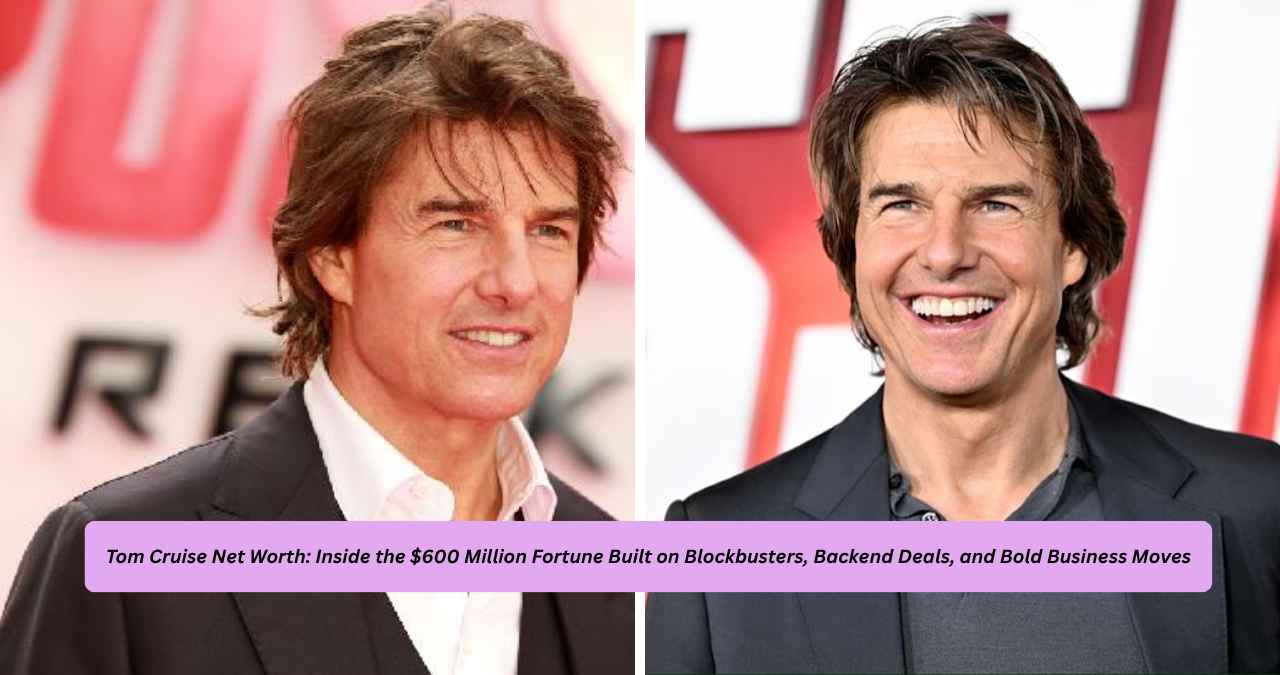
Tom Cruise net worth has become one of the most searched financial topics in entertainment media, and it’s easy to see why. Few actors have turned a single career into a business empire quite like Cruise has. Estimates from outlets that track celebrity wealth place his current fortune at roughly $600 million, with some reports suggesting his career earnings and asset value could push meaningfully higher depending on how real estate, aircraft, and unreleased profit participation are counted.
What makes Tom Cruise net worth genuinely interesting isn’t just the headline figure — it’s the mechanics behind it. Cruise didn’t get rich from a single lucky franchise. He engineered a decades-long system of salary negotiation, profit participation, and reinvestment that turned him into one of the highest-paid actors in Hollywood history, long before “creator economy” or “personal brand” were buzzwords anyone used. This guide breaks down where the money actually came from, how it’s grown over time, what he owns, and why his approach to wealth looks different from almost every other A-list celebrity.
How Much Is Tom Cruise Actually Worth?
The most commonly cited figure for Tom Cruise net worth is around $600 million, a number reported consistently across celebrity finance outlets and entertainment publications tracking his 2026 standing. Some analyses go further, estimating that when you account for the full scope of his documented career earnings — reportedly exceeding $1 billion across roughly 47 films — combined with real estate holdings and aviation assets, his broader financial footprint could be valued closer to $891 million by more generous methodologies.
The gap between these numbers illustrates something important about how celebrity net worth estimates work in general. Public figures rarely disclose exact bank balances, so outlets build estimates from a mix of publicly reported salaries, box office profit-sharing structures, real estate transactions, and known business interests. Tom Cruise net worth estimates tend to sit on the more conservative end because a large share of his wealth is tied up in illiquid assets — homes, aircraft, and reinvested capital — rather than cash sitting in an account. That distinction matters for anyone trying to understand what these numbers really represent: not a bank statement, but an informed estimate of total asset value built from the best available public data.
The Salary Structure That Built Tom Cruise’s Fortune
Understanding Tom Cruise net worth requires understanding how his pay structure evolved over four decades. Early in his career, Cruise earned relatively modest, if still substantial, fixed salaries — reportedly around $50,000 for a supporting role in 1981’s Taps and $2 million for the original Top Gun in 1986. Those numbers look small by today’s standards, but they represented a rapid rise for a young actor still building his reputation.
The real transformation came when Cruise and his representatives began negotiating backend deals — arrangements where an actor earns a percentage of a film’s box office gross rather than, or in addition to, a flat salary. This is the mechanism that took Tom Cruise net worth from “successful actor” territory into “financial powerhouse” territory. Reports indicate he earned around $100 million from Mission: Impossible 2 in 2000 through profit participation, and a similar sum from War of
Worlds in 2005. Decades later, Top Gun: Maverick reportedly delivered a record-setting payday combining a base salary near $12.5 million with box office-linked bonuses that pushed his total take to roughly $100 million for a single film. Across the Mission: Impossible franchise alone, Cruise has reportedly earned more than $285 million in combined salary and producer royalties tied to a series that has grossed over $4 billion worldwide. Few actors in Hollywood history have replicated that kind of sustained backend leverage, which is precisely why Tom Cruise net worth is so often used as a case study in entertainment finance circles.
Real Estate, Aviation, and Lifestyle Assets
A meaningful portion of Tom Cruise net worth sits outside of liquid cash, distributed across real estate, aircraft, and other tangible assets accumulated over a long career. Cruise has been an active real estate investor for decades, buying and selling high-end properties in desirable markets, with a portfolio that has reportedly generated both gains and losses depending on the transaction and market timing. His current primary residence is widely reported to be a multi-million dollar penthouse in Clearwater, Florida.
Aviation is another significant piece of the picture. As a licensed pilot, Cruise owns a personal fleet of aircraft estimated to be worth somewhere between $30 million and $35 million, reflecting both a genuine personal passion and a practical need given his famously hands-on approach to filming aerial stunt sequences himself. This is worth noting because it distinguishes Cruise’s spending pattern from typical celebrity luxury purchases — his aircraft aren’t purely lifestyle assets; they’re also functional tools tied directly to how he makes his films, and by extension, how he continues to grow Tom Cruise net worth
through box office performance. Unlike celebrities who accumulate depreciating luxury goods purely for status, Cruise’s asset base tends to blend personal enjoyment with professional utility, which is a distinctive pattern worth understanding if you’re studying how top-tier entertainers manage wealth.
Why Tom Cruise Isn’t a Billionaire Yet
A frequent point of curiosity around Tom Cruise net worth is why, despite four decades of blockbuster paydays, he hasn’t crossed into billionaire territory the way some tech founders or business moguls have. The answer comes down to a fundamental difference between earned income and compounding capital. Even extraordinary acting paydays — $100 million here, $285 million there over a franchise’s lifetime — are fundamentally episodic. They arrive in large chunks tied to specific projects rather than growing continuously the way an ownership stake in a scalable business does.
There’s also a philosophical element to this gap. Multiple entertainment finance analysts have pointed out that Cruise’s career choices reflect priorities beyond pure wealth accumulation. As one entertainment industry finance commentator put it, “Cruise reinvests in the machinery of moviemaking itself — production budgets, stunt work, marketing
muscle — rather than diversifying into passive holding companies the way some of his peers have.” That reinvestment cycle helps explain why Tom Cruise net worth has grown steadily but hasn’t compounded the way a founder’s equity stake might, even though his lifetime career earnings are extraordinary by any standard. It’s a useful reminder that “net worth” and “career earnings” are related but fundamentally different measurements, and conflating the two is one of the most common mistakes people make when researching celebrity wealth.
Tom Cruise Net Worth Compared to Hollywood Peers
Placing Tom Cruise net worth in context requires comparing it against other A-list actors with similarly long careers. Forbes’ rankings of the highest-paid actors have repeatedly placed Cruise near the top in individual years — for example, recent annual rankings placed him at number two behind Adam Sandler for highest-paid actor of the year, reflecting how his per-project earnings remain elite even decades into his career. When measured against contemporaries like Brad Pitt, several estimates suggest Tom Cruise net worth sits somewhat higher, largely due to the scale and consistency of his backend deals across a uniquely durable franchise portfolio.
That said, net worth comparisons across actors can be misleading without context, since underlying business diversification varies enormously. Some actors who appear to have comparable or lower net worth on paper have built diversified holding companies, production studios, or brand licensing empires that generate more predictable long-term income than backend movie deals. Cruise’s wealth, by contrast, remains heavily concentrated in a single professional lane: acting, producing, and profit-sharing within the film industry. This concentration is part of what makes Tom Cruise net worth such a compelling case study — it demonstrates just how much value a single, disciplined career strategy can generate when executed at the highest level over an unusually long period.

| Category | Estimated Value / Detail |
|---|---|
| Estimated Net Worth (2026) | ~$600 million (some estimates up to $891 million) |
| Career Earnings | Reportedly $1+ billion across roughly 47 films |
| Mission: Impossible Franchise Earnings | ~$285 million+ in combined salary and royalties |
| Top Gun: Maverick Payday | ~$100 million (base salary plus box office bonuses) |
| Personal Aircraft Fleet | Estimated $30–35 million |
| Primary Residence | Multi-million dollar penthouse, Clearwater, Florida |
The Business Lessons Behind Tom Cruise’s Wealth
Beyond the specific dollar figures, Tom Cruise net worth offers a genuinely instructive case study in personal brand management and negotiation strategy. Cruise was among the earliest mainstream actors to consistently push for “first-dollar gross” participation — a rare and highly favorable deal structure where an actor earns a percentage of revenue before a studio recoups its production costs, rather than waiting for a film to become profitable on paper. That single negotiating tactic, repeated across dozens of major releases, is arguably the single biggest driver behind the scale of Tom Cruise net worth relative to peers who negotiated more conventional net-profit participation deals.
There’s also a marketing lesson embedded in how Cruise has protected and grown his value over time. By consistently performing his own stunts and maintaining tight control over the quality and positioning of his films, Cruise has protected the “brand equity” that makes studios willing to offer him premium deal terms in the first place. This is a dynamic that extends well beyond entertainment — it mirrors how any professional with leverage in a competitive field can use consistent quality and calculated risk-taking to command outsized compensation. For anyone studying Tom Cruise net worth as more than just a curiosity, the real takeaway is how deliberately his financial outcomes were engineered rather than simply the product of luck or fame.
Conclusion: What Tom Cruise Net Worth Really Tells Us
Tom Cruise net worth, sitting at an estimated $600 million and built across more than four decades in Hollywood, reflects far more than box office success. It’s the product of an unusually disciplined negotiating strategy, a willingness to reinvest in the quality of his own work, and a diversified but concentrated asset base spanning real estate, aviation, and ongoing franchise royalties. While he hasn’t reached billionaire status the way some entrepreneurs have, his career earnings and sustained relevance across generations of moviegoers make his financial story one of the most remarkable in modern entertainment.
The final takeaway is this: Tom Cruise net worth isn’t just a number to look up out of curiosity — it’s a case study in how sustained excellence, smart deal structuring, and long-term brand discipline can build extraordinary wealth even within an industry known for unpredictable outcomes.
Frequently Asked Questions
What is Tom Cruise’s net worth in 2026?
Tom Cruise net worth is estimated at approximately $600 million in 2026, based on figures reported by celebrity finance outlets, though some broader estimates that include career earnings and asset value put the figure as high as $891 million depending on methodology.
How did Tom Cruise build his fortune?
Tom Cruise net worth was built primarily through a combination of acting salaries, backend profit-participation deals, and producer royalties across major franchises, most notably Mission: Impossible and Top Gun. His early negotiation of first-dollar gross deals, which pay out before a studio recoups production costs, played a significant role in accelerating his earnings compared with actors on more conventional profit-sharing terms.
Why isn’t Tom Cruise a billionaire despite his success?
Tom Cruise net worth hasn’t reached billionaire status largely because acting income, even at an elite level, tends to arrive in large but episodic paydays tied to individual film releases rather than compounding continuously like an ownership stake in a scalable business. Cruise has also prioritized reinvesting in the quality and scale of his films over diversifying into passive holding companies, which has shaped the pace of his wealth accumulation.
What assets make up Tom Cruise’s net worth?
Tom Cruise net worth includes a mix of liquid and illiquid assets, including real estate holdings such as his primary residence in Clearwater, Florida, a personal aircraft fleet estimated at $30 to $35 million, and ongoing royalty income tied to his film franchises. This diversified but industry-concentrated asset base is part of what distinguishes his financial profile from other A-list actors.
How does Tom Cruise’s net worth compare to other actors?
Tom Cruise net worth is generally reported as higher than several of his longtime peers, including Brad Pitt, largely due to the scale and consistency of his backend deals across an unusually durable franchise portfolio. Annual rankings of the highest-paid actors have also repeatedly placed Cruise near the top, reflecting that his per-project earnings remain elite even decades into his career, even though his overall net worth trails some entertainers who have built more diversified business empires.