
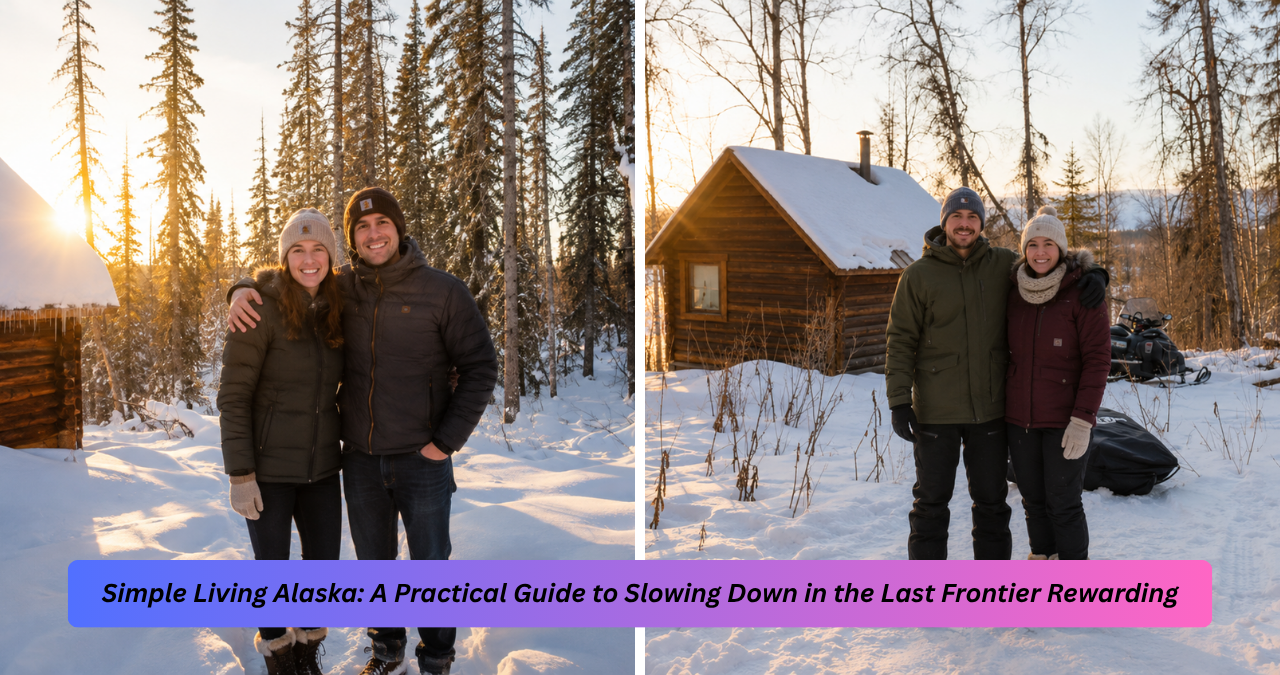
There’s a particular kind of daydream that shows up in a lot of people’s minds around the same time every year, usually somewhere between a stressful commute and a scroll through photos of snow-capped mountains: what if I just left it all behind for a cabin in Alaska? That daydream has a name, and it’s simple living Alaska, a lifestyle built around self-sufficiency, reduced consumption, and a much slower relationship with time than most of us are used to. It’s not a new idea. Alaskans have been practicing versions of this long before “minimalism” became a hashtag, but the way people pursue it today looks different than the homesteading era that shaped the state’s early reputation.
This guide is meant to walk through what simple living Alaska actually involves in practical terms, not just the romantic version you see in cabin-porn photography or reality television. We’ll cover the realities of off-grid infrastructure, the true cost of a pared-down Alaskan life, the communities where this lifestyle thrives, and the honest trade-offs that come with trading convenience for autonomy. If you’re seriously considering this path, or just curious about what draws people toward it, this article covers the ground you actually need before making any big decisions.
What Does Simple Living Alaska Actually Mean?
At its core, simple living Alaska refers to a deliberate lifestyle shift toward reduced consumption, increased self-sufficiency, and a closer relationship with the land, often but not always involving rural or off-grid living. It’s less about geography alone and more about intention. You can practice a simplified lifestyle in Anchorage with a smaller footprint, fewer possessions, and a garden, or you can go further out, building a cabin without grid power, hauling your own water, and heating with wood you cut yourself. Both fall under the same broad umbrella, but the further you move from established infrastructure, the more the lifestyle demands from you physically and logistically.
What sets Alaska apart from other states where simple living movements exist, like parts of rural Vermont or the Ozarks, is the sheer scale of remoteness available and the intensity of the seasons. Winter isn’t a mild inconvenience here; it’s a genuine test of preparation, and that reality shapes everything about how simple living Alaska is actually practiced. People who succeed at it tend to describe it less as an escape from modern life and more as a recalibration of what actually matters when survival tasks like heating, water, and food storage take up real time and attention every single day.
The Roots of Alaska’s Self-Sufficient Culture
Alaska’s relationship with independent, resourceful living didn’t start with modern minimalism trends. Indigenous peoples across the state, including the Iñupiat, Yupik, Athabascan, and Tlingit communities, developed sophisticated subsistence practices built around hunting, fishing, and seasonal food preservation long before European settlement, and much of that knowledge still informs rural Alaskan life today. Later waves of homesteaders arrived under federal land programs in the 20th century, drawn by the promise of carving out an independent life on undeveloped land, though it’s worth noting clearly that Alaska’s federal homesteading programs ended in the 1980s, so the idea of simply claiming free land today is more myth than reality.
This layered history matters because it shapes how simple living Alaska is understood by people who actually live it versus outsiders imagining it from a distance. Longtime residents often bristle a little at the romanticized cabin fantasy, not because it’s entirely wrong, but because it skips over generations of hard-earned, practical knowledge about surviving harsh winters, managing food scarcity, and building genuine community reliance in places where the nearest hospital might be a bush plane ride away. As one longtime Fairbanks-area homesteader put it, “People show up thinking it’s about escaping society, but out here you end up needing your neighbors more than you ever did in the city.” That single observation captures something a lot of newcomers underestimate.
Off-Grid Living: The Backbone of Simple Living Alaska
For a large portion of people pursuing simple living Alaska, off-grid infrastructure is the defining feature of the lifestyle. This typically means generating your own power through solar panels, wind turbines, or generators, sourcing water from wells, rainwater catchment, or nearby streams, and heating primarily with wood stoves rather than relying on utility-delivered gas or electricity. Solar setups have become increasingly popular even in a state known for long, dark winters, largely because Alaska’s summer days offer extraordinarily long sunlight hours that can help offset winter’s limited solar output when paired with battery storage and a backup generator.
The learning curve here is real, and it’s one of the most common reasons people underestimate what simple living Alaska requires before they commit. Managing a wood stove efficiently, for instance, isn’t just about
logs in and walking away; it involves understanding chimney maintenance, moisture content in firewood, and heat output relative to your cabin’s insulation. Water systems require similar diligence, since a frozen well line in January isn’t a minor inconvenience, it’s a genuine crisis that can take days to resolve in remote areas. People who thrive in this lifestyle tend to treat infrastructure knowledge as an ongoing skill set rather than a one-time setup, continually refining their systems based on what breaks, what freezes, and what actually works through an Alaskan winter.
The Real Cost of Simple Living in Alaska
There’s a persistent myth that simple living Alaska automatically means cheap living, and that’s only partially true. Land in remote areas can indeed be more affordable than urban real estate in the Lower 48, and property taxes in many rural boroughs are notably lower than in cities. However, the upfront costs of building off-grid infrastructure, solar arrays, generators, well drilling, insulated construction suited to extreme cold, often run higher than people expect, sometimes rivaling or exceeding the cost of a modest conventional home once everything is accounted for.
Beyond the initial investment, ongoing costs shift rather than disappear. Grocery prices in remote Alaskan communities can be significantly higher than the national average due to shipping costs, which is exactly why subsistence practices like hunting, fishing, and gardening remain such a central part of simple living Alaska rather than a
add-on. Heating fuel, whether wood, propane, or diesel for a generator, represents a substantial annual expense that needs realistic budgeting, particularly during a state where winter can stretch for six months or more depending on your location. The honest financial picture is one of trade-offs rather than automatic savings: you’re often exchanging a mortgage-and-utility-bill model of expense for a self-sufficiency-and-preparation model, and which one actually costs less depends heavily on your specific setup, location, and skill level.
Where People Practice Simple Living in Alaska
| Region | Lifestyle Style | Access to Amenities | Best Suited For |
|---|---|---|---|
| Matanuska-Susitna Valley | Semi-rural homesteading | Moderate, close to Anchorage | Families wanting land with services nearby |
| Fairbanks and interior | Off-grid and rural | Limited outside city center | Experienced homesteaders comfortable with extreme cold |
| Kenai Peninsula | Coastal self-sufficiency | Moderate, small towns nearby | Those combining fishing with garden-based living |
| Bush Alaska (remote villages) | Full subsistence living | Very limited, fly-in access | Highly experienced, community-integrated residents |
| Homer and surrounding areas | Artistic, low-consumption living | Good, small-town infrastructure | Creatives and retirees seeking a slower pace |
This regional breakdown matters because simple living Alaska isn’t a single uniform experience. The Matanuska-Susitna Valley, often just called the Mat-Su Valley, offers a gentler entry point for families who want more land and a simplified pace of life without cutting themselves off entirely from services like schools, grocery stores, and hospitals. By contrast, choosing full subsistence living in a remote bush village demands an entirely different level of preparation, community trust, and physical resilience, since supply runs might depend on weather-dependent bush planes rather than a quick drive to town.
Problem-Solving: Common Challenges and How Residents Adapt
Anyone researching simple living Alaska seriously needs to understand the specific problems this lifestyle creates and how experienced residents actually solve them, because glossing over the hard parts does a disservice to anyone considering the move. Isolation is one of the most immediate challenges, particularly during winter months when daylight hours shrink dramatically and travel becomes more difficult. The solution most successful simple-living Alaskans land on isn’t toughing it out alone, it’s deliberately building community ties, whether through local co-ops, church groups, or informal networks of neighbors who check in on each other during storms and cold snaps.
Food security presents another recurring problem, especially for households moving away from grocery-store dependency. The most sustainable solution tends to combine multiple food sources rather than
on just one: a root cellar or canning setup for preserved vegetables, hunting and fishing for protein, and careful seasonal planning around Alaska’s short but intense growing season, which actually benefits from nearly round-the-clock summer sunlight to produce surprisingly large yields in a compressed window. Mental health is a less discussed but
real challenge tied to seasonal affective patterns and extended isolation, and many longtime residents address this proactively through light therapy, scheduled social contact, and structured winter routines rather than waiting for the darker months to take a toll. Recognizing these challenges upfront, rather than discovering them the hard way, is really what separates people who sustain simple living Alaska long-term from those who try it for a season and retreat back to city life.
Balancing Modern Needs With a Simplified Lifestyle
It’s worth dispelling another common misconception: simple living Alaska doesn’t necessarily mean rejecting all modern technology or comfort. Plenty of people practicing this lifestyle use satellite internet, solar-powered appliances, and modern medical care while still maintaining the core principles of reduced consumption and self-sufficiency. The goal for most isn’t primitive living for its own sake, but rather intentional living, choosing which conveniences genuinely add value and which ones simply create noise, expense, or dependency without meaningfully improving quality of life.
This nuance matters because it makes the lifestyle far more accessible than the extreme off-grid stereotype suggests. A family practicing a simplified version of this lifestyle in the Mat-Su Valley might still have reliable internet and a part-time remote job, while growing a significant portion of their own food and heating primarily with wood. That’s still a legitimate expression of simple living Alaska, just one calibrated to a different risk tolerance and skill level than someone living entirely off-grid in the bush. Recognizing this spectrum helps people set realistic expectations rather than assuming it’s an all-or-nothing lifestyle choice.
Frequently Asked Questions About Simple Living in Alaska
Is it still possible to get free land for simple living in Alaska?
No, Alaska’s federal homesteading programs that once offered free land ended in the 1980s, so the popular idea of claiming free acreage today is outdated. Anyone pursuing simple living Alaska now needs to purchase land through standard real estate channels, though rural and remote properties can still be significantly more affordable than land near major cities like Anchorage.
How much does it cost to live off-grid in Alaska?
Costs vary widely depending on location and infrastructure choices, but building solar power systems, wells, and cold-weather-rated construction often requires a substantial upfront investment, sometimes comparable to or exceeding the cost of a conventional home. Ongoing expenses for simple living Alaska shift toward heating fuel, food preservation supplies, and equipment maintenance rather than disappearing entirely, so realistic budgeting is essential before committing to this lifestyle.
What is the biggest challenge of simple living in Alaska?
Winter isolation and the physical demands of maintaining off-grid infrastructure, such as wood heating and water systems, tend to be the biggest challenges people face. Successful practitioners of simple living Alaska typically address these challenges by building strong community connections and developing genuine hands-on skills before winter arrives, rather than learning everything reactively once the cold sets in.
Where in Alaska is best for someone new to simple living?
The Matanuska-Susitna Valley is often recommended for newcomers because it offers more land and a slower pace of life while remaining relatively close to Anchorage’s services, schools, and healthcare. This makes it a gentler entry point into simple living Alaska compared to fully remote bush communities, which demand significantly more self-sufficiency and experience.
Do you need farming or homesteading experience to try simple living in Alaska?
While prior experience helps considerably, many people successfully transition into simple living Alaska by starting small, learning gardening, food preservation, and basic maintenance skills gradually rather than attempting full self-sufficiency immediately. Connecting with local homesteading communities and mentors is one of the most effective ways to build practical knowledge without the steep, isolated learning curve that trips up a lot of newcomers.
Final Thoughts on Choosing Simple Living Alaska
Simple living Alaska isn’t a single lifestyle so much as a spectrum, ranging from a modestly simplified life in a Mat-Su Valley community to full subsistence living in a remote bush village accessible only by plane. What ties every version together is intentionality: a deliberate choice to prioritize self-sufficiency, reduced consumption, and a closer relationship with the land over convenience and speed. It’s a rewarding path for the right person, but it’s not a romantic escape from responsibility, it’s arguably a life with more responsibility, just distributed differently across heating, food, water, and community rather than a mortgage and a commute.
If you’re genuinely considering this path, the smartest first step isn’t buying remote land immediately, it’s spending real time in Alaska across different seasons, talking to people already living this way, and honestly assessing your tolerance for the physical and logistical demands involved. Simple living Alaska rewards preparation and humility far more than it rewards romantic idealism, and the people who thrive at it long-term are almost always the ones who took the time to learn the hard lessons before committing everything to the lifestyle.