There’s a specific kind of adrenaline that hits the moment you spawn into an open world survival game with nothing but your bare hands and a rumbling hunger meter. No quest markers pointing you toward safety. No tutorial holding your hand through the first night. Just you, a hostile landscape, and the slow, satisfying climb from “helpless wanderer” to “fortress-building overlord.” That tension between vulnerability and mastery is exactly why open world survival games have exploded from a niche genre into one of the most dominant categories in gaming today.
Whether you’re chopping your first tree in a forest that stretches to the horizon or fending off a pack of wolves as the sun dips below the tree line, these games tap into something primal. They’re not just entertainment; they’re systems of consequence, resource management, and emergent storytelling that reward patience, creativity, and grit. This guide breaks down everything worth knowing about the genre, from its core mechanics to the titles that define it, so you can find the right survival experience for your playstyle.
What Makes a Game an Open World Survival Game
At its core, an open world survival game combines two distinct design philosophies: unrestricted exploration and unforgiving resource management. The “open world” half means there’s no linear path forcing you through a scripted sequence of levels. Instead, you’re dropped into a persistent, often procedurally generated map that you’re free to explore in any direction, at any pace, using any strategy that appeals to you.
The “survival” half is what separates these titles from standard sandbox games. You’re typically managing hunger, thirst, temperature, stamina, and health simultaneously, all while gathering raw materials to craft tools, shelter, and weapons. A poorly timed decision, like wandering too far from base without enough food, can spiral into a genuine crisis. This is why veteran players often say the best open world survival games aren’t really about combat or building at all; they’re about risk assessment. Every trip outside your base is a calculated gamble between reward and exposure. <br>
“The magic of a good survival game is that the map doesn’t care about you,” one longtime Rust and DayZ player put it during a community interview. “It’s not designed around your convenience. You have to earn every inch of comfort.”
That quote captures the philosophical backbone of the genre. Unlike traditional RPGs that scale challenges to your level, open world survival games are indifferent to your progress. The storm doesn’t wait for you to finish building. The wolves don’t care that you just crafted your first spear. This indifference is precisely what generates such compelling, high-stakes gameplay loops.
The Core Mechanics That Define the Genre
Crafting is arguably the most universal mechanic across open world survival games, and it’s usually tiered in complexity. You start with basic tools like stone axes and crude shelters, then gradually unlock recipes for advanced items such as firearms, vehicles, or fortified structures. This progression system gives players a tangible sense of mastery over time, transforming a helpless newcomer into a self-sufficient survivor.
Environmental hazards form the second pillar. Depending on the title, you might be managing extreme cold in a title like The Long Dark, radiation zones in DayZ, or volcanic eruptions in Subnautica: Below Zero. These hazards aren’t just obstacles; they’re narrative devices that shape how a player experiences the world. A blizzard forces you to prioritize shelter over exploration. A radiation cloud might reroute your entire base-building strategy. Good survival design uses environmental storytelling to communicate danger without a single line of dialogue.
Multiplayer dynamics add another layer of unpredictability that single-player survival games simply can’t replicate. In titles like Rust or ARK: Survival Evolved, other players are as much a threat as the environment itself. You might spend three in-game days building a secure base only to have it raided while you’re out gathering resources. This player-versus-player tension has turned open world survival games into some of the most talked-about titles in the streaming and content creation space, since no two playthroughs ever unfold the same way.
Best Open World Survival Games by Playstyle
Choosing the right title depends heavily on what kind of experience you’re after. Some players want cooperative base-building with friends; others crave the tension of a solo, hostile wilderness. The table below breaks down some of the most respected entries in the genre by focus area.
| Game | Best For | Core Challenge | Multiplayer |
|---|---|---|---|
| Valheim | Cooperative Viking-style building | Boss progression, biome hazards | Yes, up to 10 players |
| The Long Dark | Solo narrative survival | Extreme cold, wildlife, starvation | No |
| Rust | Competitive PvP survival | Player raiding, resource scarcity | Yes, large servers |
| ARK: Survival Evolved | Creature taming and base defense | Dinosaur threats, tribe warfare | Yes |
| Subnautica | Underwater exploration horror | Oxygen management, deep-sea creatures | No |
| Green Hell | Realistic jungle survival | Disease, parasites, psychological stress | Optional co-op |
Each of these open world survival games approaches difficulty differently. Valheim leans into cooperative fun with forgiving death penalties, making it a great entry point for newcomers who want the genre’s core loop without punishing stakes. The Long Dark, by contrast, is a masterclass in atmospheric tension, where a single misstep in a snowstorm can end a hundred-hour save file. Understanding these differences before you commit to a title will save you from frustration and help you find a game that matches your tolerance for risk.
Why Open World Survival Games Have Become So Popular
Part of the genre’s rise ties directly to the streaming and content creation boom. Watching someone build an elaborate base or narrowly escape a raid creates natural, unscripted drama that’s inherently more compelling than scripted cutscenes. Twitch and YouTube are saturated with survival game content precisely because the genre generates authentic, unpredictable moments that keep audiences engaged episode after episode.
There’s also a psychological explanation rooted in autonomy and mastery, two of the core drivers behind long-term player retention according to game design research. Open world survival games hand players an enormous amount of agency. You decide your goals, your pace, and your priorities. This freedom, paired with visible skill progression, creates what psychologists call a “flow state,” where challenge and ability are perfectly balanced. It’s the same principle that makes crafting hobbies like woodworking or gardening so satisfying; you’re not following someone else’s instructions, you’re building something that’s genuinely yours.
Finally, the genre benefits from strong replayability. Procedural generation, seed-based world creation, and emergent multiplayer interactions mean that no two playthroughs are identical. A base that thrives on one server might fail spectacularly on another due to different neighbors, different resource spawns, or different environmental events. This unpredictability is a huge reason why open world survival games maintain such dedicated, long-term communities years after release.
Common Mistakes New Players Make
The most frequent problem–solution scenario in survival games involves overextending early. New players often venture too far from their starting base in search of rare resources, only to get caught by nightfall or a sudden weather shift with no shelter nearby. The solution is simple but often ignored: build a secure, well-stocked base before pushing exploration boundaries. Treat your first few in-game days as a foundation-building phase rather than a resource rush.
Another common pitfall is neglecting food and water management in favor of combat or building progress. Many open world survival games use a slow-burn hunger system that punishes neglect gradually rather than immediately, which lulls players into a false sense of security until they’re suddenly debuffed with reduced stamina or health regeneration. Prioritizing a stable food source, whether through farming, fishing, or hunting, early in your playthrough prevents this snowball effect from ever starting.
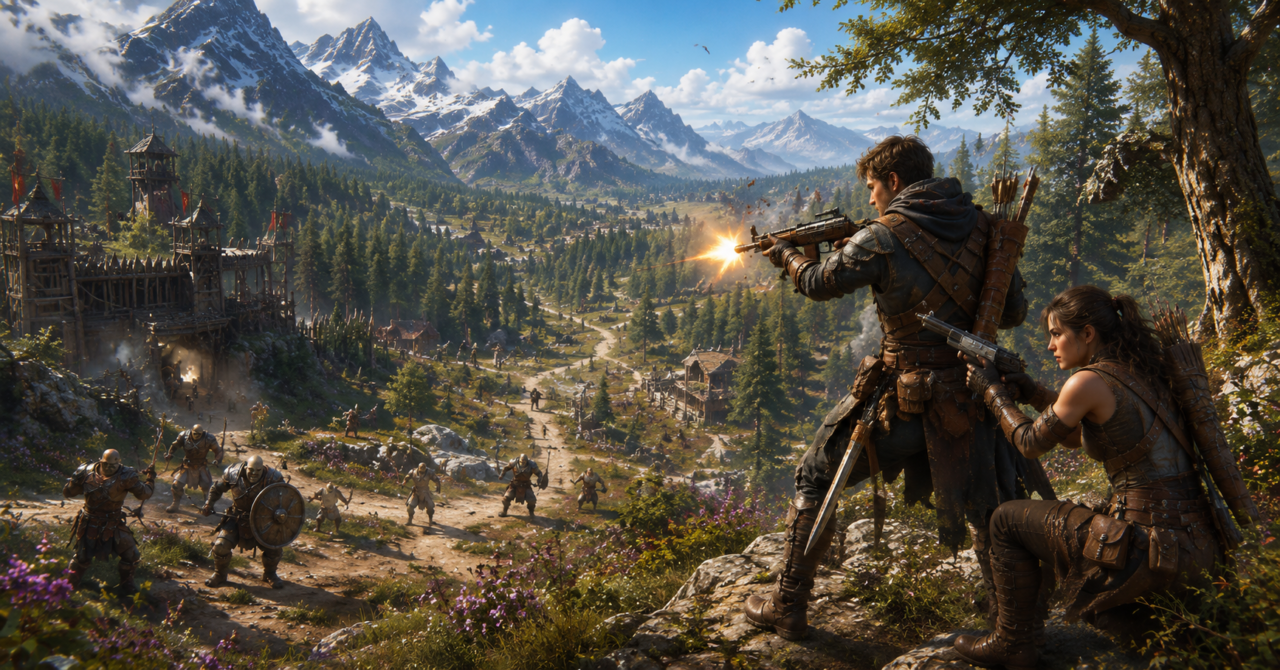
Underestimating multiplayer threats is a third mistake specific to PvP-focused titles like Rust. New players often assume distance or stealth is enough protection, but experienced raiders use tools like explosives, ladders, and coordinated timing to breach even remote bases. Building with defensive layers, decoy structures, and off-grid storage significantly reduces your risk in these more adversarial open world survival games.
Frequently Asked Questions
What is the difference between open world survival games and regular survival games?
Open world survival games give players complete freedom to explore a large, often seamless map without forced linear progression, while regular survival games may confine players to smaller, more curated environments with a set sequence of objectives. The open world format emphasizes emergent gameplay, meaning your experience is shaped by your own choices rather than a predetermined script, which is a major reason the genre feels so replayable.
Are open world survival games good for beginners?
Yes, though beginners should start with titles that have more forgiving mechanics, such as Valheim or Grounded, rather than punishing hardcore experiences like DayZ. Most open world survival games include difficulty settings or creative modes that let new players learn crafting, building, and resource systems without the constant threat of permanent failure, making the learning curve much more manageable.
Do open world survival games require an internet connection?
Not always. Many popular open world survival games, including The Long Dark, Subnautica, and Green Hell’s single-player mode, are fully playable offline. Multiplayer-focused titles like Rust and ARK: Survival Evolved do require a connection for their core social and PvP features, so it’s worth checking a game’s mode options before purchase if offline play matters to you.
What skills do open world survival games help develop?
Beyond entertainment value, these games reinforce practical problem-solving skills such as resource prioritization, risk assessment, and long-term planning. Players learn to manage limited resources under pressure, a skill set that mirrors real-world logistics and decision-making, which is part of why the genre appeals to such a broad audience beyond traditional gamers.
Which open world survival game has the best building system?
Valheim and ARK: Survival Evolved are widely regarded as having some of the most robust building systems in the genre, offering deep customization for structures, defensive layouts, and aesthetic design. Both titles allow for complex multi-tiered bases that can be tailored to specific biomes or defensive needs, giving players a genuine sense of ownership over their in-game creations.
Final Thoughts
Open world survival games occupy a unique space in gaming because they trust players with real freedom and real consequences in equal measure. There’s no safety net telling you exactly what to do next, and that absence of hand-holding is precisely what makes every successful base, every narrow escape, and every hard-won crafting recipe feel earned. Whether you gravitate toward the cooperative charm of Valheim, the punishing realism of The Long Dark, or the chaotic multiplayer tension of Rust, the genre offers something for nearly every kind of player willing to embrace uncertainty.
If you’re new to open world survival games, start small, prioritize your basic needs before ambition, and treat every failure as data rather than defeat. The genre rewards patience and observation far more than reflexes alone, and that’s exactly why it continues to attract millions of players who keep coming back, one hard-earned campfire at a time.