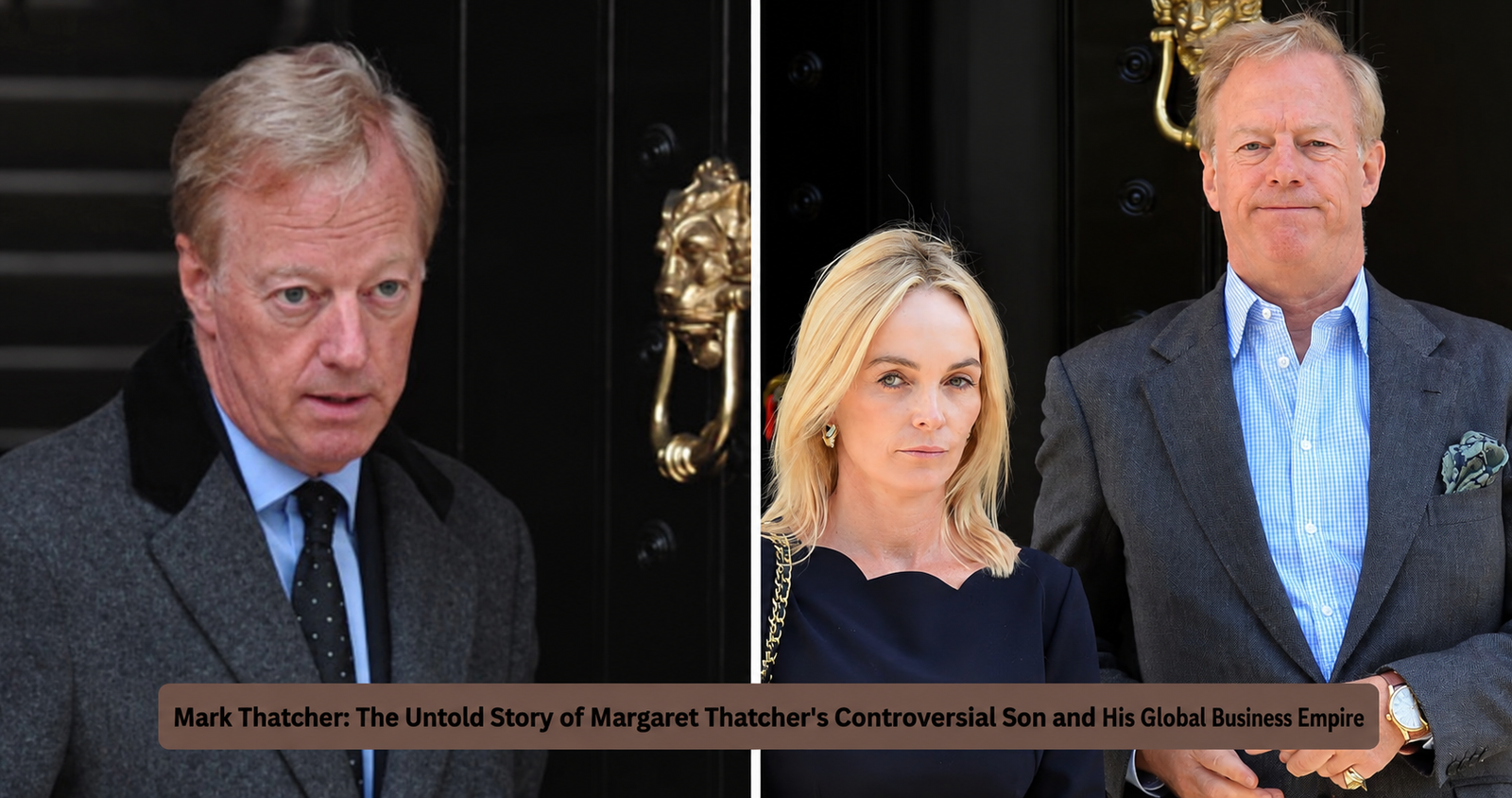
When people search for Mark Thatcher, they’re usually looking for more than a Wikipedia summary. They want to understand who this man actually is — beyond being “Margaret Thatcher’s son” — and why his name still surfaces in news archives, business circles, and true-crime discussions decades after his mother left Downing Street. Mark Thatcher’s life reads like a mix of privilege, ambition, and scandal, and untangling the real story requires looking past the headlines to the documented facts.
Born on August 15, 1953, in Hammersmith, London, Mark Thatcher is the twin brother of Carol Thatcher and the son of Margaret Thatcher, who served as UK Prime Minister from 1979 to 1990, and Sir Denis Thatcher. Educated at Harrow School, Mark Thatcher went on to build a business career that spanned continents, but it’s his entanglement with a failed coup attempt in Equatorial Guinea that cemented his place in modern political history. This article breaks down his early life, business dealings, legal troubles, and where he stands today, giving you a complete and accurate picture grounded in verified reporting.
Early Life and Family Background
Mark Thatcher grew up in a household that was, even before his mother’s political rise, comfortably upper-middle-class and deeply embedded in British Conservative circles. His father, Denis Thatcher, was a successful businessman in his own right, running an oil and chemical company, which gave young Mark an early exposure to boardrooms and commercial dealmaking. Growing up alongside his twin sister Carol, Mark Thatcher experienced a childhood shaped by expectation — the kind that comes with a surname destined for prominence, even before Margaret Thatcher became a household name.
His education at Harrow School, one of England’s most prestigious institutions, placed him among future business leaders and aristocrats, reinforcing the network effects that would follow him throughout his career. It’s worth noting that Mark Thatcher’s formative years occurred well before his mother’s premiership began in 1979, meaning his personality and early ambitions were shaped independently of the political spotlight that would later define public perception of him. Still, once Margaret Thatcher became Prime Minister, every business move her son made was scrutinized through the lens of nepotism and access — a dynamic that would follow Mark Thatcher for the rest of his professional life.
Mark Thatcher’s Business Career and the Al-Yamamah Controversy
Mark Thatcher’s entry into business coincided almost exactly with his mother’s rise to power, and critics were quick to draw connections. His name became closely associated with the Al-Yamamah arms deal, a massive arms sales agreement between the United Kingdom and Saudi Arabia. Reports at the time suggested that Mark Thatcher may have benefited financially from his mother’s political position, raising uncomfortable questions about where legitimate business ended and influence-peddling began. While no formal criminal charges were ever brought against him in relation to Al-Yamamah, the perception damage was significant and long-lasting.
This period illustrates a recurring theme in Mark Thatcher’s story: the difficulty of separating personal ambition from inherited advantage. Business analysts who’ve studied the case often point out that having a sitting Prime Minister as a parent creates opportunities that simply aren’t available to ordinary entrepreneurs — introductions happen faster, doors open more easily, and scrutiny, paradoxically, sometimes arrives too late to prevent deals from closing. By 2003, The Sunday Times estimated Mark Thatcher’s personal wealth at roughly £60 million, much of it reportedly held in offshore accounts — a detail that only intensified public curiosity about how, precisely, that fortune was built.
The 1982 Sahara Desert Incident
Long before the coup scandal, Mark Thatcher made headlines for a very different reason: getting lost in the Sahara Desert during the 1982 Paris-Dakar Rally. He vanished for six days while competing in the grueling off-road race, triggering a frantic, internationally covered search effort. As the son of the sitting British Prime Minister, his disappearance wasn’t just a personal crisis — it became a matter of national concern, with search planes and government resources mobilized to locate him.
The episode humanized Mark Thatcher in a way few other events in his life did. For six days, this wasn’t a story about privilege or political connections; it was about a mother worried for her son’s safety, played out in front of the entire world. When he was eventually found alive, the relief was genuine and widely reported. Looking back, this incident is often cited as one of the few moments where Mark Thatcher’s public image wasn’t shaped by controversy but by simple human vulnerability — a reminder that behind the business dealings and legal troubles was, ultimately, a person capable of real danger and real fear.
The Equatorial Guinea Coup Plot: What Actually Happened
The defining chapter of Mark Thatcher’s public life is undoubtedly his involvement in the failed 2004 coup attempt against Equatorial Guinea’s president, Teodoro Obiang Nguema. The plot allegedly involved a group of mostly British and South African financiers who intended to fund mercenaries to overthrow the government of the small, oil-rich West African nation. Mark Thatcher, who had been living in South Africa since the early 2000s, was arrested at his Cape Town home in August 2004 and charged with violating South Africa’s Regulation of Foreign Military Assistance Act.
At the time of his arrest, South African police spokesman Sipho Ngwema stated that authorities had “evidence, credible evidence, and information that he was involved in the attempted coup,” while also emphasizing the government’s stance that the country would not become a launching pad for African coups. Mark Thatcher’s defense centered on a helicopter he had chartered, which he admitted paying for but claimed he believed was intended for humanitarian use rather than military purposes. This distinction — knowing versus unknowing involvement — became the crux of the entire legal case.
In January 2005, Mark Thatcher pleaded guilty to unwittingly financing the coup attempt, accepting a fine of $506,000 and a four-year suspended prison sentence. The plea deal allowed him to avoid jail time and eventually leave South Africa to rejoin his family in the United States, though visa complications initially delayed that reunion. A spokesman for Lady Thatcher’s office in London captured the family’s relief at the time, noting that she was “very relieved that matters have now been settled and that the worry of these last few months is now over.” The case remains one of the most scrutinized examples of Western financiers allegedly meddling in African politics, and Mark Thatcher’s name is inseparable from that narrative.
Table: Key Events in Mark Thatcher’s Life
| Year | Event | Outcome |
|---|---|---|
| 1953 | Born in Hammersmith, London | Twin brother to Carol Thatcher |
| 1982 | Lost in the Sahara during Paris-Dakar Rally | Found alive after six-day search |
| 1980s | Linked to Al-Yamamah arms deal controversy | No formal charges, but reputational damage |
| 1986 | Left the United Kingdom | Began living across multiple countries |
| 2004 | Arrested in Cape Town for coup plot financing | Charged under Foreign Military Assistance Act |
| 2005 | Pleaded guilty to unwittingly funding the coup | $506,000 fine, suspended prison sentence |
| 2008 | Married Sarah-Jane Russell | Second marriage |
Life After the Scandal: Where Mark Thatcher Lives Now
Since the coup plot conviction, Mark Thatcher has largely retreated from public life, though he remains a figure of periodic media interest. He has lived across an unusually wide range of countries over the decades, including Switzerland, Monaco, South Africa, Gibraltar, Barbados, Guernsey, and Spain — a pattern that reflects both his business interests and, some observers suggest, a preference for jurisdictions with favorable tax arrangements. This nomadic lifestyle has made it difficult for journalists to pin down a single “home base” for Mark Thatcher, which has only added to his mystique.
Personally, Mark Thatcher’s life has also included two marriages. His first, to Diane Burgdorf in 1987, produced two children, Michael and Amanda, before ending in divorce. He remarried in 2008 to Sarah-Jane Russell. Michael Thatcher, as the eldest son, stands as heir apparent to the baronetcy that Mark Thatcher inherited — Sir Mark Thatcher, 2nd Baronet — following his father Denis Thatcher’s death in 2003. This inherited title underscores an important point: whatever controversies have followed him, Mark Thatcher remains formally tied to a lineage of British aristocratic tradition that predates and will outlast the scandals themselves.
Public Perception and Legacy
Public opinion on Mark Thatcher tends to split along fairly predictable lines. Critics view him as the archetypal example of nepotism gone unchecked — someone who leveraged his mother’s political capital for personal enrichment and, in the coup plot case, arguably crossed serious ethical and legal boundaries in the pursuit of profit. Defenders, meanwhile, point to the fact that he was never convicted of the Al-Yamamah allegations and that his coup plot conviction specifically found him guilty of unwitting rather than deliberate involvement — a meaningful legal distinction that’s often lost in casual retellings of his story.
What’s undeniable is that Mark Thatcher‘s name has become something of a case study in political science and journalism courses examining the intersection of family power, business ethics, and accountability. His story offers a real-world example of how the children of powerful political figures can find themselves operating in a gray zone — benefiting from access and connections that were never formally granted but were nonetheless available simply by virtue of birth. For students of governance and ethics, Mark Thatcher’s trajectory remains a frequently cited reference point precisely because it’s so well documented across multiple jurisdictions and legal systems.
Frequently Asked Questions
Who is Mark Thatcher?
Mark Thatcher is a British businessman, born on August 15, 1953, and the son of former UK Prime Minister Margaret Thatcher and Sir Denis Thatcher. He is best known both for his controversial business career and for his 2005 guilty plea related to financing a failed coup attempt in Equatorial Guinea.
Is Mark Thatcher Margaret Thatcher’s son?
Yes, Mark Thatcher is one of Margaret Thatcher’s two children, along with his twin sister Carol Thatcher. He was born just minutes before Carol, making him the elder twin, and their relationship with their famous mother has been the subject of extensive biographical and journalistic coverage over the decades.
What happened with Mark Thatcher and the coup plot?
In 2004, Mark Thatcher was arrested in Cape Town, South Africa, and charged with helping finance a failed coup attempt against the government of Equatorial Guinea. He pleaded guilty in 2005 to unwittingly funding the plot, primarily through chartering a helicopter, and received a $506,000 fine along with a four-year suspended prison sentence rather than active jail time.
Where does Mark Thatcher live today?
Mark Thatcher has lived in numerous countries over the years, including South Africa, Switzerland, Monaco, Spain, Gibraltar, Barbados, and Guernsey. He left the United Kingdom in 1986 and has not maintained a permanent, publicly disclosed residence in Britain since, instead moving between jurisdictions largely tied to his business and personal circumstances.
Is Mark Thatcher still a baronet?
Yes, Mark Thatcher holds the title of Sir Mark Thatcher, 2nd Baronet, which he inherited following the death of his father, Sir Denis Thatcher, in 2003. The title will eventually pass to his son, Michael Thatcher, who is currently recognized as the heir apparent to the baronetcy.
Final Thoughts on Mark Thatcher’s Legacy
Mark Thatcher’s story is far more layered than the simple label of “the Prime Minister’s son” suggests. From a dramatic six-day disappearance in the Sahara to allegations of profiting from his mother’s political influence, and ultimately to a guilty plea in one of the most notorious coup plots of the early 2000s, his life illustrates just how complicated legacy and accountability can become when political power and private enterprise intersect. Mark Thatcher’s journey through multiple countries, marriages, and legal battles paints the picture of a man who has spent much of his life navigating the consequences — and privileges — of an extraordinary surname.
Ultimately, understanding Mark Thatcher means understanding a broader story about power, family, and the blurred lines that can exist between the two. Whatever judgment history ultimately renders, his name will remain permanently linked to one of the most talked-about political scandals of the twenty-first century, and his story continues to serve as a cautionary reference point for anyone examining the risks that come with mixing family influence and international business.