There’s a particular kind of tiredness that comes from staring at screens, answering messages, and moving through a day that never really slows down. A lot of people describe it as feeling “full but empty” — busy, productive, and somehow still disconnected from anything that feels like theirs. This is usually the moment someone starts searching for creative hobbies, not because they want another task on their to-do list, but because they’re craving something that feels like play again.
Creative hobbies aren’t just a trend pushed by wellness influencers or a way to fill idle weekends. They’re one of the most well-documented, low-cost interventions for mental clarity, emotional regulation, and long-term life satisfaction. Psychologists have studied this for decades, occupational therapists prescribe it, and neuroscientists have mapped what happens in the brain when someone paints, writes, or builds something with their hands. This article walks through what creative hobbies actually are, why they matter more than most people realize, how to choose one that fits your life, and how to keep it going once the initial excitement fades.
What Counts as a Creative Hobby (And Why the Definition Matters)
A creative hobby is any voluntary, non-professional activity that involves generating something original — an idea, an object, a piece of music, a story, a visual design — rather than simply consuming content that someone else made. This distinction matters because scrolling through Pinterest boards or watching painting tutorials on YouTube isn’t the same as picking up a brush yourself. Passive engagement with creativity can be enjoyable, but it doesn’t produce the same psychological or cognitive benefits as active creation.
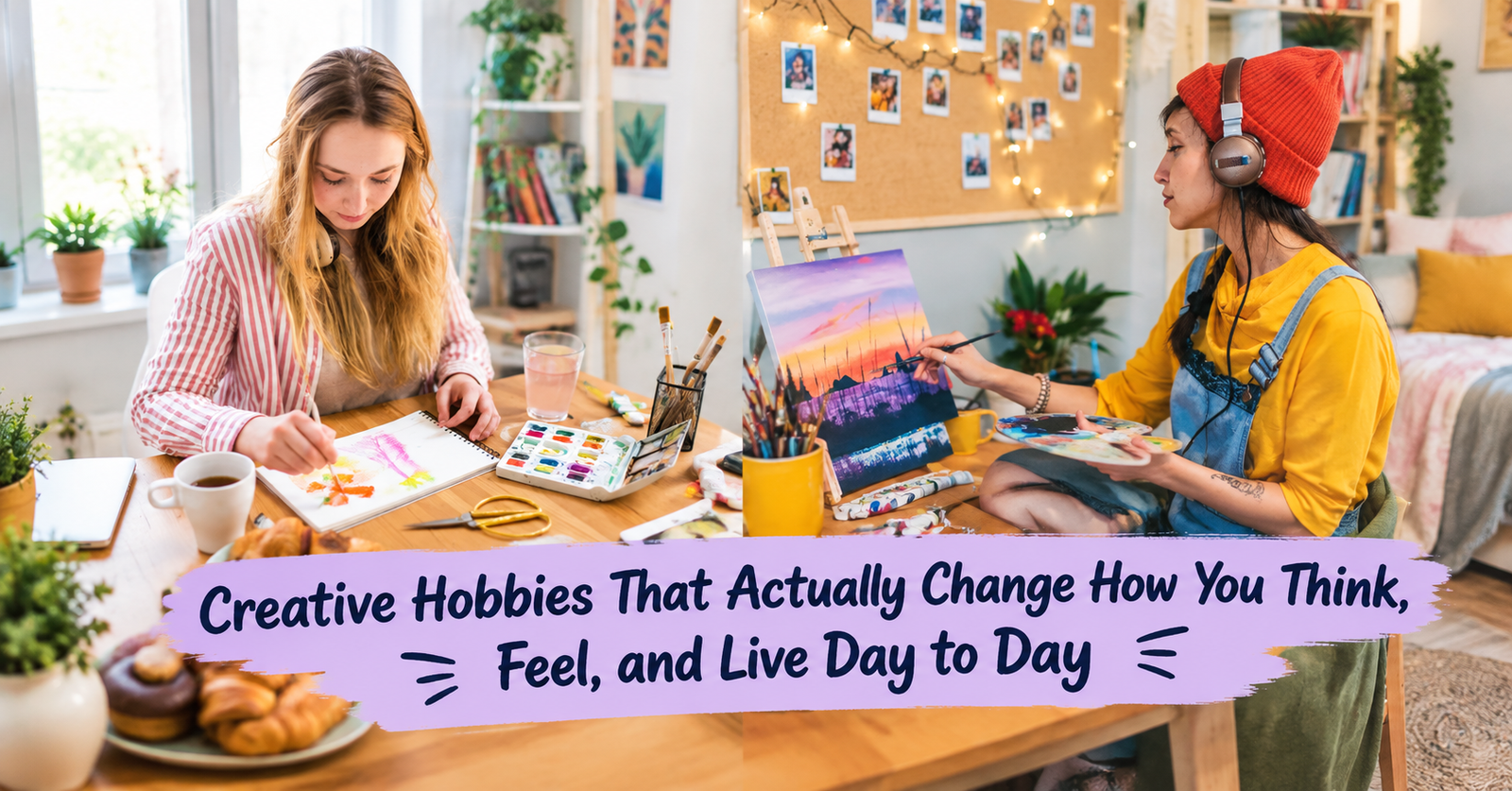
The category is broader than most people assume. Creative hobbies include the obvious ones — painting, drawing, pottery, knitting, photography — but they also include things people rarely label as “creative” at all: cooking without a recipe, rearranging furniture, gardening with an eye for design, journaling, woodworking, coding a personal project, or even building elaborate spreadsheets for fun. Occupational therapist and hobby researcher Dr. Girija Kaimal, whose work at Drexel University focuses on art-making and stress, has noted that “the medium matters far less than the act of making decisions and seeing them
take physical form.” That’s a useful lens: if you’re making choices and producing something that didn’t exist before, you’re engaging in a creative hobby, regardless of whether it looks like “art” in the traditional sense.
Why Creative Hobbies Matter More Than Most People Realize
The most immediate benefit of creative hobbies is stress reduction, and this isn’t just anecdotal. A widely cited 2016 study published in Art Therapy found that 45 minutes of art-making significantly lowered cortisol levels in participants, regardless of prior artistic experience or skill level. What’s notable is that the effect held even for people who described themselves as “not artistic,” which suggests the benefit comes from the process itself, not from producing something polished or Instagram-worthy.
Beyond stress relief, creative hobbies build something psychologists call “flow” — a state of deep absorption where time distorts and self-consciousness fades. Flow states are strongly associated with life satisfaction, and creative
are one of the most reliable ways to access them because they combine clear goals, immediate feedback, and a manageable level of challenge. Think of the difference between mindlessly watching television and getting lost in an hour of pottery on a wheel — one leaves you the same as you started, the other tends to leave you calmer and slightly more energized, even though both are technically “relaxing.” There’s also a social dimension worth mentioning: creative hobbies often become entry points into communities — knitting circles, writing groups, maker spaces — that provide connection without the pressure of small talk, since the shared activity does most of the social work.
Choosing the Right Creative Hobby for Your Personality and Lifestyle
One of the biggest reasons people abandon creative hobbies within the first few weeks is mismatch — they pick something because it looks appealing online, not because it actually fits how they think or live. Someone who craves structure and clear rules might feel frustrated by the open-endedness of abstract painting, while someone who thrives on spontaneity might feel stifled by cross-stitch patterns that demand precision. The first step in choosing well is being honest about your own temperament rather than chasing what looks aesthetically pleasing on social media.
A useful way to sort options is by the kind of engagement they demand: some creative hobbies are meditative and repetitive (knitting, calligraphy, embroidery), some are exploratory and messy (collage, freehand painting, improvisational music), and some are technical and puzzle-like (woodworking, coding, photography editing). People under chronic stress often do better starting with meditative hobbies because the repetition itself is calming, while people feeling creatively stuck or bored often respond better to exploratory hobbies that reward experimentation. Below is a quick comparison to help narrow things down.
| Hobby Type | Best For | Startup Cost | Time to First “Win” |
|---|---|---|---|
| Meditative (knitting, calligraphy) | Stress relief, anxious minds | Low | 1–2 sessions |
| Exploratory (painting, collage) | Creative burnout, boredom | Low–Medium | Immediate |
| Technical (woodworking, coding) | Problem-solvers, engineers | Medium–High | 2–4 weeks |
| Performance-based (music, dance) | Extroverts, emotional expression | Medium | Weeks to months |
| Culinary (baking, cooking) | Sensory learners, families | Low | Same day |
This table isn’t exhaustive, but it illustrates a pattern worth internalizing: the “right” creative hobby has less to do with talent and more to do with matching the activity’s rhythm to your nervous system’s current needs.
The Cognitive Science Behind Creative Hobbies
Neuroscience research has shown that engaging in creative hobbies activates the default mode network — the same brain network involved in daydreaming, self-reflection, and long-term memory consolidation. This is part of why so many people report having their best ideas while doing something unrelated, like gardening or doodling, rather than while actively trying to problem-solve at a desk. The brain uses this “background processing” time to make connections that focused, goal-directed thinking tends to suppress.
There’s also a strong case for creative hobbies as a form of cognitive cross-training. Learning to play an instrument, for instance, engages motor coordination, auditory processing, and pattern recognition simultaneously, which is part of why musicians often show enhanced executive function even outside of musical tasks. Similarly, hobbies like drawing or photography sharpen visual-spatial reasoning, a skill that transfers into everyday tasks like reading maps, packing a car efficiently, or even understanding data visualizations at work. As cognitive psychologist Dr. Rex Jung, known for his
on creativity and brain networks, put it in one interview, “creativity isn’t a separate mental faculty — it’s what happens when ordinary cognitive processes are allowed to interact more freely.” Creative hobbies, in this sense, aren’t a break from thinking; they’re a different, looser mode of thinking.

Common Obstacles That Stop People From Sticking With Creative Hobbies
The most common obstacle isn’t lack of time — it’s perfectionism disguised as “not being good enough yet.” People pick up a sketchbook, produce something that looks nothing like the reference photo, and quietly decide they’re “just not creative,” when in reality skill development in any creative hobby follows a slow, nonlinear curve that has nothing to do with innate talent. This is where the problem-solution framing matters: the problem is an unrealistic expectation of instant competence, and the solution is deliberately lowering the stakes — setting a rule like “this is just for practice, no one has to see it” — until the fear of judgment loses its grip.
A second major obstacle is the “hobby graveyard” effect, where enthusiasm spikes during the first week of a new creative hobby (often fueled by buying supplies) and then collapses once the novelty wears off. The fix here isn’t willpower — it’s environmental design. People who stick with creative hobbies long-term almost always report keeping materials visible and accessible rather than packed away, and scheduling short, low-pressure sessions rather than waiting for a large block of “inspired” free time. A knitting basket left by the couch gets used far more often than yarn stored in a closet. This kind of
reduction is a well-known behavioral principle, and it applies just as much to creative hobbies as it does to exercise or healthy eating habits.
How Creative Hobbies Support Mental Health and Emotional Regulation
Art therapists have long used creative expression as a clinical tool precisely because it offers a way to process emotions that resist direct verbal articulation. Someone struggling with grief, for example, might find it easier to express complicated, contradictory feelings through color and form than through a conversation, simply because creative work doesn’t require the emotion to be resolved or explained — it just needs to be externalized. This is part of why creative hobbies are increasingly integrated into trauma-informed care, workplace wellness programs, and even hospital settings for patients managing chronic illness.
It’s worth being precise here: creative hobbies are not a replacement for therapy or medical treatment, and framing them that way does a disservice to people dealing with serious mental health conditions. What they do offer is a consistent, accessible outlet for emotional regulation that complements clinical support. A therapist might describe this as “affect labeling through a nonverbal channel,” but in plain terms, it’s simply having somewhere to put feelings that don’t have words yet. This is one reason journaling, visual art, and music-making show up so consistently in mental health research — they give the nervous system a way to process without requiring cognitive translation first.
Building Creative Hobbies Into a Busy, Modern Life
Most people don’t lack the desire for creative hobbies — they lack a realistic plan for fitting them into a schedule already stretched thin by work, caregiving, and basic life admin. The most sustainable approach tends to involve “micro-sessions”: fifteen to twenty minutes of focused creative work, done consistently, rather than waiting for a mythical free afternoon that rarely materializes. A watercolor sketch during a lunch break or ten minutes of guitar practice before bed adds up over months in a way that occasional weekend binges never quite match, because consistency builds skill and skill builds motivation, creating a positive feedback loop.
It also helps to attach creative hobbies to existing routines rather than treating them as one more item competing for willpower. Someone who already has a habit of drinking coffee every morning might keep a sketchbook next to the coffee maker; someone who already unwinds with a podcast might use that time to knit or doodle instead of scrolling a phone. This concept, sometimes called “habit stacking,” works particularly well for creative hobbies because it removes the decision fatigue of figuring out when to start. The goal isn’t to become a professional artist, musician, or craftsperson — it’s to make room for a small, recurring pocket of the day that belongs entirely to exploration rather than output.
Creative Hobbies for Different Life Stages
The role of creative hobbies shifts depending on where someone is in life, and recognizing this helps prevent the frustration of comparing your current hobby practice to an unrealistic ideal. For students and young adults, creative hobbies often function as identity exploration — a low-stakes way to figure out what kind of person you’re becoming outside of academic or career pressure. For parents of young children, creative hobbies frequently need to be flexible and interruptible, which is why activities like sketching, hand-lettering, or simple embroidery tend to fit better than something requiring long uninterrupted stretches, like pottery on a wheel.
For retirees and older adults, creative hobbies take on a different but equally important role: maintaining cognitive engagement, fine motor skills, and social connection after the structure of a career disappears. Research on aging populations consistently links sustained engagement in creative hobbies — painting classes, community choirs, woodworking clubs — to slower cognitive decline and lower rates of reported loneliness. Across every life stage, the throughline is the same: creative hobbies aren’t a luxury reserved for people with abundant free time; they’re a tool that adapts to whatever constraints a given season of life imposes.
Getting Started Without Overthinking It
The single biggest barrier to starting creative hobbies is the belief that you need the right equipment, training, or talent before you’re “allowed” to begin. In reality, nearly every creative hobby has a near-zero-cost entry point: a pencil and blank paper for drawing, a phone camera for photography, a free app like GarageBand for music production, scrap fabric for sewing. The goal in the first few weeks isn’t quality — it’s simply building the habit of showing up to the activity regularly enough that it starts to feel familiar rather than intimidating.
A practical starting approach is choosing one creative hobby, committing to it for thirty days with no expectation of skill improvement, and then evaluating how it felt rather than how the output looked. This removes the pressure of long-term commitment while still giving the hobby enough time to reveal whether it genuinely fits. Some people discover within a week that a hobby isn’t for them, and that’s useful information, not failure — creative hobbies work best when chosen through experimentation rather than forced through obligation.
Frequently Asked Questions
What are the best creative hobbies for beginners with no experience?
Beginners generally do best starting with creative hobbies that have a low barrier to entry and forgiving materials, such as sketching with pencil and paper, journaling, basic photography using a smartphone, or simple knitting projects like scarves. These hobbies allow for visible progress within the first few sessions, which helps build motivation before moving on to more technically demanding pursuits like oil painting or woodworking.
How much time do I need to dedicate to creative hobbies to see benefits?
Research on stress reduction through art-making suggests that even short sessions of fifteen to forty-five minutes, done consistently, produce measurable benefits in mood and cortisol levels. The key factor isn’t the length of any single session but the regularity of practice, so someone doing twenty minutes several times a week will typically see more benefit than someone doing one long session a month.
Can creative hobbies help with anxiety and stress specifically?
Yes, creative hobbies are widely used as a stress-management tool because activities like drawing, knitting, and music-making engage the parts of the brain involved in focus and sensory processing, which naturally competes with the rumination that fuels anxiety. While creative hobbies aren’t a substitute for professional treatment when anxiety is clinically significant, they’re a well-supported complementary practice that many therapists actively recommend to clients.
Do I need talent to benefit from creative hobbies?
No, and this is one of the most persistent misconceptions people have about creative hobbies. The psychological and cognitive benefits of creative hobbies — stress relief, improved focus, emotional processing — come from the act of creating itself, not from the technical quality of the final result, which means a beginner doodling in a notebook gets many of the same benefits as a trained illustrator.
How do I stay consistent with a creative hobby instead of losing interest?
Consistency with creative hobbies improves dramatically when the activity is made convenient and low-pressure, such as keeping materials visible rather than stored away, scheduling short sessions instead of waiting for large blocks of free time, and attaching the hobby to an existing daily habit. Removing the expectation of producing “good” work also helps, since perfectionism is one of the most common reasons people abandon creative hobbies within the first month.
Final Thoughts on Making Creative Hobbies Part of Your Life
Creative hobbies aren’t about becoming an artist, a musician, or a craftsperson in any formal sense — they’re about reclaiming a small, recurring space in your life where the goal is exploration rather than output. Whether that shows up as fifteen minutes of sketching before bed, a Sunday afternoon spent at a pottery wheel, or a shared knitting project with friends, the value comes from consistent, low-pressure engagement rather than talent or perfect results. The research is clear, the clinical applications are well established, and the everyday experience of anyone who has stuck with a hobby for more than a few weeks tends to confirm the same thing: creative hobbies change how you relate to your own time.
If there’s one takeaway worth carrying forward, it’s this — the best creative hobby isn’t the most impressive one, it’s the one you’ll actually return to next week. Start small, remove the pressure to be good at it, and let the habit build itself around your real life rather than an idealized version of it.