
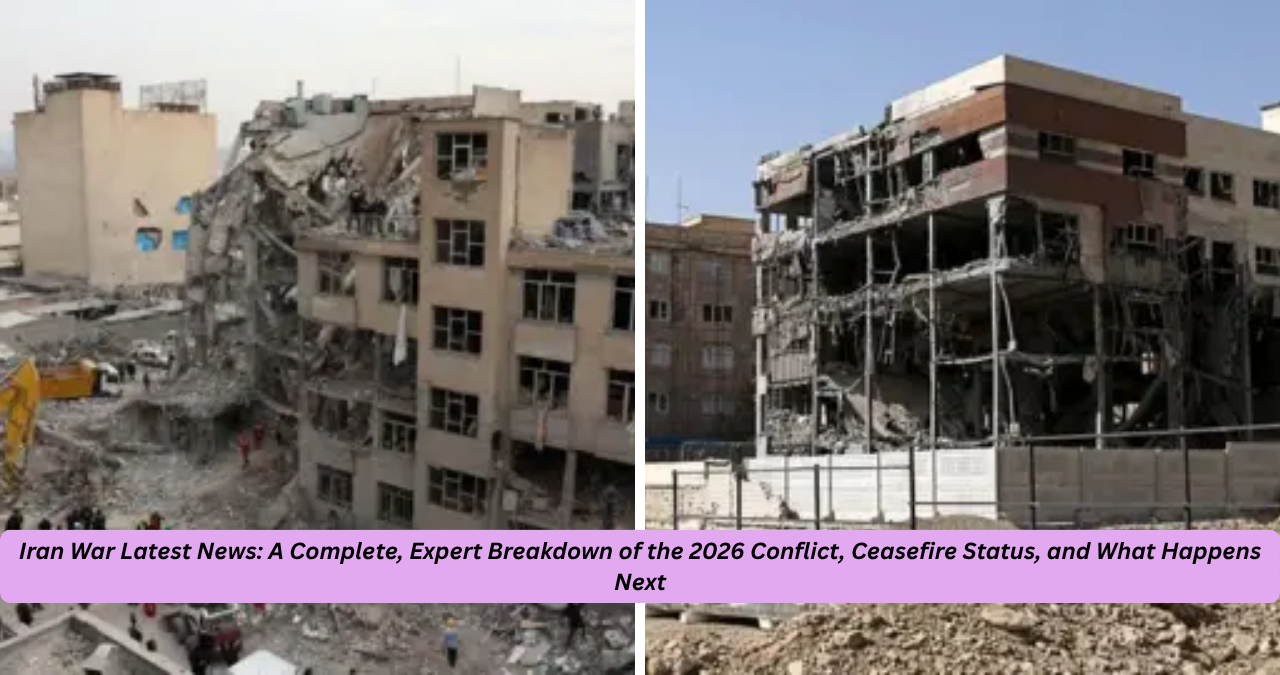
If you’ve been trying to keep up with the Iran war latest news, you already know how exhausting it can feel. One day there’s a ceasefire announcement, the next there’s a missile strike on a tanker in the Gulf, and by the following morning the entire narrative has shifted again. This isn’t a slow-burning diplomatic standoff — it’s one of the most consequential and fast-moving conflicts the Middle East has seen since the early 2000s, and it’s reshaping everything from oil prices to global shipping routes in real time.
I’ve spent a lot of time tracking this story day by day, cross-referencing military updates, government briefings, and on-the-ground reporting, because the headlines alone rarely tell the full picture. What follows is a grounded, no-fluff explainer that pulls together the origin of the war, where things stand today, and the factors that will determine whether this conflict cools down or escalates further. Whether you’re searching for context because of travel plans, market exposure, or simple curiosity about global affairs, this guide is built to give you the real substance behind the headlines.
How the 2026 Iran War Actually Started
To understand any Iran war latest news update, you need to understand the trigger point. The conflict began on February 28, 2026, when the United States and Israel launched a coordinated, large-scale military campaign against Iran — the U.S. side referred to it internally as Operation Epic Fury, while Israel called its portion Operation Roaring Lion. Iran’s counter-campaign was labeled Operation True Promise IV. Within the first twelve hours alone, allied forces reportedly carried out close to 900 strikes, an opening tempo that analysts compared to the shock-and-awe campaigns of previous Middle East conflicts.
The stated justification from Washington and Jerusalem centered on Iran’s nuclear program and its ballistic missile development, which both governments framed as an unacceptable and rapidly closing window of strategic ris
k. Officials described the campaign as preemptive self-defense, arguing that years of diplomacy had failed to produce a durable check on Iran’s enrichment activities. Iran and its allies, unsurprisingly, characterized the strikes very differently — as an act of aggression timed to exploit domestic unrest, since the country had just experienced some of its largest protests in decades amid a weakened economy and crumbling infrastructure. Both framings matter if you’re trying to understand the geopolitics driving today’s Iran war latest news cycle, because each side’s narrative continues to shape diplomatic positioning months later.
What made the opening strike particularly dramatic — and what instantly separated this conflict from prior skirmishes — was the targeting of Iran’s top leadership. Supreme Leader Ali Khamenei was killed in the initial wave of strikes, along with several senior officials and family members who were reportedly meeting at his residential compound at the time. Iran’s Supreme National Security Council moved quickly to consolidate power under a new leadership structure, with Mojtaba Khamenei eventually emerging as his father’s successor. That leadership vacuum, and the hardline consolidation that followed, has continued to influence Iran’s decision-making throughout the months since.
Timeline: From First Strikes to Today’s Iran War Latest News
Tracking the sequence of events helps make sense of why this story refuses to stay static. After the February 28 opening salvo, Iran responded with waves of retaliatory missile and drone attacks against Israeli cities, U.S. military installations across the Gulf, and infrastructure in neighboring Arab states hosting American forces — including reported strikes in Bahrain, Qatar, Kuwait, the UAE, Jordan, and Saudi Arabia. Israeli airspace was closed for days, Ben Gurion Airport suspended operations, and hundreds of thousands of civilians, foreign nationals, and diplomatic staff were caught up in emergency evacuations across the region.
A conditional ceasefire was declared on April 8, 2026, and the active combat phase of Operation Epic Fury was generally considered to have concluded by May 5. That pause, however, was never a full resolution. In June 2026, a memorandum of understanding was reached that aimed to reopen the Strait of Hormuz and formally wind the conflict down — but Iran subsequently tried to assert control over shipping through the strait, demanding vessels use pre-approved routes and, in some interpretations, attempting to collect transit fees. When Iranian forces fired on multiple commercial vessels on July 6 and 7, the fragile understanding began to unravel, and it has been fraying further ever since.
By late August and into September 2026, the Iran war latest news cycle shifted back toward active hostilities. U.S. officials confirmed strikes against an Iranian tanker near Kharg Island, described continued naval tension in the Gulf, and reported that Iran launched missile and drone attacks against Ahmed al-Jaber Air Base in Kuwait and Al Minhad Air Base in the UAE. President Trump publicly stated that any Iranian retaliation would be met with a harder response, and U.S.
floated the possibility of additional strikes on hardened Iranian sites, including a location referred to by U.S. officials as “Pickaxe Mountain.” As of early September, the conflict remains unresolved, with both sides signaling they’re prepared for further escalation rather than a durable peace.
Current Status: What’s Actually Happening on the Ground
If you only take away one thing from this Iran war latest news roundup, it should be this: the conflict has entered a cyclical pattern of strike, retaliation, and temporary de-escalation rather than moving toward a clean resolution. In the first week of September 2026 alone, reporting described U.S. missile strikes on Iranian tankers and a telecommunications tower near Minab, explosions reported near Kharg Island, and Tehran publicly condemning American attacks on oil tankers while vowing to respond. The U.S. has said it is ruling out renewed talks with Iran until attacks on shipping stop, which effectively locks both sides into an escalation posture rather than a negotiating one.
Economically, the ripple effects have been significant. Brent crude has hovered in territory near $95 a barrel amid the uncertainty, and there have been symbolic moments too — including President Trump floating the idea of renaming the Strait of Hormuz. Iran’s currency has also taken a historic hit, with reports of the rial trading at roughly 2.2 million to the U.S. dollar, a level that reflects just how much economic strain the war has placed on ordinary Iranians. On the ground, humanitarian and infrastructure damage has been substantial, and verifying exact casualty figures remains genuinely difficult given restricted internet access and limited independent media presence inside Iran.
A defense analyst tracking the conflict for a U.S. policy institute summarized the dynamic well, noting that Iran’s retaliatory strategy appears designed to “exact costs and pressure adversaries into mediation” rather than achieve outright military victory — a framing that helps explain why Iran keeps striking U.S.-linked targets in the Gulf even while clearly outmatched militarily. That single dynamic — asymmetric retaliation aimed at forcing negotiation — is probably the most useful lens for interpreting each new headline in the Iran war latest news feed.
The Strait of Hormuz: Why It’s the Center of Everything
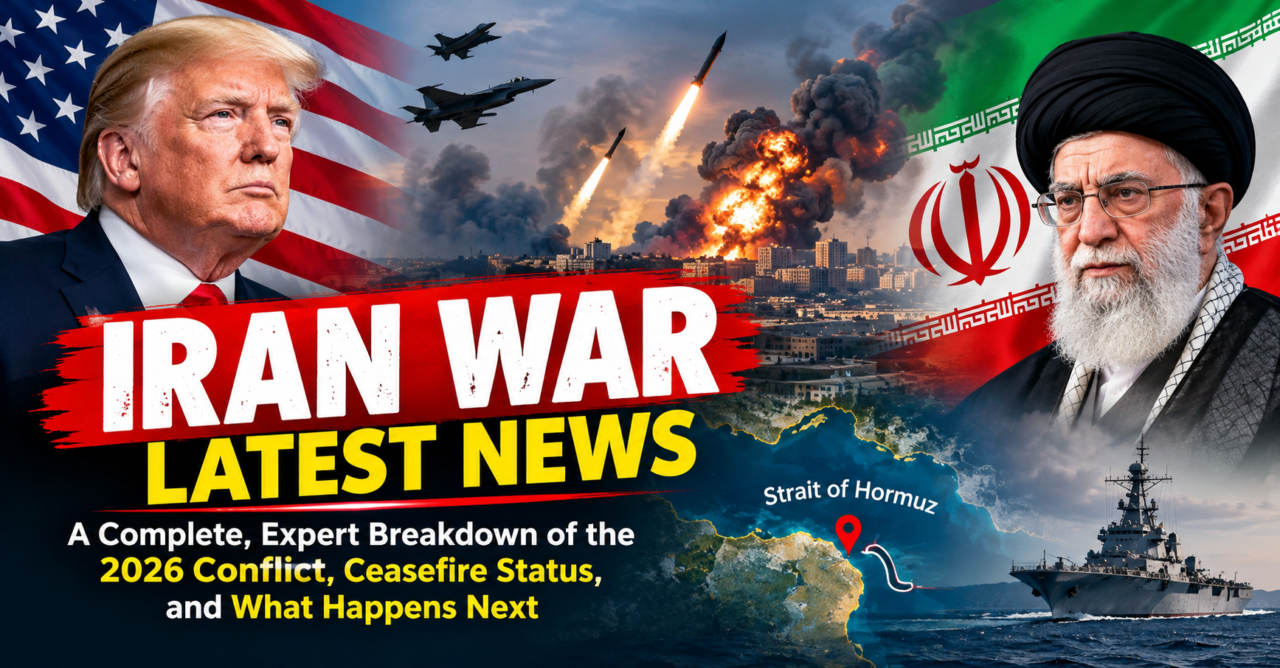
No explainer on this conflict is complete without a deep dive into the Strait of Hormuz, because it’s arguably the single most important chokepoint driving both the military and economic dimensions of the war. Roughly a fifth of the world’s oil supply transits through this narrow waterway between Iran and Oman, which means any disruption there sends immediate shockwaves through global energy markets. Iran has repeatedly used the strait as leverage — threatening commercial shipping, attempting to enforce its own transit protocols, and in some cases directly firing on vessels that didn’t comply.
Think of the strait almost like a tollbooth on a highway that half the world’s cars need to use to get to work. If the tollbooth operator suddenly starts making unpredictable demands — different rules every week, unannounced closures, occasional gunfire near the booth — every driver on that highway starts rerouting, insuring against risk, or simply
more to get through. That’s essentially what’s happened with global shipping and energy markets since mid-2026. War-risk insurance premiums for vessels transiting the Gulf have risen sharply, some shipping companies have rerouted around the region entirely, and energy traders now treat every fresh headline about Hormuz as a market-moving event. Notably, U.S. officials have pointed to moments of relative stability too — at one point citing a record 17 million barrels passing through the strait in a single day — as evidence that international shipping hasn’t been permanently deterred, even amid the volatility.
Cyberwarfare and the Hidden Front of the Conflict
While missile strikes and naval skirmishes dominate the visible Iran war latest news headlines, a quieter but equally consequential battle has been playing out in cyberspace. Coordinated U.S.-Israeli cyber operations reportedly played a supporting role even in the opening days of the war, disrupting Iranian command, control, and sensor networks ahead of the initial airstrikes. Israel has also been linked to information operations inside Iran, including the reported compromise of a widely used prayer app and elements of state broadcasting infrastructure — moves aimed as much at psychological disruption as technical sabotage.
On the other side, Iran-linked hacking groups, including the IRGC-affiliated group commonly tracked as CyberAv3ngers, have been blamed for a wave of attempted intrusions into U.S. critical infrastructure, including water utilities, energy providers, and telecommunications networks. U.S. cybersecurity officials have documented dozens of targeted water systems, though no successful disruption to actual supply has been confirmed. It’s worth noting that reported figures on the scale of these intrusions have varied noticeably between different government and media sources, which is a useful
that cyber-attribution in an active conflict is rarely as clean-cut as it sounds in a headline. This digital front matters because it shows the war isn’t confined to the Middle East geographically — it’s a global, distributed conflict touching infrastructure far outside the immediate combat zone.
Regional and International Involvement Beyond Iran and Israel
One of the more underappreciated aspects of this war is just how many countries have been pulled into its orbit, directly or indirectly. Gulf states hosting American military infrastructure — Bahrain, Qatar, Kuwait, and the UAE — have found themselves targeted by Iranian retaliation simply by virtue of their alliances, even though they weren’t originally combatants in the traditional sense. Jordan and Saudi Arabia have also reported being struck at various points, illustrating how quickly a bilateral-seeming conflict can spill into a genuinely multi-country regional crisis.
Beyond the immediate region, the war has intersected with other ongoing global
in unexpected ways. Ukraine, for instance, has become a quiet participant of sorts — offering technical and military expertise to help Gulf allies counter Iranian drone and missile threats, partly because Iran has long supplied drone technology to Russia’s war effort. In a notable twist, Ukraine reportedly began targeting Iranian shipping directly in retaliation for that support to Moscow. Meanwhile, the United Nations Security Council has weighed sanctions-related measures against Iran, though the prospect of a Russian or Chinese veto has complicated any unified international response. This tangle of alliances and counter-alliances is exactly why so much of the current Iran war latest news involves countries that aren’t Iran, Israel, or the United States at all.
Diplomatic Efforts and the Prospects for a Lasting Ceasefire
Diplomatically, this conflict has been a study in fragile agreements that don’t quite hold. The April ceasefire and the June memorandum of understanding both represented genuine attempts to de-escalate, and for a period afterward, actual combat operations largely paused. But each time a framework has been established, a new incident — often tied to shipping in the Strait of Hormuz — has reignited hostilities. Pakistan has reportedly played a mediating role in some of the more recent talks, which is notable given its own complicated regional relationships with both Iran and the Gulf states.
The core diplomatic sticking point, as of the most recent Iran war latest news reports, is sequencing: the U.S. has stated it won’t return to negotiations until Iran halts its attacks on commercial shipping, while Iran’s leadership appears to view continued pressure on shipping lanes as its primary source of negotiating leverage. That’s a classic diplomatic
-and-egg problem, and until one side blinks or a third-party broker finds a face-saving formula for both governments, it’s reasonable to expect the pattern of strike-retaliate-pause-repeat to continue. Domestically, there are also reports that some U.S. officials are wary of the war becoming a political liability ahead of the midterm elections, which adds a layer of domestic political calculation to what is already a complex international negotiation.
Key Facts at a Glance
| Category | Details |
|---|---|
| Conflict start date | February 28, 2026 |
| Main belligerents | United States, Israel vs. Iran and allied forces |
| Operation names | Operation Epic Fury (US), Operation Roaring Lion (Israel), Operation True Promise IV (Iran) |
| First ceasefire | April 8, 2026 (conditional) |
| Key agreement | Strait of Hormuz memorandum of understanding, June 2026 |
| Major flashpoint | Strait of Hormuz shipping disputes and tanker strikes |
| Leadership change | Death of Supreme Leader Ali Khamenei; succession by Mojtaba Khamenei |
| Economic impact | Brent crude near $95/barrel; Iranian rial at historic lows |
| Status as of September 2026 | Active, cyclical escalation; no comprehensive peace deal |
Why Verifying Information Matters So Much in This Conflict
Given how quickly the Iran war latest news cycle shifts, it’s worth pausing on why fact-checking and source discipline matter more here than in almost any other current global story. Iran’s restricted internet access and limited independent press presence make it genuinely difficult to verify casualty figures, damage assessments, or even the outcome of specific strikes in real time. Numbers reported by state-affiliated Iranian outlets, U.S. military spokespeople, and independent monitors frequently diverge, sometimes significantly, and it can take days or weeks for a clearer picture to emerge.
This is why credible tracking of the conflict tends to rely on triangulating multiple sources — satellite imagery analysis, official military statements from CENTCOM and the IDF, financial market indicators like shipping insurance rates and oil futures, and on-the-record briefings from government defense committees. If you’re following this story seriously, it’s worth treating any single dramatic headline with a bit of healthy skepticism until it’s corroborated elsewhere, especially claims involving mine detections, specific casualty counts, or the destruction of hardened facilities, since these have all been subject to competing and sometimes contradictory claims from different parties throughout the conflict.
Frequently Asked Questions About the Iran War Latest News
When did the current Iran war actually begin?
The war began on February 28, 2026, when the United States and Israel launched a coordinated series of airstrikes against Iranian nuclear facilities, military leadership, and infrastructure. The opening operation killed Supreme Leader Ali Khamenei and several senior officials, marking one of the most dramatic openings to a modern military conflict, and it triggered an extensive Iranian retaliatory campaign across the region in the days that followed.
Is there currently a ceasefire in the Iran war?
Not a comprehensive one. A conditional ceasefire was declared on April 8, 2026, and a follow-up memorandum of understanding in June aimed to formally wind the conflict down, but both arrangements broke down after disputes over shipping in the Strait of Hormuz escalated into direct attacks on commercial vessels. As of early September 2026, the conflict remains in an active, cyclical state of strikes and retaliation rather than a stable ceasefire.
Why is the Strait of Hormuz so important to this conflict?
The Strait of Hormuz carries roughly a fifth of the world’s oil supply, making it one of the most economically sensitive waterways on the planet. Iran has used its proximity to the strait as a form of strategic leverage, attempting to enforce transit rules and, at times, firing on vessels that didn’t comply, which has driven up shipping insurance costs, disrupted global energy markets, and repeatedly reignited direct military confrontation with U.S. and allied forces.
How has the war affected oil prices and the global economy?
The conflict has kept oil markets volatile, with Brent crude trading near $95 a barrel amid continued uncertainty over Gulf shipping security. Insurance premiums for vessels transiting the region have climbed, some shipping firms have rerouted entirely, and Iran’s own currency has collapsed to historic lows, reflecting the severe internal economic strain the war has placed on the country beyond the direct military costs.
What role has cyberwarfare played in the Iran war?
Cyberwarfare has been a significant but less visible front throughout the conflict. Coordinated U.S.-Israeli cyber operations reportedly disrupted Iranian military networks ahead of the initial 2026 strikes, while Iran-linked hacking groups have been blamed for repeated attempted intrusions into U.S. water, energy, and telecommunications infrastructure, illustrating how the war extends well beyond conventional battlefield boundaries.
Could the Iran war escalate further in the coming weeks?
Based on the pattern established since February 2026, further escalation is a realistic possibility. U.S. officials have publicly floated additional strikes on hardened Iranian targets, and Tehran has continued vowing retaliation for recent attacks on its shipping and infrastructure. Because the U.S. has tied renewed diplomacy to Iran halting attacks on commercial vessels, and Iran appears to view those attacks as leverage, the near-term trajectory of the conflict is likely to stay volatile until one side shifts its position or a mediating party brokers a new framework.
Final Takeaway
Following the Iran war latest news right now means accepting that this is a conflict without a tidy narrative arc — it’s a cycle of strikes, fragile truces, and renewed escalation that has already reshaped regional alliances, rattled global energy markets, and pulled in countries far beyond the original combatants. Understanding the Strait of Hormuz
, the diplomatic sequencing standoff between Washington and Tehran, and the quieter cyber front gives you a far more complete picture than any single day’s headline ever could. If there’s one lesson from tracking this war closely, it’s that the situation can shift dramatically within days, so treating any update as the final word — rather than one frame in an ongoing, fast-moving story — is the smartest way to stay genuinely informed.