
If you’ve landed here searching for Thomas Starr, you’re probably not alone in feeling a little confused about which one you mean. That’s the funny thing about this name — it isn’t tied to a single, universally famous individual the way “Abraham Lincoln” or “Elon Musk” might be. Instead, Thomas Starr belongs to several distinct people across history and today’s professional world, each with a completely different story worth knowing.
This guide walks through the most notable people who carry the name, explains the context behind each one, and gives you practical tools for figuring out exactly which Thomas Starr you’re actually researching. Whether you’re digging into nineteenth-century American history, checking out a designer’s portfolio, or trying to verify a professional contact, you’ll find a clear path forward here.
Why “Thomas Starr” Shows Up as an Ambiguous Search Term
Names built from common first names and common surnames tend to multiply across generations, and Thomas Starr is a textbook case. “Thomas” has been one of the most popular English-language given names for centuries, and “Starr” — while less common than “Smith” or “Jones” — still appears frequently enough in genealogical records, business directories, and professional networks that collisions are inevitable.
I’ve noticed this pattern come up constantly when researching public figures for content projects: a name feels specific until you actually start digging, and then you realize it maps to a historian, a tradesperson, a musician, and a small business owner all at once. Thomas Starr is no exception. When you search the name today, you’ll find at least three clearly di
stinct profiles: a nineteenth-century American clergyman and orator, a contemporary graphic design professor, and various private individuals and professionals who share the name on platforms like LinkedIn and Instagram. Understanding this landscape upfront saves you from accidentally attributing one person’s biography to another — a mistake that happens more often than people realize when quick searches get treated as confirmed facts.
Thomas Starr King: The Historical Figure Behind the Name
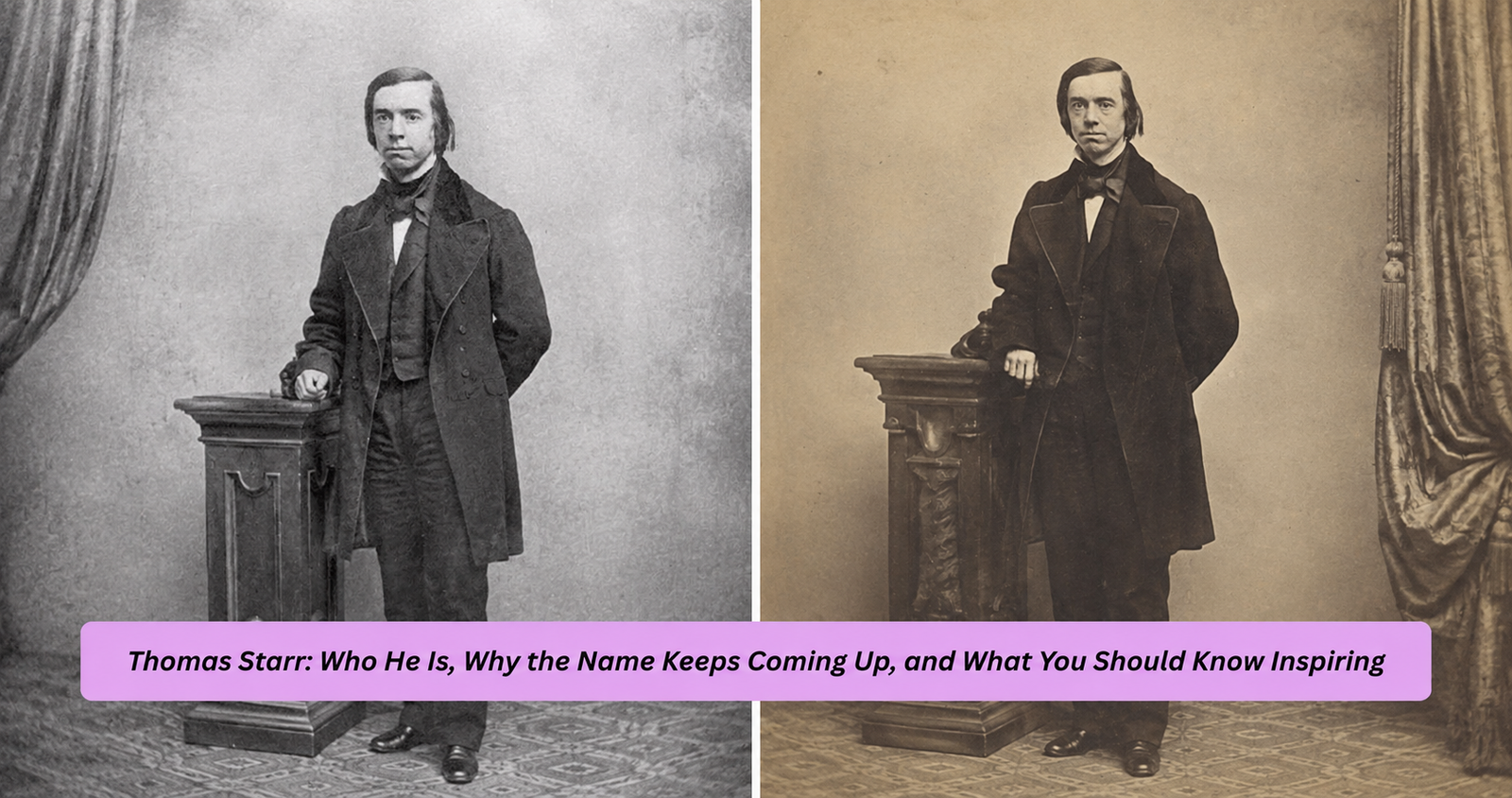
The most historically significant person named Thomas Starr is Thomas Starr King, a Universalist and Unitarian minister who became a major political voice in California during the American Civil War. Born in New York City in 1824 to a Universalist minister father, King grew up steeped in religious and rhetorical tradition, and he built on that foundation through relentless self-study rather than formal seminary training.
King’s real legacy comes from his political impact during one of the most fragile periods in American history. When California’s loyalty to the Union was far from guaranteed, King traveled the state delivering passionate speeches urging Californians to stay committed to the federal cause. His oratory was persuasive
that he earned recognition from Abraham Lincoln himself for helping prevent California from splitting off as an independent republic — an outcome that historians still discuss as a genuine turning point for the Union’s western stability. This is why he’s sometimes remembered with the nickname “the orator who saved the nation,” a title that reflects just how much weight his speeches carried at the time. His statue still stands in San Francisco’s Golden Gate Park, and a Masonic lodge in Salem, Massachusetts, was named in his honor shortly after his death in 1864. If you’re researching American Civil War history, California statehood politics, or nineteenth-century Universalist theology, this Thomas Starr is almost certainly the one relevant to your work.
Thomas Starr the Graphic Design Professor: A Modern Creative Voice
A completely different but equally noteworthy Thomas Starr is active today as a professor of graphic and information design at Northeastern University’s Department of Art + Design. His professional focus centers on visual communication that directly engages civic and political discourse — tackling difficult topics like gun violence, domestic violence, reproductive rights, and climate change through design work rather than traditional academic writing alone.
What makes this Thomas Starr particularly interesting from a design-and-communication standpoint is his long-running relationship with Yale University Press, where his book jacket designs have helped bring scholarly texts to broader public audiences. That’s a subtle but important contribution: academic publishing often struggles with visibility outside specialist circles, and thoughtful cover design is one of the quiet mechanisms that helps serious research reach general readers. Beyond publishing, his research into the typography and print history of the Declaration of Independence connects graphic design to foundational questions about democratic communication — essentially asking how the physical
of a document shapes its authority and reach. His work has been recognized internationally, with honors from the American Institute of Graphic Arts, the International Poster Biennale in Warsaw, and the International Poster Festival in Chaumont, among others, and pieces of his design work sit in the permanent collections of the Zurich Design Museum and the Library of Congress. Before joining Northeastern, he founded his own graphic design firm in New York City and taught at both the Rhode Island School of Design and Massachusetts College of Art.
Other People Named Thomas Starr You Might Encounter
Beyond the two figures above, the name surfaces frequently in professional and personal contexts that don’t necessarily indicate historical or academic significance but still matter to the person doing the searching. A Thomas Starr operating under “Thomas Starr, LLC” appears on LinkedIn as a creative specialist based in Ormond Beach, with professional recognition including a Vendor of the Year award from a healthcare-adjacent company for creative and branding work. Colleagues describing this Thomas Starr’s work style consistently point to a pattern: he’s known for connecting creative concepts directly to business goals rather than treating design as decoration, and for delivering projects on time without unnecessary friction — the kind of reliability that turns single projects into repeat working relationships.
Separately, there are private individuals sharing the name across social platforms, including small business owners in fashion and alterations work, as well as a handful of people you’ll find through basic Facebook or Instagram searches who have no notable public profile beyond their personal networks. None of these should be confused with either the historical minister or the design professor, and if you’re trying to verify a specific person’s identity — say, for a business reference check or a networking follow-up — it’s worth cross-referencing location, employer, and professional history rather than relying on the name alone.
How to Identify the Right Thomas Starr for Your Research
Given how many people share this name, a little verification goes a long way. Start with context clues from wherever you first encountered the name — was it in a history book, a design publication, a LinkedIn message, or a social media post? That single detail usually narrows things down immediately, since these different Thomas Starrs rarely overlap in subject matter or era.
| Identifier | Thomas Starr King | Thomas Starr (Design Professor) | Thomas Starr (Creative Specialist) |
|---|---|---|---|
| Era/Status | 1824–1864, historical figure | Active, contemporary | Active, contemporary |
| Field | Ministry, oratory, politics | Graphic and information design | Branding and creative consulting |
| Known For | Civil War-era pro-Union speeches in California | Civic-focused design, Yale University Press book jackets | Business-aligned creative direction |
| Institutional Ties | First Unitarian Church, San Francisco | Northeastern University, RISD, MassArt | Thomas Starr, LLC |
| Where You’d Find References | History books, California landmarks, Wikipedia | Design portfolios, university faculty pages, museum collections | LinkedIn, business award listings |
If you’re still unsure after checking context, try pairing the name with a second identifying detail in your search — a location, a profession, an institution, or a decade. Searching “Thomas Starr Northeastern” or “Thomas Starr California history” will get you to the right profile far faster than the bare name alone, and it prevents the kind of mix-up where someone accidentally cites the wrong person’s biography in a paper or article.
Why Getting the Right Thomas Starr Matters
This might seem like a minor point, but misattributing information between people who share a name causes real problems, especially in academic writing, journalism, and professional due diligence. Imagine citing Thomas Starr’s Civil War-era speeches in a paper about contemporary graphic design, or crediting the Northeastern professor’s typography research to a nineteenth-century minister — these aren’t hypothetical errors; they’re the kind of mistake that happens when researchers work quickly and trust the first search result without checking context.
A trustworthy approach to any ambiguous name search involves triangulating multiple sources before settling on an identification. If you’re working on something formal — a research paper, a professional profile, a fact-checked article — cross-check dates, institutions, and areas of expertise across at least two independent sources. For Thomas Starr specifically, the historical minister and the modern design professor are separated by roughly 150 years and completely different fields, so even a moderate amount of context should make the distinction obvious. The harder cases tend to involve private individuals with thinner public records, where a bit more patience and a willingness to reach out directly (rather than guessing) will serve you better than assuming.
Practical Tips for Searching Common or Shared Names
Names like Thomas Starr are a good reminder that search engines return results based on relevance signals, not certainty about which specific person you meant. A few habits make this kind of research much smoother. First, always add a qualifier when you search — a city, an employer, a field, or an approximate time period. Second, check whether the source you’re reading is a primary source (like a university faculty page or an official biography) or a secondary aggregator (like a stock photo site or a generic people-search tool), since primary sources are far more reliable for confirming identity.
Third, don’t assume that a Wikipedia page, a LinkedIn profile, and a social media account all refer to the same person just because the name matches — verify shared details like profession, location, or employer before treating them as one individual. This is especially true for names like Thomas Starr, where the historical figure, the academic, and the private professionals genuinely have nothing in common beyond the name itself. Building this habit doesn’t just help with this particular search; it’s a transferable skill for research integrity across any topic involving common names.
Final Thoughts on Thomas Starr
There isn’t one single “Thomas Starr” who dominates the public record — and that’s actually the most useful thing to understand before you go any further with your research. Whether you’re interested in the nineteenth-century minister whose speeches helped keep California in the Union, the design professor whose work bridges civic discourse and typography, or a professional you’ve connected with more recently, the key is anchoring your search to context rather than the name alone.
Take the extra minute to verify which Thomas Starr you’re actually after. It’s a small step that prevents misattribution, strengthens the credibility of anything you write or cite, and ultimately gets you to accurate, useful information faster than a generic search ever could.
Frequently Asked Questions About Thomas Starr
Who is Thomas Starr King, and why is he historically significant?
Thomas Starr King was a Universalist and Unitarian minister born in 1824 who became one of the most influential pro-Union voices in California during the American Civil War. His speeches are widely credited with helping keep California committed to the Union at a time when secession sentiment was a real possibility, and Abraham Lincoln himself acknowledged the impact of his advocacy. He’s remembered today through landmarks like his statue in Golden Gate Park and his designation as a historical figure tied to San Francisco’s First Unitarian Church.
Is Thomas Starr the graphic designer the same person as Thomas Starr King?
No, these are two entirely different people separated by roughly a century and a half. Thomas Starr King was a nineteenth-century clergyman and political orator, while the contemporary Thomas Starr is a graphic and information design professor at Northeastern University whose work focuses on civic-minded visual communication and typography research. Their fields, eras, and areas of impact don’t overlap at all, so confusing the two is a common but avoidable research error.
What kind of design work is Thomas Starr known for at Northeastern University?
Thomas Starr’s design work centers on visual communication that engages political and social issues, including gun violence, domestic violence, reproductive rights, and climate change. He’s also known for his long-standing collaboration with Yale University Press on book jacket design, as well as academic research into the typography and printing history of the Declaration of Independence, which connects design practice to broader questions about democratic communication.
How can I tell which Thomas Starr I’m looking for when researching online?
The most reliable method is pairing the name with a specific qualifier, such as a profession, institution, location, or time period. Searching “Thomas Starr design” or “Thomas Starr California history” will surface far more accurate results than the bare name alone. It’s also worth checking whether your source is a primary reference, like a university page or historical archive, rather than a generic aggregator site that may blend information from multiple people sharing the same name.
Why do so many different people share the name Thomas Starr?
Thomas Starr combines a historically popular first name with a surname that, while not extremely common, appears frequently enough across generations and regions to produce multiple notable and non-notable individuals sharing the exact combination. This is a common pattern with names built from widely used first names paired with moderately common surnames, and it’s why verifying context before drawing conclusions is so important whenever you encounter the name in research or casual searches.
Are there other professionals named Thomas Starr worth knowing about?
Yes, beyond the historical minister and the design professor, there are other professionals who share the name, including a creative specialist associated with Thomas Starr, LLC, recognized for branding and creative direction work with business clients. There are also private individuals across social platforms who share the name without a notable public professional record. When encountering these profiles, it’s best to verify identity through shared details like employer or location rather than assuming a connection to the more publicly documented figures.