
Few genres in gaming reward curiosity quite like adventure games. Whether you’re the type who loves piecing together clues in a moody detective story or someone who’d rather swing a sword through a sprawling open world while chasing ancient secrets, there’s a corner of this genre built just for you. Finding the best adventure games isn’t just about chasing whatever topped a sales chart last quarter — it’s about matching a game’s pacing, tone, and mechanics to the kind of experience you actually want to sit with for hours at a time.
This guide breaks down what actually makes an adventure game great, walks through standout titles across subgenres, and gives you a practical framework for picking your next playthrough. Rather than just listing titles, the goal here is to explain why certain games consistently show up on best-of lists, what design choices set them apart, and how you can apply that same critical eye when you’re browsing a storefront trying to decide what to play next.
What Defines an Adventure Game?
At its core, an adventure game puts the player in the role of an explorer, investigator, or problem-solver navigating a world designed around discovery rather than pure reflexes or combat mastery. That’s a broad umbrella, and it’s part of why the genre has splintered into so many distinct flavors over the decades — point-and-click puzzle adventures, narrative-driven story games, and action-adventure titles that blend combat with exploration all fall under the same general banner. What ties them together isn’t a shared control scheme or setting; it’s the underlying promise that something interesting is always just around the corner, waiting for you to find it.
This is also why the phrase “best adventure games” means something slightly different depending on who’s asking. A player who grew up on classic point-and-click titles from LucasArts or Sierra is going to have a different mental checklist than someone who discovered the genre through The Legend of Zelda or Uncharted. Understanding this distinction matters because it shapes how you evaluate a recommendation list. A game that’s brilliant for someone who wants slow, cerebral puzzle-solving might feel frustratingly slow to a player who wants constant momentum and set-piece spectacle. Knowing your own preferences first makes any list of the best adventure games far more useful to you personally.
Story-Driven Narrative Adventures
Narrative adventures prioritize character, choice, and emotional stakes over mechanical complexity, and this subgenre has produced some of the most talked-about games of the last decade. Titles like Disco Elysium and Life Is Strange lean almost entirely on dialogue, branching decisions, and atmosphere to pull players forward, often with minimal traditional puzzle-solving. These games tend to reward players who enjoy reading, interpreting subtext, and living with the consequences of choices that don’t always have a clean right answer.
What makes narrative adventures consistently rank among the best adventure games is their ability to create genuine emotional investment without relying on action set pieces. A well-written narrative adventure can make you feel guilt over a throwaway dialogue choice made three hours earlier, or reframe an entire relationship based on a single late-game
. As one longtime adventure game reviewer put it, “the best of these games make you feel like your choices actually cost something.” That sense of weight is exactly what separates a forgettable visual novel from something players still discuss years after release. If you’re new to the subgenre, starting with a game that has strong voice acting and a tightly paced first act will make the commitment to a longer, more emotionally demanding story feel worthwhile.
Point-and-Click and Puzzle-Focused Adventures
Point-and-click adventures are arguably the genre’s most traditional form, built around exploring detailed environments, collecting items, and solving logic puzzles to progress. This style dates back to the golden age of PC gaming in the 1980s and 1990s, and it has seen a genuine resurgence thanks to indie developers who understand exactly what made those older games click. Series like The Darkside Detective and newer entries like Broken Sword’s remastered releases show that there’s still a hungry audience for carefully constructed puzzle logic paired with strong writing and art direction.
The problem many newcomers run into with this subgenre is what’s often called “moon logic” — puzzle solutions so obscure or nonsensical that players get stuck not because they’re not thinking hard enough, but
the game’s internal logic doesn’t match real-world reasoning. The best adventure games in this category solve that problem by grounding their puzzles in clear, consistent rules the player can learn and predict, even when the solutions are clever rather than obvious. When a puzzle adventure gets this balance right, the payoff moment — that click when a solution finally makes sense — is one of the most satisfying feelings in gaming. This is precisely why well-designed point-and-click titles continue to earn a spot among the best adventure games year after year, even in a market dominated by bigger-budget action titles.
Action-Adventure Epics and Open Worlds
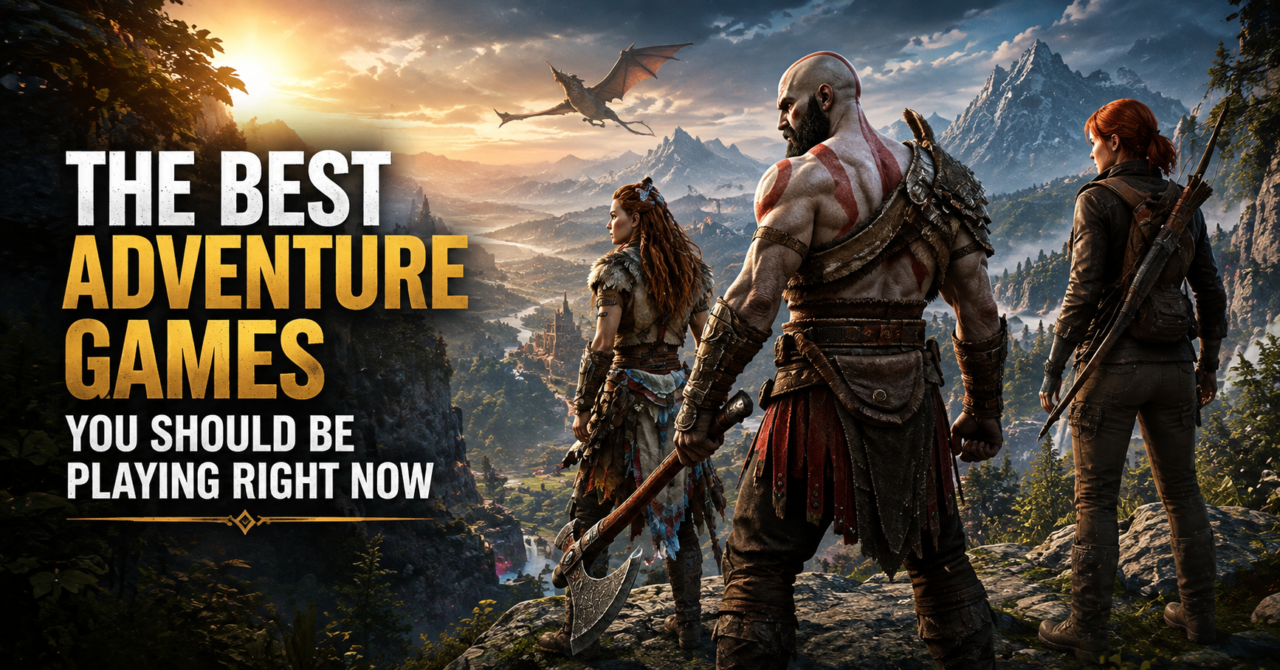
Action-adventure games blend combat, exploration, and puzzle-solving into large, often open-world experiences, and this category has produced some of the most commercially and critically successful games ever made. The Legend of Zelda: Breath of the Wild reshaped what an open-world adventure could feel like by rewarding pure curiosity — climbing any mountain, exploring any ruin — rather than funneling players down a fixed path. Baldur’s Gate 3 took a different approach, layering deep role-playing mechanics and tabletop-inspired choice-and-consequence systems onto a sprawling adventure that consistently surprises players with how much it reacts to their decisions.
More recently, games like Clair Obscur: Expedition 33 have shown that action-adventure storytelling can borrow techniques from JRPGs while still delivering the exploration-driven pacing adventure fans expect, wrapping turn-based combat around a richly detailed, sorrow-tinged world. This subgenre tends to dominate best-of conversations partly because these titles have the production budgets to build genuinely vast, detailed worlds, but also because they successfully marry two different appeals — the tactical satisfaction of combat and the slower joy of exploration — without either one undercutting the
. The challenge for developers here is pacing: an open world stuffed with content but lacking meaningful discoveries quickly starts to feel like busywork rather than adventure, which is why the strongest entries in this category are ruthless about making every explorable corner feel worth the detour.
Comparing Top Adventure Games by Style and Platform
Different players want different things from their next playthrough, so it helps to see how leading titles stack up side by side. The table below compares a handful of standout games across subgenre, platform availability, and what kind of player each one suits best.
| Game | Subgenre | Platforms | Best Suited For |
|---|---|---|---|
| Disco Elysium | Narrative adventure | PC, PlayStation, Xbox, Switch | Players who love dialogue-heavy storytelling |
| The Legend of Zelda: Breath of the Wild | Action-adventure, open world | Nintendo Switch | Players who want unstructured exploration |
| Baldur’s Gate 3 | RPG-adventure hybrid | PC, PlayStation, Xbox | Fans of choice-driven, party-based storytelling |
| Broken Sword: The Smoking Mirror – Reforged | Point-and-click adventure | PC, PlayStation, Xbox, Switch | Classic puzzle-adventure fans |
| Clair Obscur: Expedition 33 | Action-adventure, JRPG-inspired | PC, PlayStation, Xbox | Players who want emotional storytelling with tactical combat |
This kind of comparison is useful precisely because it highlights that there’s no single “correct” answer when someone asks for the best adventure games. A player choosing between Disco Elysium and Breath of the Wild isn’t picking a better or worse game in any objective sense — they’re choosing between two fundamentally different kinds of adventure, one built around introspection and dialogue, the other around physical exploration and environmental puzzle-solving.
How to Choose the Right Adventure Game for You
With so many strong options across subgenres, the practical question becomes how to actually narrow things down. Start by thinking about pacing preferences: do you want a game you can sink into for fifty-plus hours, uncovering side content and optional lore, or would you rather have a tighter, more focused story that wraps up in ten to fifteen hours? Open-world action-adventure titles tend to demand a bigger time investment, while narrative adventures and point-and-click puzzle games are often more contained, making them a better fit if you’re looking for something you can actually finish.
Platform availability and control scheme also matter more than players sometimes expect. A point-and-click adventure built around precise cursor movement can feel clunky on a controller, while an action-adventure game designed for analog stick combat loses some of its responsiveness on keyboard and mouse. It’s worth checking whether a title has been specifically adapted for the platform you plan to play on, since ports that feel like an afterthought can undercut even a well-designed game. Reading reviews that specifically mention control quality on your preferred platform, rather than just overall scores,
save you frustration later. Ultimately, the strongest picks are the ones that match your available time, your preferred pacing, and the hardware you actually own — chasing a critically acclaimed title that doesn’t fit those practical constraints often leads to an unfinished library rather than a memorable playthrough.
The Evolution of Adventure Games Over Time
Understanding where adventure games came from adds real context to why today’s top-rated titles look the way they do. The genre’s earliest roots trace back to text-based interactive fiction in the late 1970s, where players typed commands to navigate rooms and solve puzzles using nothing but written description. That evolved into the graphical point-and-click era of the 1980s and 1990s, a period defined by developers who built entire studios around this format and produced some of the most beloved puzzle-adventure titles of all time.
As gaming hardware advanced, the best adventure games genre branched outward rather than disappearing. Full 3D exploration, voice acting, and cinematic storytelling opened the door for action-adventure hybrids and narrative-focused games that would have been technically impossible decades earlier. What’s notable is that instead of one style replacing another, adventure gaming today supports all of these approaches simultaneously — classic-style point-and-click puzzles are being remastered and released alongside brand-new open-world epics, and both continue to find dedicated audiences. This layered history is exactly why any serious list of the best adventure games has to account for such a wide range of styles; the genre never fully abandoned its roots even as it grew in scope and ambition.
Frequently Asked Questions About Adventure Games
What makes a game qualify as an adventure game?
A game generally qualifies as an adventure game when its core design centers on exploration, puzzle-solving, and narrative progression rather than pure combat mechanics or reflex-based challenges. This can include point-and-click puzzle titles, narrative-driven story games, and action-adventure hybrids that blend fighting with exploration, as long as discovery and problem-solving remain central to the experience.
What are the best adventure games for beginners?
For players new to the genre, narrative adventures with clear objectives and strong pacing tend to be the most approachable starting point, since they don’t require the puzzle-solving intuition that classic point-and-click titles demand. Games with well-signposted objectives and forgiving difficulty curves let new players build confidence before tackling more puzzle-heavy or open-ended entries in the genre.
Are open-world games considered adventure games?
Yes, many open-world games fall under the adventure genre, particularly when exploration and discovery are central to the experience rather than just a backdrop for combat. Titles like The Legend of Zelda: Breath of the Wild are widely recognized among the best adventure games specifically because their open-world design rewards curiosity and rewards players for wandering off the main path.
How long does it typically take to finish an adventure game?
Completion time varies enormously depending on subgenre, ranging from tightly focused narrative adventures that can be finished in eight to twelve hours to massive open-world action-adventure titles that can easily stretch past fifty or sixty hours with side content included. When choosing among the best adventure games available, it’s worth checking estimated playtime against your own schedule, since a shorter, well-paced game is often more satisfying than a sprawling one you never finish.
Do adventure games require a lot of combat skill?
Not necessarily, and this is one of the genre’s biggest appeals for players who prefer thoughtful pacing over reflex-heavy gameplay. Narrative adventures and point-and-click puzzle games often involve little to no combat at all, while action-adventure titles do incorporate fighting but typically balance it with exploration and puzzle elements, meaning skill requirements vary widely depending on which subgenre you choose.
Final Thoughts on Finding Your Next Great Adventure
The best adventure games aren’t defined by a single formula — they’re united by a shared commitment to making exploration and discovery feel genuinely rewarding, whether that happens through branching dialogue, a cleverly designed puzzle, or a sprawling open world begging to be explored. From the introspective weight of narrative-driven titles to the sprawling scale of open-world epics and the timeless satisfaction of a well-built point-and-click puzzle, this genre offers something for nearly every kind of player willing to slow down and pay attention. The real takeaway is that picking the right game isn’t about chasing whatever tops a single ranked list; it’s about understanding your own preferences for pacing, platform, and storytelling style, and then letting that guide you toward the adventure that fits. Do that, and you’ll consistently land on titles that earn their place among the best adventure games for you personally, not just according to a critic’s scorecard.