If you’ve ever stayed up way too late because you just had to see how a game’s story ended, you already understand why narrative design matters more on PlayStation than almost anywhere else. Sony’s first-party studios have spent the better part of a decade proving that games can deliver the emotional weight of prime-time television and the pacing of a great novel, all while handing you the controller. When people search for the best story games PS5 has to offer, they’re usually not just looking for a list — they want to know which titles actually earn their reputation, and why.
This article breaks down what makes a story-driven PS5 game genuinely great, walks through standout examples across different genres, and gives you a practical framework for choosing your next narrative adventure based on tone, pacing, and personal taste. Whether you’re a longtime PlayStation fan or someone who just picked up a PS5 and wants to skip straight to the good stuff, this guide covers the ground you need.
What Actually Makes a Story Game Great on PS5
Not every game with cutscenes qualifies as a great story game. There’s a meaningful difference between a title that uses narrative as decoration and one that treats storytelling as a core design pillar. The best story games PS5 has produced share a few traits: strong character writing, meaningful player agency, and pacing that respects your time without rushing the emotional beats.
Take character writing as an example. A game like The Last of Us Part II doesn’t just tell you Ellie is angry and grieving — it shows you through her body language, her dialogue choices, and the way combat itself becomes an extension of her psychological state. That’s the difference between exposition and embodiment. Naughty Dog’s writers have talked openly about how motion capture and voice direction were treated as inseparable from the script itself, which is a level of production integration you rarely see outside prestige television. When people ask what separates a good story game from a great one, this kind of cross-department collaboration is usually the answer.
Pacing is the second piece often overlooked. Games like Ghost of Tsushima balance sweeping, cinematic main-quest moments with quieter side content — haiku composition, fox dens, hot springs — that gives players breathing room between emotionally heavy story beats. That rhythm matters. Without it, even a well-written story can feel exhausting rather than immersive.
Sony’s First-Party Powerhouses: The Backbone of PS5 Storytelling
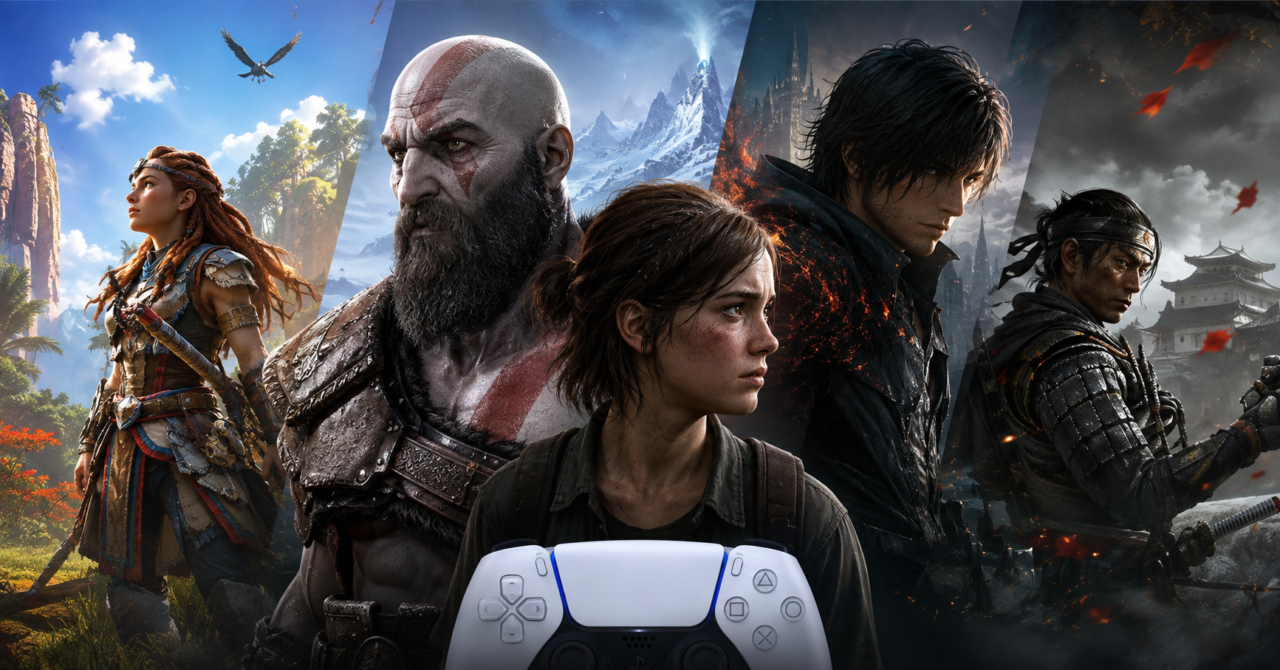
Sony’s internal studios — Naughty Dog, Santa Monica Studio, Insomniac Games, Guerrilla, and Sucker Punch — have essentially built PlayStation’s identity around narrative-first design. This isn’t accidental. Sony’s platform strategy has leaned into cinematic single-player experiences since the PS3 era, and that investment has only deepened on PS5’s hardware, which allows for near-instant loading, higher-fidelity facial animation, and adaptive haptics that reinforce emotional beats in ways older controllers simply couldn’t.
God of War Ragnarök is a good case study here. Santa Monica Studio didn’t just continue Kratos and Atreus’s story — they restructured the entire game around a father-son relationship evolving in real time, using Norse mythology as a backdrop rather than a gimmick. The writing team consulted extensively with mythology scholars to keep the Nine Realms lore internally consistent, which is part of why the world feels lived-in rather than decorative. It’s a masterclass in how worldbuilding and character arcs can reinforce each other.
Insomniac’s Marvel’s Spider-Man 2 takes a different approach, splitting its narrative between Peter Parker and Miles Morales to explore identity, legacy, and the cost of heroism from two distinct emotional angles. The dual-protagonist structure isn’t just a gameplay variety trick — it’s a storytelling device that lets the writers explore themes of inheritance and self-doubt without either character feeling like a sidekick. If you’re compiling a list of the best story games PS5 exclusives, this one belongs near the top for how confidently it handles parallel narratives.
Beyond Exclusives: Third-Party and Multiplatform Story Games Worth Your Time
While Sony’s exclusives dominate the conversation, plenty of third-party titles hold their own when it comes to narrative craftsmanship. Baldur’s Gate 3, developed by Larian Studios, brought CRPG-style branching narrative design to a mainstream console audience, complete with companion characters whose loyalty, romance, and betrayal arcs genuinely respond to player choice. It’s a reminder that some of the best story games PS5 users can access weren’t built with cinematic cutscenes at all — they’re built on reactive dialogue trees and systemic consequence.
Alan Wake 2, from Remedy Entertainment, deserves mention too. It blends live-action sequences with psychological horror storytelling in a way that feels genuinely experimental for a big-budget release. Remedy’s writers leaned into unreliable narration and metafiction, which is a bold structural choice that pays off if you’re willing to sit with ambiguity rather than demand clean answers. Contrast that with Final Fantasy XVI, developed by Square Enix’s Creative Business Unit III, which tells a much more traditional political fantasy epic with Game of Thrones-style intrigue layered under Eikon battles. Both games are excellent, but they demonstrate just how wide the range is when people search for the best story games PS5 offers — there’s no single formula.
Comparing Story-Driven Genres on PS5
Different genres deliver narrative in fundamentally different ways, and understanding these distinctions helps you pick the right game for your mood. Below is a breakdown of how major story-focused genres on PS5 typically structure their narrative experiences.
| Genre | Narrative Style | Example Titles | Best For Players Who Want |
|---|---|---|---|
| Cinematic Action-Adventure | Linear, film-like pacing with heavy cutscenes | God of War Ragnarök, Uncharted 4 | A tightly directed, emotionally scripted journey |
| Open-World RPG | Branching quests, player-driven pacing | Horizon Forbidden West, Cyberpunk 2077 | Freedom to explore themes at their own pace |
| CRPG / Tactical RPG | Choice-based dialogue trees, reactive world states | Baldur’s Gate 3 | Deep agency and consequence-driven storytelling |
| Psychological / Horror Narrative | Nonlinear, atmosphere-driven storytelling | Alan Wake 2, Silent Hill 2 Remake | Unsettling, ambiguous, thematically dense stories |
| Superhero / Legacy Drama | Dual-protagonist or ensemble storytelling | Marvel’s Spider-Man 2 | Character-driven arcs about identity and duty |
This kind of comparison matters because “best” is subjective — a player who loves branching consequence in Baldur’s Gate 3 might find a linear cinematic game like God of War comparatively restrictive, and vice versa. Knowing your own preferences going in saves you from picking up a critically acclaimed game that just isn’t your style.
The Role of Technology in Elevating PS5 Storytelling
It’s worth acknowledging how much of PS5’s storytelling reputation is tied to hardware capability. The console’s SSD architecture virtually eliminates loading screens, which means games like Ratchet & Clank: Rift Apart can weave dimension-hopping directly into the narrative without breaking immersion for a loading bar. That’s not a small thing — earlier generations had to design around load times, sometimes awkwardly justifying elevator rides or slow-walking sequences just to mask technical limitations.
DualSense haptic feedback and adaptive triggers also play a quieter but meaningful role. In Returnal, the controller’s resistance changes based on weapon heat and tension, reinforcing the psychological horror of Selene’s time-loop without a single line of dialogue. As one narrative designer put it during a GDC talk on sensory storytelling, “the controller is not just an input device anymore — it’s part of the performance.” That sentiment captures something real about how PS5 hardware has quietly expanded what narrative delivery even means in games. When evaluating the best story games PS5 hardware enables, it’s fair to credit the platform itself, not just the writing teams.
How to Choose the Right Story Game for Your Taste
Picking from a crowded list of acclaimed titles can be paralyzing, so it helps to ask a few honest questions before you commit twenty-plus hours. First, consider your tolerance for ambiguity. If you want clear answers and satisfying resolution, something like God of War Ragnarök delivers a complete emotional arc. If you’re comfortable with unresolved tension and psychological complexity, Alan Wake 2 or Death Stranding 2 will reward that patience.
Second, think about pacing preference. Some players want a tightly authored fifteen-hour experience with no filler; others want to sink forty-plus hours into a world and let the story breathe alongside side content. Horizon Forbidden West leans into the latter, using its open world to deepen Aloy’s character through optional lore rather than forcing everything into the main quest line. Matching a game’s structural pacing to your own play habits is often more predictive of enjoyment than review scores alone — and it’s a big reason “best” lists can feel inconsistent from one player’s perspective to another’s.
Frequently Asked Questions
What are considered the best story games PS5 owners should start with?
For newcomers, a strong starting point includes God of War Ragnarök, The Last of Us Part I, and Marvel’s Spider-Man 2, since all three combine accessible gameplay with tightly written, emotionally resonant narratives. These titles also represent different storytelling approaches, giving new players a sense of the range available before branching into more niche genres like CRPGs or psychological horror.
Are PS5 exclusive games generally better written than multiplatform titles?
Not necessarily — exclusivity doesn’t guarantee narrative quality. Sony’s first-party studios do benefit from larger budgets and tighter creative control over hardware-specific features, which can enhance storytelling delivery, but multiplatform titles like Baldur’s Gate 3 and Alan Wake 2 consistently rank among the best story games PS5 users can play, proving strong writing isn’t exclusive to first-party development.
How long do the best story-driven PS5 games typically take to complete?
Completion times vary widely depending on genre. Linear cinematic titles like God of War Ragnarök typically run twenty to twenty-five hours for the main story, while open-world RPGs like Horizon Forbidden West or Cyberpunk 2077 can stretch past sixty hours with side content included. CRPGs like Baldur’s Gate 3 often exceed one hundred hours for players pursuing multiple branching paths.
Do story choices in PS5 games actually affect the outcome, or are they mostly cosmetic?
It depends entirely on the game’s design philosophy. Cinematic action-adventures often use choices for characterization rather than branching outcomes, while CRPGs and some narrative-driven titles build entire systems around consequence, altering companion relationships, world states, or endings based on player decisions. Understanding this distinction upfront helps set realistic expectations for how much agency you’ll actually have.
What genre offers the most emotionally impactful storytelling on PS5?
There’s no single answer, since emotional impact is subjective, but action-adventure titles from Sony’s first-party studios consistently top critical and player rankings for emotional storytelling due to their cinematic direction, strong voice acting, and tightly scripted pacing. Players seeking a different kind of emotional weight often find psychological narrative games like Alan Wake 2 equally powerful, just through a more unsettling, ambiguous lens.
Final Thoughts on Finding the Best Story Games PS5 Has to Offer
There’s no single “correct” answer when it comes to naming the best story games PS5 owners should play, because the console’s library spans such a wide emotional and structural range — from tightly scripted father-son mythology epics to sprawling, choice-driven fantasy campaigns. What ties the strongest titles together isn’t genre or budget, but a shared commitment to treating narrative as a design pillar rather than an afterthought.
If you’re building your own list, start by identifying what kind of story experience you actually want — resolution versus ambiguity, linear direction versus branching consequence — and let that guide your choices rather than chasing review scores alone. The best story games PS5 has to offer earn their reputation because they respect both the medium and the player’s time, and once you find the ones that match your taste, you’ll understand exactly why this console has become synonymous with great storytelling.