There’s a specific kind of magic in sitting down alone with a controller or keyboard, no lobby to wait for, no teammates to coordinate with, just you and a world built for one. That’s the enduring appeal of the best single player games — they hand you a story, a challenge, or a system to master entirely on your own terms. While multiplayer titles dominate a lot of gaming headlines, single player experiences have quietly become some of the most technically ambitious, emotionally resonant, and mechanically deep games on the market.
This guide walks through what actually makes a single player game great, breaks down the strongest genres to explore, and gives you a practical framework for picking your next game based on what you’re actually in the mood for. Whether you’re chasing a gripping narrative, a punishing challenge, or a sprawling world to lose yourself in, understanding these categories will help you find the best single player games for your specific taste rather than just chasing whatever’s trending.
What Actually Makes a Single Player Game “Great”
Before diving into recommendations, it’s worth understanding the criteria that separate a forgettable single player game from one that people still talk about a decade later. Pacing is one of the biggest factors. A game can have gorgeous visuals and a compelling premise, but if it drags in the middle third or front-loads all its best ideas in the opening hours, the experience falls apart. The best single player games tend to respect the player’s time, introducing new mechanics, story beats, or environments at a rhythm that keeps momentum without overwhelming the player.
Another underrated factor is agency — how much control the player actually has over outcomes, pacing, and approach. Games that lean heavily on scripted sequences with little player input can still be enjoyable, but the titles that tend to earn lasting reputations usually give players meaningful choices, whether that’s how to approach a combat encounter, which skills to prioritize, or how a story ultimately resolves. As one longtime game designer put it during a talk on narrative design, “Players don’t remember the cutscene, they remember the moment they decided something for themselves.” That distinction between watching a story and shaping one is often what separates good single player games from truly great ones.
Story-Driven Single Player Games
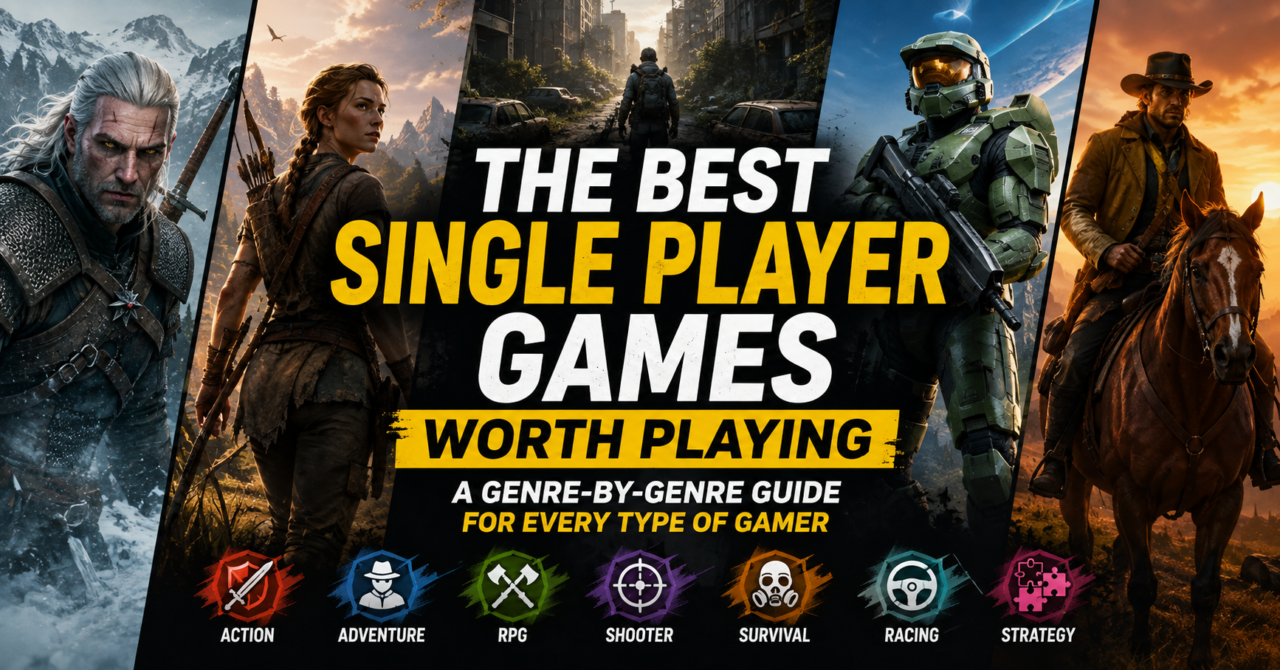
Narrative-focused titles are probably what most people picture first when they think about the best single player games, and for good reason. These games treat the player less like a scorekeeper and more like a reader or viewer embedded directly inside the plot. Strong examples of this genre include games like The Last of Us, Red Dead Redemption 2, and Disco Elysium, each of which uses pacing, dialogue, and environmental storytelling to build emotional stakes that linger well after the credits roll.
What makes narrative-driven single player games particularly effective is their use of interactivity to reinforce theme. Unlike a film, where the audience is a passive observer, these games often make the player complicit in decisions that carry weight, which creates a different kind of emotional investment. A game like Disco Elysium, for instance, leans almost entirely on dialogue and internal monologue rather than combat, proving that some of the best single player games don’t need action set pieces at all — they need strong writing, a distinct voice, and a world worth paying attention to. This genre is a great entry point for players coming from books, film, or television who want a more participatory version of storytelling.
Open-World and Exploration-Focused Games
Open-world titles occupy a different corner of the single player space, prioritizing freedom and scale over tightly scripted narrative beats. Games like The Legend of Zelda: Breath of the Wild, Elden Ring, and Ghost of Tsushima are frequently cited among the best single player games specifically because they hand players a massive world and largely get out of the way, letting curiosity drive the experience rather than a rigid mission structure.
The appeal here is closely tied to a psychological concept sometimes called “systemic emergence” — the idea that a well-designed set of game systems can produce unscripted, memorable moments purely through player experimentation. In Breath of the Wild, for example, players might discover they can combine fire, wind, and physics mechanics in unexpected ways that the developers never explicitly scripted, yet the game supports it naturally because the underlying systems are consistent and reactive. This is a strong example of a problem-solution dynamic in game design: linear games solve the problem of narrative control by limiting player freedom, while open-world single player games solve the problem of repetitive gameplay by building flexible systems that reward experimentation rather than punishing it.
Challenge-Based and Skill-Focused Games
Not every player is chasing a story or a sprawling map — plenty of gamers gravitate toward the best single player games specifically because of the challenge they offer. This category includes titles like Dark Souls, Hollow Knight, and Celeste, games built around precision, pattern recognition, and earned mastery rather than narrative payoff alone. These games tend to use difficulty as a core storytelling device in itself, where overcoming a brutal boss fight or a punishing platforming sequence becomes part of the emotional arc.
What separates well-designed challenge-based games from ones that feel simply unfair is consistency. The best single player games in this category are difficult because of clear rules the player can learn, not because of random unpredictability. Celeste is a particularly strong example here — its difficulty ramps steadily, and every death feels like the result of a player mistake rather than a design flaw, which keeps frustration from tipping into disengagement. This genre tends to attract players who enjoy games in the same way they might enjoy a difficult puzzle or an instrument they’re learning: the satisfaction comes directly from the effort invested.
Strategy and Simulation Single Player Games
Strategy and simulation titles represent one of the most cerebral corners of the single player games in this space, appealing to players who want to think several steps ahead rather than react in real time. Civilization, XCOM, and Crusader Kings are frequently mentioned among the best single player games in this category because they reward long-term planning, resource management, and adaptive decision-making over reflexes.
These games are particularly good examples of emergent storytelling through systems rather than scripted plot. In a game like Crusader Kings, a player’s dynasty might collapse not because of a written narrative event, but because of a cascading series of decisions made dozens of hours earlier — a rushed alliance, a neglected heir, an ignored rebellion. This kind of organically generated narrative is one of the clearest illustrations of why single player strategy games have such dedicated followings; the stories that emerge feel genuinely personal because no two playthroughs unfold the same way.
How to Choose the Right Single Player Game for You
With so many strong options across genres, picking where to start can feel overwhelming, which is exactly why matching game type to mood matters more than chasing “best of all time” lists blindly. If you’re looking for emotional depth and want to feel like you’re inside a story, narrative-driven titles are the clear starting point. If you want freedom and discovery, open-world games will scratch that itch far better than a linear experience ever could.
| Player Goal | Recommended Genre | Example Games |
|---|---|---|
| Emotional, story-first experience | Narrative-driven | The Last of Us, Disco Elysium |
| Freedom and exploration | Open-world | Breath of the Wild, Elden Ring |
| Skill mastery and challenge | Challenge-based | Celeste, Hollow Knight |
| Long-term planning and strategy | Strategy/simulation | Civilization, Crusader Kings |
| Relaxed, low-pressure play | Simulation/cozy | Stardew Valley, Animal Crossing |
It’s also worth acknowledging that plenty of the best single player games blend genres, which can make categorization tricky but often produces the most memorable experiences. Elden Ring, for instance, combines open-world exploration with the punishing combat of a challenge-based game, giving players both freedom and mastery-driven difficulty in the same package. Rather than treating genre as a strict box, think of it as a starting filter to narrow down options before reading deeper into specific titles that match your preferred pacing, tone, and mechanical focus.
Frequently Asked Questions
What makes a single player game one of the best in its genre?
The best single player games typically combine strong pacing, meaningful player agency, and consistent internal logic, whether that’s in storytelling, world design, or difficulty. Games that respect the player’s time and give them real choices — narrative, mechanical, or both — tend to stand out far more than titles that simply look impressive but offer little actual interactivity.
Are single player games better for storytelling than multiplayer games?
Single player games generally have more control over pacing and narrative structure since they don’t need to account for unpredictable human teammates or opponents, which makes them especially well-suited for character-driven storytelling. That said, this isn’t a strict rule — some multiplayer games incorporate strong narrative elements too, but the best single player games tend to have an edge specifically because every story beat can be carefully authored.
How long do the best single player games usually take to complete?
Completion time varies enormously depending on genre, ranging from tightly focused narrative games that take eight to fifteen hours to sprawling open-world or strategy titles that can easily exceed sixty or a hundred hours. When researching the best single player games to try next, it’s worth checking expected playtime alongside genre, since a densely packed narrative experience and an open-world epic offer very different time commitments.
Do the best single player games require powerful hardware to run well?
Not necessarily — plenty of critically acclaimed single player games, particularly in the strategy, narrative, and indie challenge-based categories, are designed to run smoothly on modest hardware. High-budget open-world titles tend to demand more processing power due to detailed environments and physics systems, but some of the best single player games ever released, like Celeste or Hollow Knight, are intentionally optimized to run on a wide range of systems.
Is it worth playing older single player games, or should I focus on recent releases?
Absolutely — many of the best single player games from years or even decades ago still hold up remarkably well because strong writing, thoughtful design, and satisfying mechanics don’t really go out of date the way graphics can. Older titles often get overlooked simply due to recency bias in gaming discussions, but classics in the narrative, strategy, and challenge-based genres frequently remain just as engaging today as when they first released.
Final Takeaway
Chasing a single definitive list of the best single player games misses the point a little, because what makes a game “best” is deeply tied to what kind of experience you’re actually looking for in that moment. A gripping narrative, a punishing challenge, an open world to wander, or a strategy game that rewards patient planning all represent different flavors of the same core appeal — deep, personal engagement with a game built for exactly one player. Use genre as your starting filter, match it to your mood, and you’ll consistently land on titles that feel less like items on a checklist and more like experiences worth remembering.